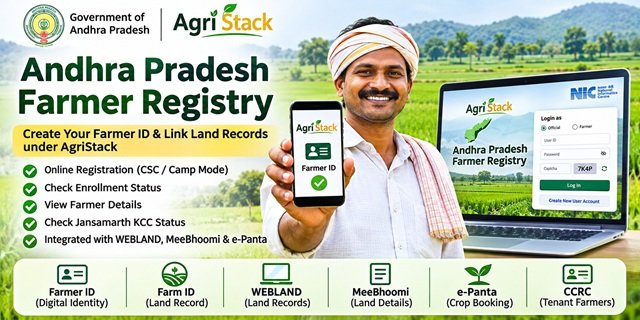
The Farmer Registry is a digital initiative under the Government of India’s AgriStack programme. It aims to create a unique digital identity for farmers and connect their verified information with agricultural land records. The initiative helps the government maintain organised farmer-related information and improve the delivery of agricultural services.
Andhra Pradesh has integrated AgriStack with its existing land governance infrastructure. According to the National Informatics Centre (NIC), Andhra Pradesh has generated 3.27 crore Farm IDs from land records and integrated them with the Central Project Monitoring Unit (CPMU).
It is important to understand that Farm IDs and Farmer IDs are different. A Farmer ID identifies an individual farmer, whereas a Farm ID identifies a particular farmland ownership record.
The state also connects its digital agricultural infrastructure with systems such as WEBLAND, MeeBhoomi, Crop Cultivator Rights Card (CCRC) and e-Panta. These integrations support coordination between farmer identity, land ownership and crop-related information.
Farmers can visit the official Andhra Pradesh Farmer Registry Portal to access the available registry services.
What is Andhra Pradesh Farmer Registry and How Does It Work?
The Andhra Pradesh Farmer Registry is a state-level digital database that maintains verified information about farmers and their agricultural landholdings under the AgriStack framework.
In simple terms, it helps the government identify an individual farmer digitally and connect that identity with relevant farmland records. Instead of repeatedly collecting the same identity and land information for different agricultural services, authorised departments can use linked digital records wherever the applicable system permits.
The registry works through coordination between farmer identity information and the state’s Record of Rights (RoR) database.
Its working process involves the following major activities:
- Farmer Identification: The system uses Aadhaar-based identity verification to establish the identity of an individual farmer under the national Farmer Registry framework.
- Land Record Identification: The system uses existing land records to identify agricultural plots, ownership details and corresponding survey information.
- Land Ownership Verification: The concerned authorities verify the farmer’s claim against the available Record of Rights and related land information.
- Farmer and Land Linkage: After the required verification and approval, the system connects the farmer’s digital identity with the relevant farmland information.
- Farmer ID Generation: The system generates a unique Farmer ID after completing the required registration and approval process.
- Database Integration: The verified information becomes part of the digital agricultural infrastructure and supports authorised government services.
The Government of India has designed the Farmer Registry framework to work with state-maintained land records. Therefore, Andhra Pradesh uses its existing digital land governance infrastructure to support implementation.
Important: Farmer Registry creation does not automatically establish land ownership. The system relies on relevant revenue records for ownership verification. If the land records contain incorrect or outdated information, the farmer may need to resolve those issues through the appropriate Revenue Department process.
Objectives of Farmer Registry in Andhra Pradesh
Andhra Pradesh is implementing Farmer Registry to establish a reliable digital foundation for agricultural administration. Its major objectives include:
- Creating a unique digital identity for individual farmers.
- Connecting farmer identities with verified agricultural land records.
- Improving the accuracy of farmer and land-related information.
- Supporting coordination between Agriculture and Revenue Departments.
- Reducing repeated collection of information across connected government services.
- Improving the identification and verification of eligible agricultural beneficiaries.
- Supporting integration with crop insurance and other agricultural systems.
- Strengthening digital agriculture planning and administration.
The initiative also supports the broader AgriStack objective of creating a common digital infrastructure for agricultural services across India.
Key Features of Andhra Pradesh Farmer Registry
The Andhra Pradesh Farmer Registry combines farmer identification with the state’s existing digital agriculture and land governance systems. Its important features include:
- Unique Farmer Identification: The system provides a unique digital identity to an individual farmer. This identity helps authorised systems identify and verify farmers.
- Digital Land Record Linkage: The registry connects relevant farmer information with land records maintained through the state’s revenue infrastructure.
- Aadhaar-Based Verification: The national Farmer Registry framework uses Aadhaar-based identity verification to establish the farmer’s identity and support registration.
- Integration with WEBLAND: The system uses Andhra Pradesh’s digital land record infrastructure to support the identification and verification of farmland ownership.
- Support for Tenant Farmers: Andhra Pradesh maintains a separate legal and administrative framework for recognising eligible tenant cultivators through CCRC.
- Integration with e-Panta: The state’s digital crop booking system connects crop information with relevant land and cultivator records.
- Central Database Integration: NIC Andhra Pradesh reports that the state has integrated its generated Farm IDs with the Central Project Monitoring Unit.
- Digital Record Management: The registry supports better organisation of farmer identity and agricultural land information for authorised government departments.
Understanding Farmer ID and Farm ID in Andhra Pradesh
Farmer ID and Farm ID are two different identifiers used under the AgriStack framework. Farmers should understand the difference because both relate to agricultural records but identify different things.
| Basis | Farmer ID | Farm ID |
|---|---|---|
| Meaning | Identifies an individual farmer. | Identifies a farmland ownership record. |
| Purpose | Establishes farmer identity. | Identifies a particular landholding. |
| Related to | Individual person. | Agricultural land parcel and ownership. |
| Identification | Aadhaar-based identity framework. | Land and ownership records. |
| Multiple landholdings | One farmer can have multiple linked land records. | Separate IDs may exist for different ownership portions or plots. |
Example: Suppose a farmer owns agricultural land in three different survey numbers. The Farmer ID identifies the individual farmer, while the corresponding Farm IDs identify the relevant landholding records associated with that farmer.
Therefore, one Farmer ID can connect with multiple Farm IDs.
The national AgriStack technical clarification document explains that a Farmer ID belongs to an individual, whereas a Farm ID identifies farmland owned by that farmer within a particular survey number or sub-survey number.
Another important point concerns joint ownership. When multiple individuals jointly own a land parcel, the system considers the ownership structure and recorded ownership extent while creating Farm IDs.
Farm IDs do not simply represent the total land area owned by a farmer across the entire state.
How Andhra Pradesh Farmer Registry Connects Farmers with Land Records
Land record integration plays an important role in the Andhra Pradesh Farmer Registry because the state uses its existing revenue database to identify and verify agricultural landholdings.
The registry connects farmer identity information with relevant land ownership details available in the Record of Rights (RoR). These records contain important information such as:
- Name of the recorded landowner.
- Village and land identification details.
- Survey and sub-survey numbers.
- Landholding extent.
- Ownership information.
- Khata-related details.
- Joint ownership information, wherever applicable.
The system uses these details to establish the relationship between the farmer and the corresponding farmland records.
Andhra Pradesh also maintains digital land governance infrastructure through WEBLAND. The state uses this system to manage land records, process mutations and maintain important revenue information.
Why Does Accurate Land Information Matter?
Consider a situation where a farmer purchases agricultural land but the revenue records still show the previous owner’s name. In this situation, the Farmer Registry may not correctly identify the new owner through the existing land records.
Similarly, if the land records contain spelling differences, incorrect survey numbers or outdated ownership details, the verification process may require correction.
Farmers should therefore check their land information through the MeeBhoomi Land Records Portal and approach the concerned Revenue Department authority if they find any discrepancy.
The national AgriStack guidelines also explain that Farm ID creation depends on land identifiers, ownership details, ownership extent and joint ownership information.
Role of WEBLAND and MeeBhoomi in Andhra Pradesh Farmer Registry
Andhra Pradesh uses two important digital land record platforms, WEBLAND and MeeBhoomi. Both support the state’s land governance infrastructure, but they serve different purposes.
WEBLAND: Digital Land Record Management System
The WEBLAND Portal is a digital land record management system developed and maintained with the support of NIC Andhra Pradesh for the Revenue Department.
It helps government authorities manage land ownership information and perform important revenue-related operations.
Its major functions include:
- Updating village, pattadar and landholding information.
- Generating Adangal and Record of Rights documents.
- Processing land mutations.
- Correcting ROR and Adangal records.
- Maintaining unique Khata numbers.
- Supporting electronic Pattadar Passbook issuance.
- Integrating land information with other government systems.
WEBLAND also connects with MeeBhoomi, the Online Case Management System (ORCMS), the Loan Charge Module and the Crop Cultivator Rights Card system.
Connection Between WEBLAND and AgriStack
NIC Andhra Pradesh confirms that the state’s WEBLAND infrastructure supports integration with AgriStack. This connection helps the state use its existing land records for agricultural digital identification and related administrative services.
MeeBhoomi: Online Land Records Access
The MeeBhoomi Portal is an online land records service provided by the Andhra Pradesh Revenue Department.
Unlike WEBLAND, which primarily supports land record administration and management, MeeBhoomi provides citizens with access to relevant land information.
Farmers and landowners can use the portal to check available land records, including:
- Land ownership details.
- Adangal information.
- Record of Rights.
- Khata-related information.
- Electronic land record details, where available.
Why Should Farmers Use Both Platforms?
WEBLAND supports the administrative management of land records, while MeeBhoomi helps citizens access relevant land information.
Farmers should ensure that their recorded ownership details remain accurate because the Farmer Registry relies on the state’s verified land record infrastructure.
Who Can Register Under Andhra Pradesh Farmer Registry?
The Andhra Pradesh Farmer Registry follows the national AgriStack framework, which connects individual farmer identities with relevant agricultural land information.
However, the exact state-specific registration conditions and the treatment of different farmer categories must follow the applicable Andhra Pradesh government instructions.
The following categories are relevant to understanding the registration framework:
1. Farmers with Recorded Agricultural Land
Farmers whose names appear in the relevant land ownership records can have their identity linked with the corresponding agricultural land information after verification.
2. Farmers with Joint Land Ownership
Farmers who jointly own agricultural land can also fall within the registry framework. The system considers the recorded ownership structure and ownership extent.
3. Farmers with Multiple Land Parcels
A farmer who owns agricultural land in different villages or survey numbers can have multiple Farm IDs associated with one individual Farmer ID.
4. Tenant Farmers
Tenant farmers who cultivate land belonging to another person require special consideration. Andhra Pradesh recognises eligible tenant cultivators through its Crop Cultivator Rights Card framework.
However, tenant cultivation rights and recorded land ownership are different matters. Possessing a CCRC does not automatically mean that a tenant farmer will receive a Farm ID as the recorded landowner.
Farmers should confirm the applicable registration and verification procedure with the local Agriculture or Revenue Department before applying.
Documents and Information Required for Farmer Registry
The exact document requirements for Andhra Pradesh should follow the instructions issued by the concerned authorities and the applicable registration channel.
Based on the national AgriStack technical guidelines and the information processed by the official Andhra Pradesh Farmer Registry service, farmers should keep the following details available:
| Document or Information | Purpose |
|---|---|
| Aadhaar Card | Identity verification. |
| Aadhaar-linked mobile number | OTP-based verification, where required. |
| Land records | Verification of ownership. |
| Survey and sub-survey numbers | Identification of agricultural land. |
| Pattadar details | Matching ownership information. |
| Khata details | Identifying recorded landholding. |
| Bank account details | Where a connected service specifically requires them. |
| CCRC | Relevant for eligible tenant cultivators. |
Farmers should confirm the final document checklist with the registration operator or the concerned Agriculture Department office before submitting their details. The requirements may differ depending on the farmer’s category and registration method.
How to Complete Andhra Pradesh Farmer Registry Registration?
Farmers can approach the designated registration channels in Andhra Pradesh to complete the Farmer Registry process. The state has used Common Service Centres (CSCs) and registration camps to facilitate farmer enrollment.
The registration process generally involves identity verification, collection of agricultural land details, verification against revenue records and generation of the Farmer ID after approval.
1. Visit the Designated Registration Centre
Farmers can approach an authorised Common Service Centre (CSC) or a Farmer Registry enrollment camp organised by the concerned authorities. They can also contact their local Agriculture Department office to obtain information about available registration facilities.
2. Provide Farmer Identification Details
The farmer must provide the required personal information and Aadhaar details for identity verification. The registration operator follows the applicable authentication procedure to establish the farmer’s identity.
3. Submit Agricultural Land Information
The farmer must provide the relevant land details, including survey numbers and ownership information. The concerned system uses available digital land records to identify the corresponding agricultural holdings.
4. Complete Land Record Verification
The registration authorities verify the submitted land information against the available Record of Rights and other relevant revenue records.
If the land records contain incorrect ownership details or other discrepancies, the farmer may need to approach the Revenue Department for correction before the system can complete the required verification.
5. Complete the Required Authentication
The farmer must complete the identity authentication and other verification requirements applicable to the selected registration channel. The authorities may also conduct additional checks wherever necessary.
6. Complete Enrollment and Wait for Approval
After submitting the required information, the farmer’s enrollment enters the verification and approval process. The authorities check the submitted details and the corresponding land information before approving the Farmer ID.
7. Receive the Farmer ID
Once the required verification and approval are complete, the system generates the Farmer ID. Farmers can use the official Andhra Pradesh Farmer Registry Portal to access the available Farmer Registry services.
Note: The exact registration screens, authentication steps and approval timelines depend on the current instructions and facilities provided by the authorities. Farmers should follow the instructions displayed by the authorised registration operator.
Farmer Registry for Tenant Farmers and CCRC Card Holders
Andhra Pradesh has a significant number of agricultural cultivators who do not own the land they cultivate. These farmers may cultivate agricultural land under tenancy arrangements or other recognised cultivation arrangements.
To address the requirements of eligible tenant cultivators, the state uses the Crop Cultivator Rights Card (CCRC) framework.
What is a Crop Cultivator Rights Card?
The Crop Cultivator Rights Card is an official recognition mechanism for eligible tenant cultivators in Andhra Pradesh. It helps establish the cultivation rights of a farmer who cultivates land belonging to another person, subject to the applicable state rules.
The CCRC framework is important because agricultural cultivation and legal land ownership do not always belong to the same person.
How Does CCRC Help Tenant Farmers?
Eligible CCRC holders may use the card to access certain agricultural services and support, subject to the applicable eligibility conditions and government instructions.
These may include:
- Access to subsidised seeds and agricultural inputs.
- Eligibility for applicable crop insurance facilities.
- Support under notified crop loss compensation arrangements.
- Recognition of cultivation rights for relevant agricultural services.
Connection Between CCRC and Farmer Registry
CCRC and Farmer Registry serve different purposes. CCRC recognises eligible cultivation rights, whereas Farmer Registry establishes a digital identity and connects relevant farmer information with agricultural records.
Andhra Pradesh’s e-Panta system also recognises different cultivator categories, including landowners, tenants and CCRC-certified farmers.
However, possession of a CCRC should not be treated as automatic proof of land ownership or automatic entitlement to a particular Farm ID. Tenant farmers should confirm the applicable Farmer Registry procedure with the local Agriculture Department or designated registration authority.
Role of e-Panta in Andhra Pradesh’s Digital Agriculture System
Andhra Pradesh has developed e-Panta as a digital crop booking system to maintain crop-related information across the state. NIC Andhra Pradesh supports its development and digital integration with other agricultural and land record systems.
The system records crop information for Agriculture, Horticulture and Sericulture across Kharif, Rabi and Summer seasons.
Major Features of e-Panta
The e-Panta system supports several activities related to crop information and agricultural administration, including:
- Geo-referenced crop booking.
- Recording single crops, intercropping and mixed-crop details.
- e-KYC through supported biometric, OTP or facial authentication methods.
- Field-level validation by Village Agriculture Assistants (VAAs) and Village Revenue Officers (VROs), as applicable.
- SMS alerts and digital acknowledgements.
- Prevention of duplicate crop booking on the same land parcel.
- Integration with procurement, insurance and subsidy-related platforms.
How Does e-Panta Connect with Farmer Registry?
Farmer Registry and e-Panta are separate digital systems, but they support the broader digital agriculture infrastructure of Andhra Pradesh.
Farmer Registry focuses on identifying farmers and connecting their identities with relevant agricultural land records. On the other hand, e-Panta records crop-related information and the details of cultivation on agricultural land.
The e-Panta system also uses information from connected databases such as WEBLAND, the Record of Forest Rights (RoFR) database and CCRC records, where applicable.
This integration helps government departments access relevant farmer, land and crop information for authorised agricultural services. It also supports crop insurance registration and crop damage compensation-related activities under applicable government provisions.
How to Check Andhra Pradesh Farmer Registry Status?
Farmers can use the official Andhra Pradesh Farmer Registry Portal to access the enrollment status facility.
The portal provides a dedicated option to check enrollment status against an Aadhaar Number or Farmer ID. The Aadhaar-based verification option sends an OTP to the mobile number linked with the farmer’s Aadhaar.
Farmers can follow these general steps:
- Visit the Andhra Pradesh Farmer Registry Portal.
- Open the Check Enrollment Status option.
- Select Aadhaar Number or Farmer ID as the search method.
- Enter the required identification details.
- Complete the OTP verification wherever required.
- Follow the instructions displayed on the portal to view the available enrollment information.
The portal also provides a separate option to view Farmer Details using the farmer’s Aadhaar Number and OTP verification.
For complete login instructions, dashboard information and other portal facilities, farmers can refer to the separate Andhra Pradesh AgriStack Portal Guide.
Important Links Related to Andhra Pradesh Farmer Registry
| Service | Official Link |
|---|---|
| Andhra Pradesh Farmer Registry | Visit Portal |
| National AgriStack Portal | Visit Portal |
| Andhra Pradesh WEBLAND | Visit Portal |
| Andhra Pradesh MeeBhoomi | Visit Portal |
| Andhra Pradesh Agriculture Department | Visit Website |
Contact Details for Andhra Pradesh Farmer Registry Assistance
Farmers who face difficulties during enrollment, identity verification or land record linkage can seek assistance from the appropriate government authorities.
- Farmer Registry Portal: Visit the official AP Farmer Registry Portal for available services and portal-related instructions.
- Common Service Centre: Contact an authorised CSC operator for assistance with the registration process.
- Agriculture Department: Approach the concerned Mandal or District Agriculture Office for farmer enrollment-related assistance.
- Revenue Department: Contact the concerned Revenue Department authority for land ownership, survey number, mutation and Record of Rights discrepancies.
The official Andhra Pradesh Farmer Registry privacy policy lists the following email address for service-related questions and suggestions:
Email: us-it@gov.in
Farmers should avoid sharing their Aadhaar OTP, login password or other confidential authentication details with unauthorised persons.
Frequently Asked Questions (FAQs)
Ans. Andhra Pradesh Farmer Registry is a digital initiative under the AgriStack programme that creates a unique digital identity for farmers and connects their verified information with relevant agricultural land records.
Ans. The official website is https://apfr.agristack.gov.in/farmer-registry-ap/.
Ans. Farmer ID identifies an individual farmer, whereas Farm ID identifies a particular farmland ownership record. One Farmer ID can be linked with multiple Farm IDs.
Ans. Farmers can approach authorised Common Service Centres (CSCs) or designated Farmer Registry enrollment camps. They must complete the required identity and land record verification before the authorities approve their enrollment.
Ans. Aadhaar-based identity verification forms part of the national Farmer Registry framework. Farmers should follow the authentication requirements specified by the authorised registration channel.
Ans. Tenant farmers must follow the applicable state registration rules. Andhra Pradesh recognises eligible tenant cultivators through the Crop Cultivator Rights Card (CCRC) framework. However, CCRC does not automatically establish land ownership.
Ans. WEBLAND maintains digital land records in Andhra Pradesh. Its integration with AgriStack supports the identification and verification of relevant agricultural land information.
Ans. MeeBhoomi allows farmers and landowners to access available land records online. They can use it to check ownership details and other relevant revenue information.
Ans. e-Panta is Andhra Pradesh’s digital crop booking system. It records crop and cultivation information and connects with relevant land and cultivator databases.
Ans. Farmers can visit the official enrollment status page and select Aadhaar Number or Farmer ID as the search method. They must complete the required verification to check their enrollment details.
Ans. No. A Farmer ID provides a digital identity under the AgriStack framework. It does not independently establish or transfer legal ownership of agricultural land. Ownership remains subject to the relevant revenue records and applicable laws.
Ans. No. Tenant cultivation rights and recorded land ownership are different. The applicable registration and identification process depends on the state rules and the farmer’s recorded details.
Ans. According to NIC Andhra Pradesh, the state has generated 3.27 crore Farm IDs from land records and integrated them with the Central Project Monitoring Unit (CPMU). This figure represents Farm IDs, not individual Farmer IDs.
Ans. Farmers should check their available land records through the MeeBhoomi Portal. If they find incorrect ownership, survey or other revenue details, they should approach the concerned Revenue Department authority for correction.

Tabassum is a government schemes researcher and writer with 5 years of experience tracking Central and State welfare scheme programmes across India. She has covered 500+ schemes spanning agriculture, women welfare, education, and housing, helping lakhs of beneficiaries understand their entitlements in simple language.