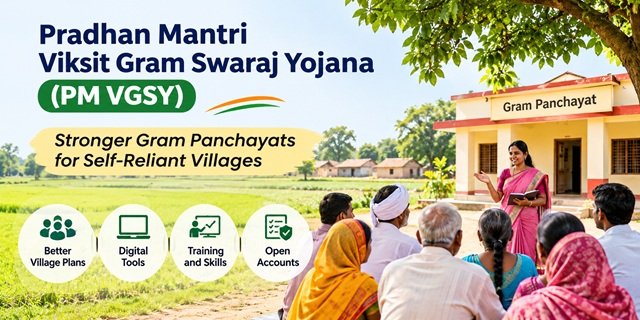
The Pradhan Mantri Viksit Gram Swaraj Yojana (PM VGSY) is a Centrally Sponsored Scheme approved by the Union Cabinet on 28 October 2026. The Ministry of Panchayati Raj implements it through State Governments and Union Territory administrations. With a total outlay of ₹7,395.55 crore for 2026-27 to 2030-31, the scheme aims to strengthen more than 2.55 lakh Panchayats and Traditional Local Bodies through better village planning, training, digital governance and transparent financial management. It will support around 32 lakh elected representatives, Panchayat functionaries and other stakeholders.
Pradhan Mantri Viksit Gram Swaraj Yojana (PM VGSY) Highlights | |
|---|---|
| Scheme Name | Pradhan Mantri Viksit Gram Swaraj Yojana (PM VGSY) |
| Scheme Type | Centrally Sponsored Scheme for strengthening Panchayat governance and capacity building |
| Approval Date | 28 October 2026, by the Union Cabinet chaired by the Prime Minister |
| Implementing Ministry | Ministry of Panchayati Raj, Government of India |
| Implementation Through | State Governments and Union Territory administrations, based on Annual Action Plans approved by the Central Empowered Committee |
| Scheme Duration | 2026-27 to 2030-31, covering the period of the Sixteenth Finance Commission |
| Total Financial Outlay | ₹7,395.55 crore |
| Central Government Share | ₹4,869.48 crore |
| State Government Share | ₹2,526.07 crore |
| Coverage | More than 2.55 lakh Panchayats and Traditional Local Bodies across all States and Union Territories |
| Coverage of Non-Part IX Areas | Traditional rural local bodies in areas where the Panchayat system does not exist |
| Direct Beneficiaries | About 32 lakh elected representatives, Panchayat functionaries and other stakeholders |
| Annual Village Planning Target | More than 2.55 lakh holistic Gram Panchayat Development Plans (GPDPs) through eGramSwaraj |
| Annual Audit Target | At least 2.55 lakh online audit plans through AuditOnline |
| Public Awareness Target | At least 1 crore citizens during each awareness drive |
| Digital Platforms and Tools | eGramSwaraj, AuditOnline and PANCHAM WhatsApp chat service in 17 Indian languages |
| Finance Commission Grants | About ₹4.35 lakh crore recommended for Rural Local Bodies during 2026-27 to 2030-31 |
| Six Main Pillars | Gram Panchayats as hubs of local governance, holistic village planning, digital governance, alignment of national priorities with local needs, capacity building, and transparent use of resources |
| Staffing Support | No permanent posts. States may engage need-based contractual staff at State, District and Block levels |
| Direct Individual Benefits | No direct cash payments or goods. The scheme strengthens Panchayats and rural governance institutions |
| How to Participate | Villagers participate through Gram Sabha meetings, Gram Panchayats prepare village development plans, and States submit Annual Action Plans |
| Ministry Email | nic-mopr@nic.in |
| Official Scheme Backgrounder | Read the PM VGSY Backgrounder on the Press Information Bureau Website |
Introduction of Pradhan Mantri Viksit Gram Swaraj Yojana: A Brief Insight
Villages receive funds through several government schemes, but Gram Panchayats often struggle to bring all these resources together. Development plans may remain scattered across departments, financial records may be difficult to track, and elected representatives may not receive enough training to manage local development effectively. The Pradhan Mantri Viksit Gram Swaraj Yojana (PM VGSY) aims to address these gaps by making Gram Panchayats stronger, more capable and better equipped to lead their own development.
The Union Cabinet, chaired by Prime Minister Narendra Modi, approved PM VGSY on 28 October 2026 as a Centrally Sponsored Scheme. The scheme will run for five years, from 2026-27 to 2030-31, with a total outlay of ₹7,395.55 crore. Out of this amount, the Centre will contribute ₹4,869.48 crore, while the States will contribute ₹2,526.07 crore.
The Ministry of Panchayati Raj oversees the scheme through State Governments and Union Territory administrations. Each State or UT prepares an Annual Action Plan based on its requirements and sends it for review. The Central Empowered Committee examines and approves these plans.
PM VGSY aims to develop Gram Panchayats into empowered, self-reliant and accountable institutions of local government. It places Panchayats at the centre of village-level planning, connects the schemes of different government departments through a common development plan, and improves the skills, financial management and accountability of local representatives.
Under the scheme, more than 2.55 lakh holistic Gram Panchayat Development Plans (GPDPs) will be supported every year through the eGramSwaraj portal. The scheme also aims to train around 32 lakh elected representatives, Panchayat functionaries and other stakeholders. Each awareness drive will target at least 1 crore citizens to encourage greater public participation in village development.
The scheme also introduces PANCHAM, a WhatsApp-based chat service that provides information and assistance in 17 Indian languages. It encourages Panchayats to increase their Own Source Revenue through local taxes, fees and rents. It also promotes online accounting and audits through the AuditOnline portal.
Another important aspect is the use of funds available to Rural Local Bodies. The Sixteenth Finance Commission has recommended about ₹4.35 lakh crore for Rural Local Bodies during 2026-27 to 2030-31. PM VGSY aims to help Panchayats plan their spending better and use available funds more effectively.
The scheme covers more than 2.55 lakh Panchayats and Traditional Local Bodies across all States and Union Territories. It also includes eligible rural areas where the traditional local governance system operates without Gram Panchayats. However, individual villagers do not receive direct cash payments or goods under this scheme, and they do not need to submit a personal application.
Villagers can still play an important role by attending Gram Sabha meetings, sharing local problems and suggesting development priorities. Gram Panchayats prepare village development plans, while State and UT administrations coordinate implementation through their Annual Action Plans. For scheme-related assistance, people can contact the Ministry of Panchayati Raj in New Delhi through its official email address: nic-mopr@nic.in.
Families looking for financial assistance to build a pucca house in a rural area can explore the PM Awas Yojana Gramin. Urban families can check the PM Awas Yojana Urban. Similarly, rural households looking for employment opportunities can read about the Viksit Bharat G RAM G Yojana, while families seeking property cards for their residential properties can learn about the SVAMITVA Yojana. Small traders and street vendors can also explore the PM SVANidhi Yojana.
Villagers, Panchayat representatives, government officials and readers interested in rural development, local governance and welfare programmes can explore more schemes launched by the Central Government on our Central Government Welfare Schemes page.
Latest Updates on Pradhan Mantri Viksit Gram Swaraj Yojana
- 28 October 2026: The Union Cabinet approved the Pradhan Mantri Viksit Gram Swaraj Yojana (PM VGSY). The Press Information Bureau also released a backgrounder explaining the scheme on the same day.
- 29 October 2026: The Ministry of Panchayati Raj published the Cabinet approval document on its official website, providing access to the scheme’s approval details.
- Next Step for States and Union Territories: State Governments and Union Territory administrations must prepare their Annual Action Plans and submit them for review. The Central Empowered Committee will examine and approve these plans.
- Digital Infrastructure: PM VGSY builds on existing digital platforms, including eGramSwaraj and AuditOnline, launched in 2020, along with the PANCHAM WhatsApp chat service, launched in January 2026.
- Sixteenth Finance Commission Period: The scheme’s implementation period, 2026-27 to 2030-31, coincides with the award period of the Sixteenth Finance Commission.
- Detailed Scheme Guidelines: The Ministry of Panchayati Raj is yet to publish the detailed implementation guidelines. Panchayat representatives, officials and interested citizens should check the Ministry’s official website for further instructions and updates.
- What Villagers Can Do Now: Villagers can attend their next Gram Sabha meeting and share their development needs with the Panchayat. These local priorities help shape the Gram Panchayat Development Plan.
Benefits Provided to Eligible Beneficiaries
Gram Panchayats often receive funds through several government schemes, but identifying the village’s actual needs, available resources and pending development work can be difficult. The Pradhan Mantri Viksit Gram Swaraj Yojana (PM VGSY) addresses this gap by strengthening local planning, improving financial management and providing digital tools and training. It helps Panchayats prepare better development plans, coordinate government schemes and monitor the use of public funds.
Financial Support for Rural Local Governance
- The scheme has a total budget of ₹7,395.55 crore for the five-year period from 2026-27 to 2030-31.
- The Central Government will contribute ₹4,869.48 crore, while the States will provide the remaining ₹2,526.07 crore.
- It aims to strengthen the financial and administrative capacity of rural local government institutions across the country.
Better Village Development Planning
- Support for preparing 2.55 lakh comprehensive Gram Panchayat Development Plans (GPDPs) every year through local participation and the eGramSwaraj portal.
- A common digital system brings together information about government schemes, beneficiaries, community assets and available resources of each Gram Panchayat.
- Panchayats can connect village-level priorities with the ongoing schemes of Central and State Government departments, identify development gaps and avoid duplication of work.
- Gram Panchayats across different States can share useful practices and learn from successful village development activities through the common platform.
Training and Capacity Building for Panchayat Representatives
- Annual training and digital support for approximately 32 lakh elected representatives, Panchayat functionaries and other stakeholders.
- Both general and specialised training, including technical subjects such as preparing engineering estimates for development works.
- Training support through the Integrated Government Online Training platform and the National Academy for Capacity Building of Civil Services.
- Continuous digital handholding to help Panchayat representatives and staff use online planning, accounting and monitoring systems effectively.
PANCHAM: Multilingual Digital Assistance
- A two-way digital chat service called PANCHAM provides information and assistance in 17 Indian languages.
- People can access scheme updates, training material, surveys and Panchayat-related services through WhatsApp.
- Its multilingual facility makes information more accessible to Panchayat representatives, functionaries and rural residents.
Greater Public Participation and Awareness
- Each awareness drive aims to reach at least 1 crore citizens through Gram Sabha meetings, Panchayat forums and digital platforms.
- Villagers get opportunities to understand government schemes, discuss local development requirements and review their impact on the community.
- Regular public discussions can help Panchayats prepare development plans that reflect the actual needs of residents.
Improved Use of Panchayat Funds and Revenue
- The scheme supports better utilisation of Finance Commission grants. The Sixteenth Finance Commission has recommended approximately ₹4.35 lakh crore for Rural Local Bodies for 2026-27 to 2030-31.
- It encourages Gram Panchayats to increase their Own Source Revenue (OSR) through local taxes, fees, rents and other permitted sources.
- Improved financial planning can reduce dependence on external grants and help Panchayats manage their development priorities more effectively.
Online Accounting, Auditing and Transparency
- Online accounting helps Panchayats maintain clear records of their income, receipts and expenditure.
- Public disclosure of financial information allows villagers to understand how the Panchayat uses its funds.
- The scheme aims to prepare at least 2.55 lakh online audit plans every year and complete the corresponding audits on time through the AuditOnline portal.
- Digital audit records strengthen financial accountability and make it easier to monitor the use of public money.
Integrated Digital Services Through eGramSwaraj
- The scheme builds on the existing eGramSwaraj platform to support Panchayat planning, accounting and monitoring.
- The platform also connects Panchayat operations with online payments, government procurement, multilingual services, internet monitoring and weather information.
- Bringing these facilities together helps Panchayats manage different administrative activities through a common digital system.
Coverage Across States and Rural Governance Institutions
- The scheme covers all States and Union Territories and supports more than 2.55 lakh Panchayats and Traditional Local Bodies.
- It also extends to traditional local governance institutions in areas where the Panchayat system does not operate under Part IX of the Constitution.
- Need-based contractual staff can provide implementation support at State, District and Block levels. The scheme does not create permanent posts for this purpose.
- Existing Central and State Government schemes will continue to provide their respective benefits. PM VGSY strengthens the planning and governance system through which rural development activities are coordinated.
Eligibility Conditions Required to be Fulfilled
The Pradhan Mantri Viksit Gram Swaraj Yojana (PM VGSY) focuses on strengthening rural local governance rather than providing individual financial assistance. Therefore, its coverage depends on the participation of Panchayats, Traditional Local Bodies, State Governments and other rural governance institutions. The Ministry of Panchayati Raj will issue the detailed implementation guidelines, while the following conditions reflect the approved framework of the scheme.
Who Is Covered Under the Scheme?
- More than 2.55 lakh Panchayats and Traditional Local Bodies across India.
- Gram Panchayats, which play the central role in village-level planning and development.
- Approximately 32 lakh elected representatives, Panchayat functionaries and other stakeholders who will receive institutional and capacity-building support.
- All States and Union Territories participating in the implementation of the scheme.
- Traditional Local Bodies in areas not covered under Part IX of the Constitution, where the conventional Panchayat system does not operate.
- Village residents who participate in Gram Sabha meetings and awareness activities. The scheme aims to reach at least 1 crore citizens through each awareness drive.
Conditions for States and Union Territories
- The State Government or Union Territory administration must implement the scheme through its designated departments and authorities.
- It must prepare and submit an Annual Action Plan covering proposed activities, development priorities and implementation requirements.
- The designated Central Empowered Committee must examine and approve the submitted action plan.
- The State or Union Territory must provide its prescribed share of the scheme cost. The total State share is ₹2,526.07 crore, while the Central Government will contribute ₹4,869.48 crore.
- It may appoint contractual staff based on actual requirements at the State, District and Block levels. The scheme does not provide for the creation of permanent posts.
Conditions for Gram Panchayats
- Each Gram Panchayat is expected to participate in preparing a comprehensive Gram Panchayat Development Plan (GPDP) every year through the eGramSwaraj portal.
- The development plan must reflect local priorities, village requirements, ongoing Central and State Government schemes and the Panchayat’s available resources.
- The Panchayat must use eGramSwaraj and other designated digital platforms for development planning, financial management and progress monitoring.
- It must maintain online financial records and participate in the online audit process through AuditOnline, along with the required public disclosure.
- Elected representatives and Panchayat functionaries must participate in the training programmes and digital support activities provided under the scheme.
- The Gram Sabha and other Panchayat-level forums must provide opportunities for discussions on village development priorities, government schemes and local requirements.
Who Is Not Eligible for Direct Benefits?
- Individual villagers seeking personal cash assistance, housing benefits, loans or employment, as PM VGSY focuses on strengthening local governance institutions rather than providing direct individual benefits.
- Urban local bodies, such as Municipal Corporations, Municipal Councils and Nagar Panchayats, because the scheme focuses on rural local governance.
- Existing Central and State Government welfare schemes are not replaced by PM VGSY. Their respective departments will continue delivering benefits under their own guidelines.
Documents Required to be Attached
The Pradhan Mantri Viksit Gram Swaraj Yojana (PM VGSY) is implemented through Gram Panchayats and State Governments. Therefore, the scheme mainly involves institutional records, village development plans, financial documents and audit reports rather than individual applications from villagers. The Ministry of Panchayati Raj will prescribe the final implementation requirements. Until then, the following records indicate what Gram Panchayats and State Governments should keep organised for planning, implementation and monitoring.
Documents and Records of the Gram Panchayat
- Registration and login credentials of the Gram Panchayat on the eGramSwaraj portal
- Details of elected representatives and Panchayat functionaries, including their respective roles and responsibilities
- Resolutions and proceedings of Gram Sabha meetings
- Village-level records containing details of residents and households within the Panchayat area
- Inventory of community assets, including Panchayat buildings, ponds, roads and common land
- Details of Gram Panchayat staff, working committees and their responsibilities
Documents Related to Village Development Planning
- Records of development priorities and local requirements identified during Gram Sabha and ward meetings
- Draft Gram Panchayat Development Plan (GPDP), covering village needs, development priorities and existing infrastructure gaps
- Details of Central and State Government schemes operating in the village, including their beneficiaries and benefits
- Statement of available financial resources, including grants received from the Finance Commission
- Records of capacity-building programmes and training attended by elected representatives and Panchayat functionaries
Financial Records and Audit Documents
- Updated online accounts of the Gram Panchayat, showing its income, receipts and expenditure
- Supporting financial documents, including bills, payment vouchers and bank statements
- Records of Own Source Revenue (OSR) collected through local taxes, fees, rents and other permitted sources
- Utilisation details of Finance Commission grants and other funds received by the Panchayat
- Gram Panchayat audit plan and corresponding audit reports available through the AuditOnline portal
- Records showing public disclosure of Panchayat accounts, expenditure and audit findings
Documents Required from the State or Union Territory
- Annual Action Plan outlining proposed activities, development priorities and implementation requirements under the scheme
- Financial documents showing the State or Union Territory’s share of the scheme cost
- Training and capacity-building plan for elected representatives and Panchayat functionaries
- Proposal for need-based contractual staff at the State, District and Block levels
- Documents related to the submission, review and approval of the action plan by the Central Empowered Committee
Documents for Villagers Participating in the Scheme
- Villagers do not need to submit a personal loan or benefit application, as the scheme does not provide direct cash assistance or individual goods to beneficiaries.
- Residents may keep a voter ID card or ration card as proof of residence when participating in Gram Sabha meetings and village development planning activities.
- A mobile phone can help residents access the PANCHAM chatbot and receive information about government schemes, public meetings and village-level activities.
How Beneficiaries Can Apply to Avail the Benefit of this Scheme
There is no application form for an individual to apply under the Pradhan Mantri Viksit Gram Swaraj Yojana (PM VGSY). Villagers do not need to register on any portal or submit personal documents to receive benefits. The scheme works through State Governments, Union Territory administrations and Gram Panchayats.
Instead of applying individually, villagers can take part in Gram Sabha meetings and share their needs. Gram Panchayats prepare village development plans, while State Governments manage the scheme’s implementation. The following steps explain what villagers, Panchayats and State Governments need to do.
First, Understand How the Scheme Works
Step 1: Know that the Union Cabinet approved PM VGSY on 28 October 2026 for five years, from 2026-27 to 2030-31.
Step 2: Read the Press Information Bureau’s backgrounder on PM VGSY. It explains the scheme’s six main pillars and how they will strengthen rural governance.
Step 3: Visit the Prime Minister’s Office website to read the Cabinet announcement, including the approved budget and targets.
Step 4: You can also read the official scheme approval document on the Ministry of Panchayati Raj website.
Step 5: Remember that PM VGSY does not provide direct cash payments or goods to individual villagers. Therefore, you do not need to fill out a personal application form to join the scheme.
How Villagers Can Participate in the Scheme
Although villagers do not have to submit an application, they have an important role in deciding what their village needs. They can share their suggestions during Gram Sabha meetings and keep track of how the Panchayat uses public funds.
Step 1: Check the notice board of your Gram Panchayat to find out when the next Gram Sabha meeting will take place.
Step 2: Attend the meeting with other villagers. The Gram Sabha provides a platform where residents can discuss village problems and development priorities.
Step 3: Tell the Panchayat which facilities your village needs most. For example, you can raise issues related to drinking water, roads, school buildings, drainage or health centres.
Step 4: Ask the Panchayat representatives about the government schemes already running in your village. This helps everyone understand which facilities are available and where more work is needed.
Step 5: Ask how the Panchayat collects and spends its money. PM VGSY aims to improve financial transparency, so villagers should be able to understand how public funds are used.
Step 6: Check the public information shared by your Gram Panchayat about its accounts and audit reports. These records help residents see whether the Panchayat has used its funds properly.
Step 7: If your Panchayat shares the official WhatsApp access details, you can use PANCHAM, the scheme’s multilingual chat service, to receive updates and information in your preferred language.
How a Gram Panchayat Will Implement the Scheme
Gram Panchayats play a central role in PM VGSY. They will identify local needs, prepare development plans, maintain financial records and use digital platforms to monitor their work.
Step 1: The Sarpanch and elected Panchayat members organise Gram Sabha meetings to understand the problems and development needs of the village.
Step 2: The Panchayat Secretary and other functionaries collect information about existing government schemes, their beneficiaries, available funds and community assets such as roads, ponds, buildings and common land.
Step 3: The Panchayat prepares a Gram Panchayat Development Plan (GPDP). In simple words, this is a development roadmap for the village. It brings together the needs raised by villagers, ongoing government schemes and the funds available to the Panchayat.
Step 4: The Panchayat uploads its development plan and related information to the eGramSwaraj portal. This digital platform helps Panchayats manage planning, accounts and development activities.
Step 5: Elected representatives and Panchayat staff take the training arranged by the State Government. The training helps them prepare plans, maintain records and use digital tools correctly.
Step 6: The Panchayat maintains its accounts online and works to increase its own income through sources such as local taxes, fees and rents.
Step 7: The Panchayat completes its online audit-related activities through the AuditOnline portal. It also shares the relevant financial information and audit results with villagers.
How State Governments and Union Territories Will Join the Scheme
State Governments and Union Territory administrations will coordinate the implementation of PM VGSY in their respective areas. They will assess the needs of local Panchayats, prepare action plans and arrange the required support.
Step 1: The State Government or Union Territory administration reviews the requirements of its Gram Panchayats and other eligible rural local bodies.
Step 2: It prepares an Annual Action Plan. This plan explains the activities, priorities, training requirements and other steps it proposes to take under PM VGSY during the year.
Step 3: The State or Union Territory submits its Annual Action Plan to the Central Government for review.
Step 4: The Central Empowered Committee examines the submitted plan and approves it as per the scheme’s requirements.
Step 5: After approval, the State arranges its required share of funds and starts the planned training, digital support and other implementation activities in its Panchayats.
Step 6: The State may engage contractual staff at the State, District and Block levels wherever it needs additional technical or administrative support. The scheme does not provide for creating permanent posts for this purpose.
Where to Check the Latest Scheme Guidelines
The detailed implementation rules and instructions will explain how States, Union Territories and Gram Panchayats must carry out their responsibilities. Villagers and Panchayat representatives should check official updates instead of relying on unofficial messages or claims.
Step 1: Visit the official website of the Ministry of Panchayati Raj regularly to check for new guidelines, notifications and implementation updates.
Step 2: Contact your Block Development Officer (BDO) or District Panchayat Officer to understand how your State is implementing the scheme at the local level.
Step 3: If you need clarification from the Ministry, use its official contact page to find the relevant contact details.
Important: Do not pay anyone who promises to arrange a personal benefit or approve an application under PM VGSY. The scheme does not offer direct cash or goods to individual villagers, and no personal application fee is required. Follow the official Ministry guidelines for the latest implementation instructions.
The Six Pillars of PM VGSY Explained in Simple Words
The Pradhan Mantri Viksit Gram Swaraj Yojana (PM VGSY) follows six main pillars. Each pillar focuses on a different area of Panchayat governance, from village-level planning and digital systems to staff training and proper use of public funds.
The following table explains these six pillars in simple language and shows how they may affect the everyday working of a Gram Panchayat.
| Pillar | What It Means | What You May Notice in Your Village |
|---|---|---|
| 1. Gram Panchayats as Hubs of Local Governance | The Gram Panchayat becomes the main institution for local development. It brings village needs, government schemes and available resources together while preparing development plans. | The Panchayat takes a more active role in deciding village priorities and coordinating development work. |
| 2. Holistic Planning at the Gram Panchayat Level | Different Central and State Government schemes are brought together through a common digital planning system. This helps the Panchayat prepare one coordinated development plan instead of handling separate plans without a common view. | The village gets a more organised development plan that identifies pending work, available support and areas where additional facilities are needed. |
| 3. Digital Governance | The eGramSwaraj platform helps bring information about government schemes, beneficiaries, benefits, village assets and available resources into a common digital system. | Panchayat officials can access important village records more easily and identify existing facilities and development gaps. |
| 4. Connecting National Priorities with Local Needs | The pillar connects wider Government priorities with the actual needs of villages. Gram Sabha discussions and the PANCHAM chat service help communicate scheme-related information in simple and local languages. | Villagers can understand relevant government initiatives more easily and discuss how these programmes can address local requirements. |
| 5. Capacity Building | Elected representatives, Panchayat functionaries and other stakeholders receive general and specialised training. This includes practical skills such as preparing engineering estimates and using digital governance tools. | Panchayat representatives and staff become better equipped to prepare plans, handle official work and respond to villagers’ questions. |
| 6. Transparent and Efficient Use of Resources | The Panchayat focuses on proper use of grants, improvement of its own income, online accounting and regular online audits. These steps aim to make financial management more accountable. | Villagers can access information about Panchayat spending and ask questions about the use of public funds and audit findings. |
All six pillars work together to strengthen local governance. Their combined purpose is to help Gram Panchayats prepare better development plans, manage resources responsibly, use digital systems effectively and remain accountable to the people they serve.
Important Links Available of the Scheme
- PM VGSY Backgrounder: Six Pillars, Targets and Implementation Details
- Cabinet Approval of PM VGSY for 2026-27 to 2030-31: PIB Press Release
- PM VGSY Cabinet Approval and Budget of ₹7,395.55 Crore
- PM VGSY Official Approval Document, Ministry of Panchayati Raj
- Ministry of Panchayati Raj Official Website
- Panchayat Schemes and Services
- Panchayat Scheme Background, Guidelines and Documents
- eGramSwaraj Portal for Gram Panchayat Planning and Accounts
- AuditOnline Portal for Gram Panchayat Financial Audits
- Ministry of Panchayati Raj Contact Details
Contact Details in Case of Help Needed
For help or clarification regarding PM VGSY, villagers and Panchayat representatives can contact the concerned authority at the village, Block, District or State level. They can also approach the Ministry of Panchayati Raj for scheme-related information.
- Ministry: Ministry of Panchayati Raj, Government of India, 11th Floor, Jeevan Prakash Building, 25 Kasturba Gandhi Marg, New Delhi – 110001.
- Phone: 011-23389008 (Office of the Secretary, Ministry of Panchayati Raj).
- Email: nic-mopr@nic.in
- State or UT Level: Contact the Panchayati Raj Department or Rural Development Department of your State or Union Territory. These departments coordinate the scheme and submit the Annual Action Plan.
- District Level: Approach your District Panchayat Officer or the Zila Panchayat office for information about implementation in your district.
- Block Level: Contact the Block Development Officer (BDO) for guidance on scheme activities and support available to Gram Panchayats.
- Village Level: Speak to your Gram Panchayat’s Sarpanch or Panchayat Secretary to learn about upcoming Gram Sabha meetings, village development plans and local activities under the scheme.
For official updates and additional contact information, visit the Ministry of Panchayati Raj Contact Page.
Frequently Asked Questions (FAQs)
Ans. It is a Centrally Sponsored Scheme that strengthens the Gram Panchayats of India, through better village planning, training, digital tools and open accounts, so that they can govern the village well and depend less on outside help.
Ans. The Union Cabinet, headed by the Prime Minister, approved it on 28 October 2026.
Ans. For five years, from 2026-27 to 2030-31, the same period as the Sixteenth Finance Commission.
Ans. ₹7,395.55 crore, of which ₹4,869.48 crore is the share of the Centre and ₹2,526.07 crore is the share of the States.
Ans. The Ministry of Panchayati Raj, Government of India, through the State Governments and the Union Territory administrations.
Ans. About 32 lakh elected representatives, Panchayat functionaries and other stakeholders, across more than 2.55 lakh Panchayats and Traditional Local Bodies.
Ans. No. The scheme gives no cash and no goods to a person. It makes the Panchayat stronger, and a stronger Panchayat plans and delivers better for the village.
Ans. It is the plan of a village, which puts together what the village needs, the schemes of the Central and State departments, and the money that the Panchayat can use. The scheme supports more than 2.55 lakh such plans every year on the eGramSwaraj portal.
Ans. It is the digital platform of the Panchayats, launched in 2020, which handles planning, budgeting, accounts, monitoring and the list of village assets in one place, with online payments. You can see it on the eGramSwaraj portal.
Ans. It is a chat service on WhatsApp, launched in January 2026, that gives scheme news, training content, surveys and Panchayat services in 17 Indian languages.
Ans. It is the money that a Panchayat earns by itself, from taxes, fees and rents. The scheme helps Panchayats to raise it, so that they stand on their own feet.
Ans. More than 2.55 lakh village plans, at least 2.55 lakh online audit plans, training for about 32 lakh people, and an awareness drive that reaches at least 1 crore citizens each time.
Ans. Each State and Union Territory sends an Annual Action Plan with its activities and needs, and the Central Empowered Committee checks it and approves it.
Ans. No. The scheme may hire contractual staff for the State, District and Block levels, where they are needed for technical help.
Ans. Yes. It covers all States and Union Territories, including the traditional local bodies of rural areas where Panchayats do not exist.
Ans. No. The Gram Sadak Yojana builds village roads, while PM VGSY strengthens the Panchayats, their plans, their training and their accounts. The existing schemes of the departments carry on as before. You can read the official release on the Press Information Bureau site.

Tabassum is a government schemes researcher and writer with 5 years of experience tracking Central and State welfare scheme programmes across India. She has covered 500+ schemes spanning agriculture, women welfare, education, and housing, helping lakhs of beneficiaries understand their entitlements in simple language.