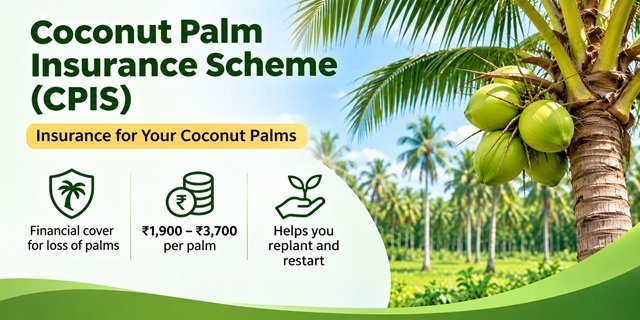
The Coconut Palm Insurance Scheme (CPIS), implemented by the Coconut Development Board (CDB) under the Ministry of Agriculture and Farmers Welfare in association with the Agriculture Insurance Company of India (AIC), provides insurance protection to coconut growers. It offers ₹1,900 per palm for insured palms aged 4 to 15 years and ₹3,700 per palm for those aged 16 to 60 years. Farmers contribute only 15% of the premium, while CDB pays the remaining 85%. To qualify, a farmer must have at least 10 healthy, nut-bearing palms in a contiguous plot.
Coconut Palm Insurance Scheme (CPIS) Highlights | |
|---|---|
| Scheme Name | Coconut Palm Insurance Scheme (CPIS) |
| Launch | Started as a pilot project in 2009-10 under the Eleventh Five-Year Plan |
| Ministry | Ministry of Agriculture and Farmers Welfare, Government of India |
| Implementing Agency | Coconut Development Board (CDB), Kochi, with support from State Agriculture and Horticulture Departments |
| Insurance Partner | Agriculture Insurance Company of India (AIC) |
| Scheme Type | Insurance protection for coconut palms against natural calamities and other specified risks |
| Objective | To compensate growers for the loss or irreparable damage of insured coconut palms and help them continue cultivation |
| Eligible Applicants | Individual coconut farmers, planters and growers from any coconut-growing State or Union Territory |
| Minimum Palms Required | At least 10 healthy, nut-bearing palms in a contiguous plot |
| Eligible Age of Palms | Dwarf and Hybrid varieties: 4 to 60 years; Tall variety: 7 to 60 years |
| Sum Insured for 4 to 15 Years | ₹1,900 per palm |
| Sum Insured for 16 to 60 Years | ₹3,700 per palm |
| Premium Contribution | Farmer: 15%; CDB: 85% |
| Long-Term Policy Rebate | 7% for a two-year policy and 12% for a three-year policy |
| Policy Duration | One year, two years or three years; applications are accepted throughout the year |
| Risks Covered | Storms, cyclones, floods, widespread pest and disease attacks, wild animal attacks, accidental fires, lightning, earthquakes, landslides, tsunamis and severe drought |
| Partial Insurance | Not permitted. All eligible palms in a contiguous area must be insured |
| Franchise Limit | 1 palm for 10 to 30 insured palms, 2 palms for 31 to 100, and 3 palms for more than 100 insured palms |
| Loss Reporting Period | Within 10 days of the insured event |
| Claim Settlement Period | Within one month after the insurer receives all required documents |
| Application Form | Available through the CDB or AIC website; every insured palm must be numbered |
| Contact Number | 0484-2376265 |
| kochi.cdb@gov.in | |
| Official Website | coconutboard.gov.in |
Introduction of Coconut Palm Insurance Scheme (CPIS): A Brief Insight
A coconut palm takes around six to seven years to produce its first nuts. If a cyclone, flood or disease destroys the palm, the farmer loses not only the current harvest but also years of hard work and investment. The Coconut Palm Insurance Scheme (CPIS) helps reduce this financial loss by providing fixed compensation for every insured palm damaged or destroyed due to an eligible event.
The scheme started as a pilot project in 2009-10 under the Eleventh Five-Year Plan. The government introduced it because existing crop insurance programmes did not provide adequate insurance protection to coconut palms. The Coconut Development Board and the Agriculture Insurance Company of India (AIC) proposed the scheme, and the Board has revised its operational guidelines over time.
The Coconut Development Board (CDB), functioning under the Ministry of Agriculture and Farmers Welfare, implements the scheme. AIC underwrites the insurance risk, while State Agriculture and Horticulture Departments assist with its implementation at the district level.
CPIS aims to protect coconut growers against financial losses caused by the death, destruction or permanent loss of productivity of insured palms. It covers specified natural calamities, pest and disease attacks, and damage caused by wild animals. This support helps farmers, particularly small and marginal growers, recover from unexpected losses and continue coconut cultivation without facing a heavy financial burden.
Under the scheme, farmers receive ₹1,900 for each insured palm aged 4 to 15 years and ₹3,700 for each palm aged 16 to 60 years. CDB pays 85% of the insurance premium, while the farmer contributes only 15%. Farmers can also receive a 7% premium rebate on a two-year policy and a 12% rebate on a three-year policy.
The insurance covers storms, cyclones, floods, widespread pest and disease attacks, wild animal attacks, accidental fires, lightning, earthquakes, landslides, tsunamis and severe drought. Once the insurer receives all the required claim documents, it must settle the claim within one month.
Individual coconut farmers, planters and growers from any coconut-growing State or Union Territory can apply. They must have at least 10 healthy, nut-bearing palms in one contiguous plot. The scheme covers Dwarf and Hybrid palms aged 4 to 60 years and Tall palms aged 7 to 60 years. Farmers must insure all eligible palms in the plot rather than selecting only a few.
To apply, farmers need to obtain the prescribed form from the CDB or AIC website, assign a number to every insured palm, declare its age group and submit the application with the required documents. If an insured palm gets damaged, the farmer must report the loss within 10 days and keep the damaged palm undisturbed until the authorised officer completes the inspection. For assistance, farmers can email CDB at kochi.cdb@gov.in or call its Kochi office at 0484-2376265.
Farmers looking for insurance protection for their crops can also explore the PM Fasal Bima Yojana. Those who need credit to meet agricultural expenses can check the Kisan Credit Card Scheme. Coconut tree climbers who need personal accident protection can read about the Kera Suraksha Insurance Scheme, while farm families can explore the income support available under the PM Kisan Samman Nidhi Yojana.
Farmers, planters, farmer collectives and others interested in agriculture, insurance and welfare programmes offered by the Central Government can explore more schemes on our Central Government Welfare Schemes page.
Benefits Provided to Eligible Beneficiaries
The Coconut Palm Insurance Scheme (CPIS), run by the Coconut Development Board (CDB), protects growers against financial losses caused by damage or destruction of insured coconut palms. It provides a fixed compensation amount for each eligible palm lost due to an insured peril, helping farmers recover and restore their plantations.
- ₹1,900 per palm for coconut palms aged 4 to 15 years.
- ₹3,700 per palm for coconut palms aged 16 to 60 years.
- Insurance covers palms that die, get destroyed or permanently lose their productivity due to an insured event.
- 85% premium subsidy from CDB, while farmers pay only the remaining 15%.
- Premium discounts of 7% for a 2-year policy and 12% for a 3-year policy.
- Farmers can choose an annual policy or insurance coverage for up to three years.
- Applications remain open throughout the year, with insurance coverage starting from the first day of the following month.
- Protection against natural calamities such as storms, hailstorms, cyclones, typhoons, tornadoes and heavy rainfall.
- Coverage against floods, inundation, widespread pest and disease attacks, and wild animal attacks that cause irreparable damage.
- Protection against accidental fires, including forest and bush fires, lightning, earthquakes, landslides and tsunamis.
- Special coverage for severe drought. Farmers can receive the full sum insured for total loss or 25% of the sum insured for production loss, subject to the required declaration by the State Government or competent authority. This amounts to ₹475 or ₹925 per palm, respectively.
- Claim settlement within one month after the insurer receives all required documents.
- Loss assessment by an empanelled officer, which must be completed within 15 days of receiving the loss report.
- Farmer collectives submitting bulk insurance applications receive a 10% service charge on the farmers’ premium.
- Financial support to help farmers replant damaged areas and restore their coconut gardens.
Eligibility Conditions Required to be Fulfilled
The Coconut Palm Insurance Scheme (CPIS), offered by the Coconut Development Board (CDB), provides insurance cover to coconut palms rather than the farmers who climb them. Therefore, eligibility depends on the farmer, the plantation and the age and health of the palms. The following conditions are based on the revised operational guidelines issued by CDB. Check each requirement carefully before applying.
Who Can Apply
- Any individual farmer, planter or coconut grower can apply.
- Growers from any coconut-producing State or Union Territory can participate in the scheme.
- The applicant must have at least 10 healthy, nut-bearing coconut palms in a contiguous area.
- Growers of all coconut varieties, including Tall, Dwarf and Hybrid, can apply.
- Palms grown as a sole crop or intercrop, including those on bunds, farms and homesteads, are eligible.
- Farmer collectives can also submit applications on behalf of their members in bulk.
Conditions for the Palms
- Dwarf and Hybrid coconut palms must be between 4 and 60 years old.
- Tall coconut palms must be between 7 and 60 years old.
- Only healthy and nut-bearing palms qualify for insurance.
- Unhealthy and senile palms are not covered under the scheme.
- Every insured coconut palm must have a unique identification number.
- The farmer must declare the age group of the palms through a self-declaration in the proposal form.
Rules to Remember
- Farmers must insure all eligible palms in a contiguous area. The scheme does not allow partial insurance of a plantation.
- The insurer can inspect and verify the insured palms at any time. Any false declaration about the age of the palms or other material facts can make the insurance policy void.
- The farmer pays 15% of the premium, while CDB contributes the remaining 85%.
- A claim becomes eligible for assessment only when the number of damaged palms in a contiguous area exceeds the applicable franchise. The limit is 1 palm for 10 to 30 insured palms, 2 palms for 31 to 100 insured palms, and 3 palms for more than 100 insured palms.
- Farmers must report any loss within 10 days of the insured event. They must also leave the damaged palms undisturbed until the insurer completes the loss assessment.
Who Is Not Covered
- Growers who have fewer than 10 healthy, nut-bearing palms in a contiguous plot.
- Farmers who want to insure only selected palms instead of all eligible palms in the plantation.
- Palms younger than 4 years for Dwarf and Hybrid varieties or younger than 7 years for Tall varieties, as well as palms older than 60 years.
- Unhealthy or senile coconut palms.
- People who climb coconut trees and need personal accident insurance. The Kera Suraksha Insurance Scheme covers this type of protection instead.
Documents Required to be Attached
The Coconut Palm Insurance Scheme (CPIS), operated by the Coconut Development Board (CDB), requires farmers to submit a duly filled and certified application form along with the requisite supporting documents. However, the Board’s guidelines do not specify every document by name. The following are the commonly required documents that coconut growers should keep ready while applying for the policy. Check the exact document list in the application form issued by CDB or the Agriculture Insurance Company of India (AIC) before submission.
Papers for the Policy
- Duly filled and certified application form, available through the CDB or AIC website
- Self-declaration of the age group of coconut palms, as provided in the application form
- Aadhaar Card or another valid identity proof of the farmer
- Recent passport-size photograph of the farmer
- Active mobile number of the farmer
- Bank account details for receiving claim payments
- Proof of payment of the farmer’s share of the insurance premium, as required by the application form
Papers about Your Palms
- Land ownership or possession proof, such as a land record, tax receipt or possession certificate
- List of insured coconut palms, with a unique number assigned to each palm, as required under the scheme guidelines
- Details showing at least 10 healthy, nut-bearing coconut palms in a contiguous plot
- Variety details of the palms, such as Tall, Dwarf or Hybrid
- Age group of the palms, either 4 to 15 years or 16 to 60 years
- Plot details, including the survey number, land area and location of the coconut garden
Papers for a Claim
- Notice of loss submitted to the insurer or CDB within 10 days of the insured peril
- Insurance policy certificate or cover note issued by the insurer
- Photographs of damaged or dead coconut palms, taken before removing or disturbing them
- Loss assessment certificate issued by an empanelled officer, confirming that the palm has died or permanently lost its productivity
- Declaration issued by the State Government or competent authority, where the claim relates to severe drought
- Farmer’s bank account details for receiving the approved claim amount
Papers for Farmer Collectives
- Registration certificate or other registration documents of the farmer collective, such as an FPO, society or group
- List of member farmers along with details of their insured coconut palms
- Completed application forms of all participating members, submitted together as a bulk application
How Beneficiaries Can Apply to Avail the Benefit of this Scheme
Farmers can apply for the Coconut Palm Insurance Scheme (CPIS) by submitting the prescribed application form issued by the Coconut Development Board (CDB) and the Agriculture Insurance Company of India (AIC). The scheme accepts applications throughout the year, and the insurance cover starts from the first day of the following month.
The application process involves checking the eligibility of your coconut palms, numbering each palm, filling out the form, paying your share of the premium and collecting the insurance certificate. The steps below also explain what to do if your insured palms get damaged and you need to claim compensation.
Before You Start
Step 1: Visit your coconut garden and count the healthy palms that produce nuts in one continuous plot. Make sure you have at least 10 eligible palms.
Step 2: Note the variety of your coconut palms. Each palm may belong to the Tall, Dwarf or Hybrid variety.
Step 3: Check the age of every palm. Dwarf and Hybrid palms must be between 4 and 60 years old, while Tall palms must be between 7 and 60 years old.
Step 4: Do not include weak, diseased or senile palms in your application, as the scheme does not cover them.
Step 5: Remember that you must insure all eligible palms in the same contiguous plot. You cannot choose only a few palms and leave out the others.
Step 6: Read the scheme guidelines on the Official Coconut Development Board scheme page.
Number Your Palms and Fill In the Form
Step 1: Assign a separate identification number to every coconut palm you want to insure. The scheme guidelines make this compulsory.
Step 2: Prepare a list of all the numbered palms. Mention the variety and age group of each palm against its number.
Step 3: Download the application form from the official Coconut Development Board website or obtain it through the Agriculture Insurance Company of India (AIC).
Step 4: Fill in your name, address and coconut garden details carefully. Make sure the information matches your supporting documents.
Step 5: Enter the total number of palms, their varieties and their respective age groups. Attach the list you prepared earlier.
Step 6: Complete the self-declaration about the age of your palms. Provide correct information because any false declaration can make your insurance policy void.
Step 7: Get the application form certified as required and attach all the necessary documents.
Submit the Form and Get Your Policy
Step 1: Submit your completed application form, supporting documents and the required premium contribution to the office or authority mentioned in the application form.
Step 2: Pay only 15% of the total premium. The Coconut Development Board pays the remaining 85% on your behalf.
Step 3: Choose your insurance period. You can select a one-year policy or opt for a two-year or three-year policy to receive a premium rebate of 7% or 12%, respectively.
Step 4: Collect the payment receipt and keep copies of your application form, documents and premium payment proof.
Step 5: Wait for the Certificate of Insurance or Cover Note issued by AIC. The insurer issues it within 30 working days.
Step 6: Check the certificate carefully. Make sure your name, number of insured palms and policy dates are correct. Contact the insurer immediately if you find any mistake.
Step 7: Remember that your insurance protection does not start on the application date. It begins on the first day of the following month.
If You Lose Palms: How to Claim
Step 1: Do not cut, remove or disturb any damaged coconut palm. The insurance officer must inspect the damaged palm before you take any action.
Step 2: Take clear photographs of the damaged or dead palms in their original condition. Keep these photographs safe as evidence.
Step 3: Report the loss to AIC or the Coconut Development Board within 10 days of the insured event, such as a cyclone, flood, fire or disease outbreak.
Step 4: Provide the identification numbers of the damaged palms, the date of the incident and the reason for the damage.
Step 5: Wait for an empanelled officer to inspect your coconut garden. The loss assessment must be completed within 15 days of receiving your loss report.
Step 6: Show the officer your insurance policy, numbered palm list and photographs of the damage during the inspection.
Step 7: Remove the dead or permanently unproductive palms only after the inspection. If you keep an unproductive palm standing, the insurer deducts 50% of its sum insured from the claim amount.
Step 8: Submit the documents requested by the insurer, including the loss assessment certificate issued by the empanelled officer.
Step 9: After receiving all the required documents, the insurer processes the claim. The scheme provides for claim payment within one month of receiving the complete documents.
Step 10: Remember that the number of damaged palms must exceed the applicable franchise limit before the insurer assesses the claim. This limit is 1 palm for 10 to 30 insured palms, 2 palms for 31 to 100 insured palms and 3 palms for more than 100 insured palms.
If You Are a Farmer Collective
Step 1: Collect the completed application forms from all participating members, along with the details of their coconut palms.
Step 2: Check every application carefully. Make sure each insured palm has an identification number and the farmer has completed the age declaration.
Step 3: Combine the applications and submit them together as a bulk application through the prescribed process.
Step 4: Collect the farmers’ share of the insurance premium from your members and deposit it as instructed in the application process.
Step 5: Contact CDB to understand the 10% service charge available to farmer collectives for submitting bulk insurance policies.
If You Need Help
Step 1: Contact the Coconut Development Board through its official email address, kochi.cdb@gov.in, or call its Kochi office at 0484-2376265.
Step 2: You can also visit your nearest Agriculture or Horticulture Department office for assistance with the application form and submission process.
Important: Pay only your prescribed share of the insurance premium and keep every payment receipt safely. Do not pay an agent any extra amount for getting your policy. Also, remember that CPIS insures coconut palms, not the people who climb them. Coconut climbers who need personal accident insurance can explore the Kera Suraksha Insurance Scheme.
Coconut Palm Insurance Scheme: Earlier Rules vs Revised Rules
The Coconut Palm Insurance Scheme (CPIS) has undergone several changes in its insurance benefits, premium contribution and eligibility conditions. Some older websites still display the previous figures, which may confuse coconut growers. The comparison below highlights the key differences between the earlier rules and the revised guidelines issued by the Coconut Development Board (CDB).
| Point | Earlier Rules | Revised Rules |
|---|---|---|
| Sum Insured per Palm | ₹900 for palms aged 4 to 15 years and ₹1,750 for palms aged 16 to 60 years | ₹1,900 for palms aged 4 to 15 years and ₹3,700 for palms aged 16 to 60 years |
| Premium Contribution | CDB paid 50%, the State Government paid 25% and the farmer paid 25%. If the State did not participate, the farmer’s share increased to 50%. | CDB pays 85% and the farmer contributes only 15%. |
| Minimum Palms Required | At least 5 healthy coconut palms | At least 10 healthy, nut-bearing palms in a contiguous plot |
| Long-Term Policy Rebate | 7.5% for a two-year policy and 12.5% for a three-year policy | 7% for a two-year policy and 12% for a three-year policy |
| Wild Animal Attacks | Not covered under the earlier rules | Widespread attacks by wild animals that cause irreparable damage to insured palms are covered. |
| Drought Coverage | Compensation available for total loss | Compensation for total loss or 25% of the sum insured for production loss, subject to an official drought declaration |
| Loss Reporting Period | Within 15 days of the insured event | Within 10 days of the insured event |
These changes are important for farmers calculating their insurance benefits and premium contributions. If you find older CPIS figures on another website, refer to the latest guidelines available through the official Coconut Development Board website before applying.
Important Links Available of the Scheme
- Coconut Palm Insurance Scheme (CPIS) of the Coconut Development Board
- Coconut Development Board Official Website
- Application forms of the Coconut Development Board
- Ministry of Agriculture and Farmers Welfare, Government of India, Official Website
Contact Details in Case of Help Needed
- Head Office: Coconut Development Board, Kera Bhavan, SRVHS Road, Kochi – 682011, Kerala
- Phone: 0484-2376265
- Email: kochi.cdb@gov.in
- State Level: The regional or State centre of the Coconut Development Board in your State, which helps growers with the scheme
- District Level: The nearest office of the Department of Agriculture or the Department of Horticulture of your State, such as the Krishi Bhavan in Kerala
- Insurer: The nearest office of the Agriculture Insurance Company of India, which issues the policy and settles the claim
Frequently Asked Questions (FAQs)
Ans. The Coconut Palm Insurance Scheme (CPIS) is an insurance programme run by the Coconut Development Board (CDB). It provides financial compensation to coconut growers when an insured palm dies or permanently loses its productivity due to events such as cyclones, floods, fires or widespread pest and disease attacks.
Ans. The Coconut Development Board (CDB), under the Ministry of Agriculture and Farmers Welfare, implements the scheme in association with the Agriculture Insurance Company of India (AIC) and State Agriculture and Horticulture Departments. The scheme started as a pilot project in 2009-10.
Ans. The compensation amount depends on the age of the insured palm. Farmers receive ₹1,900 per palm for palms aged 4 to 15 years and ₹3,700 per palm for palms aged 16 to 60 years.
Ans. Farmers pay only 15% of the total premium, while the Coconut Development Board covers the remaining 85%.
Ans. Yes. Farmers receive a 7% premium rebate for a two-year policy and a 12% rebate for a three-year policy.
Ans. Individual coconut farmers, planters and growers from any coconut-growing State or Union Territory can apply. They must have at least 10 healthy, nut-bearing coconut palms in a contiguous plot.
Ans. The scheme covers Dwarf and Hybrid palms aged 4 to 60 years and Tall palms aged 7 to 60 years. Unhealthy and senile palms are not eligible for insurance.
Ans. No. You must insure all eligible palms in a contiguous area. The scheme does not permit partial insurance of a plantation.
Ans. The scheme covers storms, hailstorms, cyclones, typhoons, tornadoes, heavy rainfall, floods, widespread pest and disease attacks, and wild animal attacks that cause irreparable damage. It also covers accidental fires, lightning, earthquakes, landslides, tsunamis and severe drought.
Ans. In the case of severe drought, farmers can receive the full sum insured for total loss. For a loss of production, the scheme provides 25% of the sum insured, subject to a drought declaration by the State Government or competent authority.
Ans. Farmers can apply throughout the year. However, the insurance cover starts from the first day of the following month, not from the date of application.
Ans. Download the application form from the CDB or AIC website, assign a number to every eligible palm, provide the required age declaration and fill in the form. Submit it with the supporting documents and your share of the premium. Read the official CPIS guidelines on the Coconut Development Board website before applying.
Ans. Report the loss to AIC or CDB within 10 days of the insured event. Do not remove or disturb the damaged palms until the empanelled officer completes the inspection. The insurer processes the claim within one month after receiving all the required documents.
Ans. Franchise is the minimum number of damaged palms that the insurer does not count towards a claim. The applicable limit is 1 palm for 10 to 30 insured palms, 2 palms for 31 to 100 insured palms and 3 palms for more than 100 insured palms. The damaged palms must exceed this limit for the claim to be assessed.
Ans. No. Both schemes provide different types of insurance. CPIS protects coconut palms against insured risks, whereas the Kera Suraksha Insurance Scheme provides personal accident cover to people who climb coconut trees.

Tabassum is a government schemes researcher and writer with 5 years of experience tracking Central and State welfare scheme programmes across India. She has covered 500+ schemes spanning agriculture, women welfare, education, and housing, helping lakhs of beneficiaries understand their entitlements in simple language.