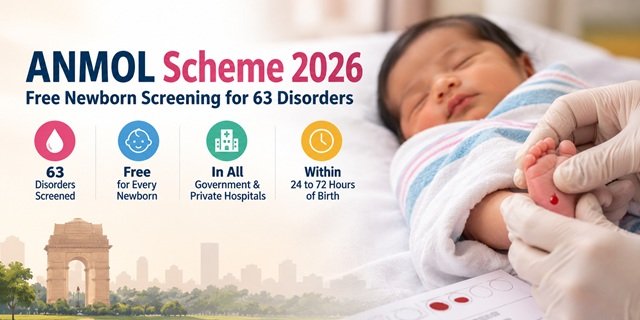
The ANMOL Scheme (Advanced Newborn Monitoring for Optimal Lifecare), implemented by the Department of Health and Family Welfare, Government of NCT of Delhi, provides free screening for 63 disorders to newborns born in government and private hospitals across Delhi. Parents do not need to submit a separate application, as hospitals arrange the screening, generally within 24 to 72 hours after birth.
Delhi ANMOL Scheme Highlights | |
|---|---|
| Scheme Name | ANMOL Scheme (Mission ANMOL) |
| Full Form | Advanced Newborn Monitoring for Optimal Lifecare |
| Announced In | Delhi Budget 2026–27 (24 March 2026) |
| Announced By | Chief Minister Rekha Gupta |
| Implementing Department | Department of Health and Family Welfare, Government of NCT of Delhi |
| Budget Allocation | Rs. 25 crore |
| Disorders Screened | 63, expanded from 56 on 6 October 2026 |
| Screening Method | Heel-prick blood test |
| Screening Period | 24 to 72 hours after birth |
| Cost to Parents | Free of cost |
| Hospitals Covered | Government and private hospitals in Delhi |
| Newborns Screened | More than 75,000 (over 700 children reportedly received treatment) |
| Annual Screening Target | 2.5 lakh newborns |
| Application Process | No separate application required; screening is arranged through the hospital |
| Official Website | health.delhi.gov.in |
Introduction of Delhi ANMOL Scheme: A Brief Insight
Some babies are born with hidden health conditions that may not show any visible symptoms at first. Disorders such as congenital hypothyroidism and phenylketonuria can affect a child’s brain and physical development if doctors do not detect them in time. Since private newborn screening can be expensive, many families may find it difficult to access these tests. The Delhi Government’s ANMOL Scheme aims to address this concern through early screening.
The Advanced Newborn Monitoring for Optimal Lifecare (ANMOL) programme was announced by Delhi Chief Minister Rekha Gupta in the Delhi Budget 2026–27 on 24 March 2026, with a budget allocation of Rs. 25 crore. The Department of Health and Family Welfare, Government of NCT of Delhi, implements the programme to identify serious health conditions in newborns at an early stage and help reduce infant deaths and long-term disabilities.
Under Mission ANMOL, newborns receive free screening for 63 genetic, metabolic and congenital disorders. The process includes collecting a few drops of blood from the baby’s heel for testing. On 6 October 2026, the government expanded the screening coverage from 56 to 63 disorders. According to the available programme figures, healthcare teams have screened more than 75,000 newborns, and over 700 children have received timely treatment.
The scheme covers babies born in government and private hospitals in Delhi, without an income limit. Hospitals generally conduct the screening within 24 to 72 hours after birth, preferably before discharge. Parents do not need to submit a separate application because the hospital arranges the screening process.
If parents have questions about the screening or their baby’s results, they can contact the nursing staff or the designated nodal officer at the hospital. They can also approach their local ASHA worker for guidance.
Expecting mothers can also explore financial assistance during pregnancy through the PM Matru Vandana Yojana and support for safe institutional delivery under the Janani Suraksha Yojana. Parents of baby girls in Delhi can learn about long-term financial support through the Lakhpati Bitiya Yojana. Once children start school, the PM Poshan Yojana helps support their nutritional needs.
New parents, families and other readers looking for health and welfare assistance can explore more programmes through our Popular Welfare Delhi Government Schemes page.
Latest Update
- 6 October 2026: Lieutenant Governor Taranjit Singh Sandhu and Chief Minister Rekha Gupta expanded Mission ANMOL at the ASHA Sammelan held at Thyagraj Stadium. The screening coverage increased from 56 to 63 disorders. By this time, more than 75,000 newborns had reportedly been screened, and over 700 children had received treatment.
- 8 April 2026: Health Minister Pankaj Kumar Singh approved the expanded rollout of Mission ANMOL, increasing the annual screening target to 2.5 lakh newborns and sanctioning 148 staff positions.
- 24 March 2026: The Delhi Government announced the ANMOL Scheme in the Delhi Budget 2026–27 with a budget allocation of Rs. 25 crore.
Benefits Provided to Eligible Beneficiaries
Some genetic, metabolic and congenital conditions may not show clear symptoms immediately after birth. Without timely detection, certain conditions can affect a baby’s growth, development, eyesight or other vital functions. Mission ANMOL aims to identify these health concerns early so that families can seek medical advice and start appropriate treatment without unnecessary delay.
Free Screening for Every Newborn
- Screening for 63 genetic, metabolic and congenital disorders, expanded from the earlier list of 56 conditions.
- Free screening at government and private hospitals in Delhi, as described under the programme.
- A small blood sample collected from the baby’s heel for screening, making the process quick and minimally invasive.
- Reduced financial burden on families, as similar tests in private laboratories may cost up to Rs. 25,000.
Conditions Detected Early
| Type of Condition | Examples |
|---|---|
| Hormonal and Metabolic Disorders | Congenital Hypothyroidism, Phenylketonuria |
| Genetic Disorders | Cystic Fibrosis |
| Functional and Other Health Conditions | Congenital Heart Defects, Hearing Impairment, Retinopathy of Prematurity |
| Visible Birth Defects | Cleft Lip and Palate, Clubfoot, Spina Bifida, Polydactyly |
Results Achieved So Far
- More than 75,000 newborns have reportedly undergone screening.
- Over 700 children have reportedly received timely treatment following early detection.
Expansion and Support
- Annual screening coverage is planned to increase from approximately 1.5 lakh to 2.5 lakh newborns.
- 148 staff positions have been approved, including 60 staff nurses and 15 optometrists.
- A dedicated allocation of Rs. 25 crore has been provided in the Delhi Budget 2026–27, according to the information available for the programme.
Eligibility Conditions Required to be Fulfilled
The Advanced Newborn Monitoring for Optimal Lifecare (ANMOL) Scheme aims to provide newborn screening to eligible babies born in Delhi. Parents do not need to meet any income-related or category-based conditions to access the screening service.
- The beneficiary must be a newborn baby.
- The baby must be born in a government or private hospital in Delhi.
- The screening should take place within 24 to 72 hours after birth, preferably before the mother and baby leave the hospital.
- Babies from all income groups and social categories are covered, without an income-based eligibility test.
Who Benefits the Most
- Families who may find private newborn screening expensive, with costs reportedly reaching Rs. 25,000.
- Preterm and low-birth-weight babies who may face a higher risk of certain health conditions, including eye-related problems.
- Families with a history of genetic or metabolic disorders who may benefit from timely screening and medical follow-up.
Points to Keep in Mind
- Babies born at home or outside Delhi may not receive screening automatically under the hospital-based process. Parents should contact the nearest government hospital to confirm the available options.
- If the baby misses screening within the first 72 hours, parents should contact the hospital promptly and ask whether the test can still be arranged.
Documents Required to be Attached
Parents do not need to submit a separate application under the Advanced Newborn Monitoring for Optimal Lifecare (ANMOL) Scheme. The hospital conducts the screening after the baby’s birth. However, parents should keep a few basic documents and contact details ready to help the hospital complete the registration and share screening reports or follow-up information.
- Aadhaar Card or any other valid photo ID of the mother
- Hospital admission or delivery registration slip of the mother
- Active mobile number of the parents to receive reports and follow-up calls
- Residential address in Delhi, as recorded in the hospital’s delivery records
- Antenatal care card or MCP (Mother and Child Protection) card, if available
If Follow-Up Is Needed
- Copy of the baby’s screening report
- Discharge summary of the mother and newborn
- Birth certificate of the baby, once issued
How Beneficiaries Can Apply to Avail the Benefit of this Scheme
Parents do not need to apply separately for the Advanced Newborn Monitoring for Optimal Lifecare (ANMOL) Scheme. The hospital where the baby is born arranges the screening process. Here is how the screening works, step by step.
Step-by-Step Screening Process
Step 1: The baby is born in a Government or private hospital in Delhi.
Step 2: Between 24 and 72 hours after birth, a trained nurse gently pricks the baby’s heel and collects a few drops of blood on a special card.
Step 3: The hospital sends the blood sample to the designated laboratory for testing against the conditions covered under the scheme.
Step 4: Trained healthcare staff also conduct other required checks, such as hearing, eye and heart screening, wherever applicable.
Step 5: If the screening results do not indicate any problem, parents should follow the hospital’s advice and continue routine newborn check-ups.
Step 6: If a result needs further attention, the healthcare team contacts the family and asks them to bring the baby for a confirmatory test.
Step 7: If further tests confirm a health condition, doctors guide the family about the required treatment, specialist care or follow-up.
What Parents Should Do
Step 1: Provide the hospital with the correct mobile number and residential address during admission.
Step 2: Before discharge, ask the nurse whether the baby’s blood sample has been collected and the required screening checks have been completed.
Step 3: Keep the registered mobile number active and answer calls from the hospital or healthcare team regarding the baby’s screening results.
Step 4: If the hospital recommends a repeat test or confirmatory examination, take the baby to the recommended facility without delay.
Important: The screening service under Mission ANMOL is provided free of cost. Do not pay unauthorised persons claiming to arrange these tests. For official information and updates, visit the Department of Health and Family Welfare, Government of NCT of Delhi.
Important Links Available of the Scheme
- Department of Health and Family Welfare, Government of NCT of Delhi
- Delhi State Health Mission
- Government of NCT of Delhi official portal
Contact Details in Case of Help Needed
- Nodal Department: Department of Health and Family Welfare, Government of NCT of Delhi
- At the Hospital: Labour room or newborn ward nursing staff, or the hospital’s nodal officer for newborn screening
- Local Help: ASHA worker or nearest Ayushman Arogya Mandir in your area
Frequently Asked Questions (FAQs)
Ans. The Advanced Newborn Monitoring for Optimal Lifecare (ANMOL) Scheme is a Delhi Government initiative that provides free screening for newborns to help identify serious genetic, metabolic and congenital disorders at an early stage.
Ans. Chief Minister Rekha Gupta announced Mission ANMOL in the Delhi Budget 2026–27 on 24 March 2026, with a budget allocation of Rs. 25 crore.
Ans. The scheme covers 63 disorders, up from the earlier list of 56 conditions. The screening coverage was expanded on 6 October 2026, according to the information provided.
Ans. Yes. The screening is provided free of cost at government and private hospitals in Delhi, as described under the scheme.
Ans. The screening is generally conducted within 24 to 72 hours after birth, preferably before the mother and baby are discharged from the hospital.
Ans. A trained healthcare worker gently pricks the baby’s heel and collects a few drops of blood on a special card for laboratory testing.
Ans. No. Parents do not need to submit a separate application. The hospital arranges the screening process after the baby’s birth.
Ans. Screening may help identify conditions such as congenital hypothyroidism, phenylketonuria, cystic fibrosis, congenital heart defects, hearing impairment, retinopathy of prematurity and certain birth defects, including cleft lip and palate.
Ans. According to the figures provided, more than 75,000 newborns have been screened, and over 700 children have received timely treatment following early detection.
Ans. The healthcare team may contact the parents and recommend a confirmatory test. If further testing confirms a condition, doctors guide the family about the appropriate treatment and follow-up care.
Ans. The government plans to increase annual screening coverage from approximately 1.5 lakh to 2.5 lakh newborns.
Ans. Parents can contact the nursing staff or designated nodal officer at the hospital where the baby was born. They can also approach their local ASHA worker for guidance.

Tabassum is a government schemes researcher and writer with 5 years of experience tracking Central and State welfare scheme programmes across India. She has covered 500+ schemes spanning agriculture, women welfare, education, and housing, helping lakhs of beneficiaries understand their entitlements in simple language.