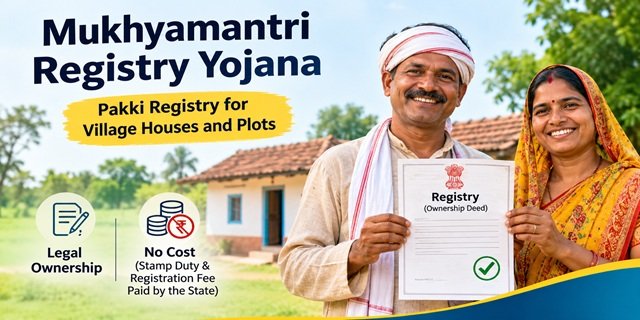
The Mukhyamantri Registry Yojana, launched by the Government of Madhya Pradesh, aims to provide owners of rural houses and plots with a pakki registry, a legally registered document that proves property ownership. The State Government bears the stamp duty and registration fee, so eligible families do not have to pay these charges. Revenue officers organise village-level camps to complete the process, and the Government aims to cover around 50 lakh rural properties under the scheme.
Madhya Pradesh Mukhyamantri Registry Yojana Highlights | |
|---|---|
| Scheme Name | Mukhyamantri Registry Yojana (also referred to as the Swamitva Yojana of Madhya Pradesh) |
| Launched By | Government of Madhya Pradesh, under Chief Minister Dr. Mohan Yadav |
| Implementing Department | Revenue Department, with support from the Registration Department |
| Work Began | 17 September 2026, according to reports |
| Ownership Papers Distributed | 6 November 2026, on Dhanteras, in a village of Morena district by the Chief Minister |
| Scheme Type | Registration of ownership documents for rural houses and plots, with registration costs covered by the State Government |
| Main Objective | To provide eligible rural property owners with a registered ownership document and legal proof of their property |
| Eligibility | Owners of houses or plots in a village’s abadi area who hold a patta or property rights record but do not have a pakki registry |
| Cost to Beneficiaries | No stamp duty or registration fee; the State Government bears these costs |
| Target Coverage | Approximately 50 lakh rural properties |
| Registrations Completed by 1 November 2026 | More than 12.87 lakh properties, according to reports |
| Target for 15 November 2026 | 20 lakh registrations, according to reports |
| Officials Involved | Patwari, Tehsildar, Naib Tehsildar and other revenue officers, according to reports |
| Registration Process | Village-level camps, linking properties with land records and Aadhaar-based e-KYC, according to reports |
| Benefits of the Registry | Legal proof of ownership, support for property transactions and an opportunity to apply for bank credit, subject to the bank’s rules |
| Official Websites | Government of Madhya Pradesh and Sampada Portal |
Introduction of Madhya Pradesh Mukhyamantri Registry Yojana: A Brief Insight
In many villages, families have lived in their houses for generations, and everyone knows who owns the property. However, their documents may include only a patta or property rights record, not a registered ownership deed. This can create problems when they want to sell their house or apply for a bank loan. The Mukhyamantri Registry Yojana aims to solve this problem by providing eligible families with a registered ownership document, commonly known as a pakki registry.
The Government of Madhya Pradesh runs this scheme under the leadership of Chief Minister Dr. Mohan Yadav. According to reports, the Government started the work on 17 September 2026. Later, on 6 November 2026, the day of Dhanteras, the Chief Minister handed over ownership documents to families in a village in Morena district.
The Revenue Department of Madhya Pradesh implements the scheme. Reports say that Patwaris, Tehsildars, Naib Tehsildars and other revenue officers visit villages to carry out the registration work and help eligible families.
The main objective is to provide owners of rural houses and plots with a proper and permanent ownership document. The Chief Minister said that this document gives owners legal proof of their property and can help them sell it or apply for bank credit.
One of the biggest benefits is that the State Government pays the stamp duty and registration fee. Families therefore do not have to bear these registration costs. The Government aims to cover around 50 lakh rural properties under the scheme.
According to reports, officers had registered more than 12.87 lakh properties by 1 November 2026. The Government also set a target of reaching 20 lakh registrations by 15 November 2026. The Chief Minister asked ministers, MPs and MLAs to ensure that every eligible house in their villages receives its registry.
Owners of houses or plots located in the abadi area of a Madhya Pradesh village may qualify if they hold a patta or property rights record but do not have a registered ownership document. The Government has not yet published detailed eligibility rules, so property owners should contact their Patwari to check whether their property qualifies.
The process does not require families to visit a registry office repeatedly or fill out a lengthy form. According to reports, revenue officers organise village-level camps, link properties with land records and complete e-KYC using the owner’s Aadhaar details and Aadhaar-linked mobile number. Keep your patta or property rights record, Aadhaar card and mobile phone ready. You should not pay anyone for the registry.
If you need help, contact your local Patwari or visit the Tehsildar office of your tehsil. Your Gram Panchayat can also help you find out when the village camp will take place.
Families who want to understand how the Government maps village land can also read about the SVAMITVA Scheme, which provides property records to owners of rural houses. Rural families who need financial assistance to build a house can explore the Pradhan Mantri Awas Yojana Gramin.
Families living in towns and cities can also check the Pradhan Mantri Awas Yojana Urban, which aims to help eligible urban families get a house.
Villagers, house owners, farmers and rural families looking for more land, housing and welfare schemes offered by the Madhya Pradesh Government can explore our Madhya Pradesh Government Popular and Welfare Schemes List page to find other available programmes.
Latest Update on Mukhyamantri Registry Yojana
- Current Registration Status: The registration drive is underway in villages across Madhya Pradesh. According to reports, the Government aims to complete 20 lakh property registrations by 15 November 2026.
- Revenue Department’s Letter to Collectors: Reports say that the Revenue Department has written to district Collectors, assuring them that Patwaris will not face future difficulties for carrying out the registry work. This step is expected to give revenue officers greater confidence in completing the registration process.
- Registration Drive to Continue: The Chief Minister has said that the drive will continue in the coming years. He also indicated that the initiative will be linked with the Year of Youth next year, giving families whose properties remain unregistered another opportunity to receive their registry.
- Updates to Watch: Property owners should look for official announcements about village camp dates, the required documents and the procedure for getting their house or plot included if it is missing from the list.
- Keep Your Documents Ready: Keep your patta or property rights record, Aadhaar card and Aadhaar-linked mobile number ready in one place. You should also contact your Patwari before the village camp to check your property’s registration status.
Benefits Provided to Eligible Beneficiaries
Many rural families in Madhya Pradesh have lived in their houses for generations but still lack a registered ownership document. A patta or property rights record may not be enough when they want to sell the property or seek a bank loan. The Mukhyamantri Registry Yojana aims to solve this problem by providing eligible families with a registered property document (pakki registry) without charging them stamp duty or registration fees.
A Proper Registered Paper of Your House
- Get a pakki registry, a legally registered document for your house or plot
- Get your property recorded in your name through the registration process
- Receive a permanent revenue document that supports your legal ownership rights
No Cost to the Family
- The State Government pays the stamp duty and registration fee
- Reports also mention relief from Panchayat cess and additional stamp duty
- Village-level camps save families the time and travel costs of visiting registration offices
What You Can Do With a Registry
- Sell your property or complete a property transaction with a registered ownership document
- Use the registry as property proof when applying for a bank loan, subject to the bank’s rules
- Make it easier to transfer property rights to your children or legal heirs
Fewer Disputes
- A registered document helps reduce disputes over property ownership within families and villages
- Reports state that the Government has assured support to owners if property disputes arise later
- Owners get an official document to present before revenue authorities when required
How the Work Is Done
- Patwaris, Tehsildars and other revenue officials conduct verification and registration work through village-level camps
- Reports state that the drive covers 55 districts and that more than 12.87 lakh properties had been registered by 1 November 2026
- The Government aims to cover around 50 lakh rural properties through this initiative
How the Scheme Helps You
- Get greater ownership security through a registered property document
- Save money because the Government pays the applicable stamp duty and registration fee
- Use the registry as property proof when seeking a loan for education, business or home repairs
- Keep an official property document for future generations
Good to Know
- The scheme covers eligible properties identified by the Government. Confirm your property’s status with your Patwari
- A registry does not automatically settle an existing ownership dispute or court case
- The Government has not released all detailed guidelines yet. Confirm the applicable benefits with your local revenue office
- Do not pay anyone for the registry, as the State Government bears the applicable costs
Eligibility Conditions Required to be Fulfilled
The Mukhyamantri Registry Yojana targets rural property owners in Madhya Pradesh who have a patta or property rights record but do not have a registered ownership document. The scheme aims to provide these families with legal proof of ownership without charging them stamp duty or registration fees. Although the Government has not released detailed eligibility guidelines, the following conditions are based on the available announcements and reports.
Basic Eligibility
- The applicant must own a property in a village of Madhya Pradesh
- The property must be a house or plot located in the village abadi area
- The owner must have a valid patta or property rights record
- The property must not already have a registered ownership deed (pakki registry)
- Reports state that the Government aims to cover around 50 lakh private rural properties
What the Officers Check
- The property must be linked to the village land records, with the Patwari assisting in verification
- The owner must complete e-KYC. Keep your Aadhaar card and Aadhaar-linked mobile number ready
- Revenue officials, including the Patwari, Tehsildar and Naib Tehsildar, help verify property details and process registration
- Reports indicate that officials organise village-level camps and may visit households to assist property owners
Who Is Not Eligible
- The Government has not yet published a complete list of excluded applicants or properties
- The scheme focuses on rural properties. Owners of properties in towns or cities should confirm their eligibility with the concerned revenue office
- The scheme targets properties supported by a patta or rights record. Owners of undocumented or disputed properties should check their cases with the Patwari
Check Before You Go
- Ask your Patwari whether your house or plot appears in the village property records prepared for the scheme
- Confirm the date of the registration camp in your village and the documents required for verification
- Keep your patta or property rights record, Aadhaar Card and linked mobile number ready
- Do not pay anyone for the registry. The State Government will bear the stamp duty and registration fee, as announced by the Chief Minister
Documents Required to be Attached
The Mukhyamantri Registry Yojana helps eligible rural families in Madhya Pradesh obtain legal ownership documents for their houses or plots. Under the scheme, the State Government pays the stamp duty and registration fee, allowing families to get their property registered without bearing these costs. The Government has not released an official document checklist yet. However, applicants should keep the following papers ready for verification during the village-level registration process.
- Patta or property rights record of the house or plot
- Plot details, including its size, village location and details of neighbouring plots
- Aadhaar card of the property owner for identity verification and e-KYC
- Mobile number linked to the owner’s Aadhaar card for e-KYC and updates
- Aadhaar Cards of other family members who share ownership, if required
- Other property-related records, such as Gram Panchayat tax receipts, electricity bills or allotment documents
How Beneficiaries Can Apply to Avail the Benefit of the Scheme
Under the Mukhyamantri Registry Yojana, Government officers visit villages to help eligible families get their pakki registry. This means you do not need to visit the registry office repeatedly or pay stamp duty and registration fees. The Government has not released a fixed application form or a separate online portal for the scheme. Therefore, the steps below explain the process based on the announcements and reports available so far. In simple words, officers bring the registration process to your village. You only need to keep your documents ready, attend the village camp and check the details on your registry.
What Has Happened So Far
Step 1: The Government of Madhya Pradesh launched the scheme on 17 September 2026. It aims to provide pakki registries to around 50 lakh rural properties across the State.
Step 2: According to reports, officers had registered more than 12.87 lakh properties by 1 November 2026. The Government also aimed to increase this number to 20 lakh by 15 November 2026.
Step 3: On 6 November 2026, during Dhanteras, the Chief Minister handed over ownership documents to families in a village in Morena district. Ministers, MPs and MLAs were also asked to ensure that every eligible house in each village receives its registry.
Before the Camp Comes to Your Village
Step 1: First, check whether your house or plot falls within the village abadi area, which means the part of the village where people live. You should also have a patta or property rights record for it.
Step 2: Visit your Patwari and ask whether the revenue officers have included your house or plot in the list of properties prepared for your village.
Step 3: Ask the Patwari about the date, time and location of the village camp so that you can reach there on time.
Step 4: Keep your patta or property rights record, Aadhaar card and Aadhaar-linked mobile phone number ready. Keep all these documents together so you do not have to search for them at the last moment.
Step 5: If your house has more than one owner, inform all the co-owners about the camp. They should also keep their Aadhaar cards ready and attend if the officers ask them to be present.
At the Village Camp
Step 1: Visit the camp on the announced date with your documents and mobile phone. Try to reach on time so that the officers can complete your work without delay.
Step 2: Meet the Patwari and show your patta or property rights record. The Patwari will check your property details against the village revenue records.
Step 3: The Patwari will help link your house or plot with the relevant land record. Reports say that this is an important part of the registration process.
Step 4: Complete your e-KYC using your Aadhaar card and Aadhaar-linked mobile number, as instructed by the officer. Keep your phone with you because you may receive a one-time password (OTP) to complete the verification.
Step 5: Carefully check your name, father’s name and plot details on the computer screen or printed document. If you notice any mistake, inform the officer immediately so that it can be checked before registration.
Step 6: The Tehsildar, Naib Tehsildar or authorised registration officer will complete the property registration. The State Government will pay the stamp duty and registration fee, so you do not have to pay these charges.
Step 7: Collect your registered property document (pakki registry) or its copy from the officer. Also, ask for a receipt or acknowledgement as proof that you have received the document.
After You Get the Registry
Step 1: Once you reach home, check your registry again. Make sure your name, plot details and property boundaries are correctly mentioned.
Step 2: Keep the original registry in a safe place. Make a photocopy and give one copy to a trusted family member so that you have a backup.
Step 3: Take clear photographs of all pages of the registry using your mobile phone. These photographs can help you refer to the details if the original document gets misplaced.
Step 4: If you find any mistake in the registry, visit your Patwari or Tehsildar office and ask about the correction process. Do not ignore errors in names or property details.
Step 5: You can show your registry to a bank when applying for a loan or to a buyer when you plan to sell your property. However, the bank will decide whether to approve a loan according to its own rules and requirements.
If Your House Is Not on the List
Step 1: Do not panic or pay anyone to add your house to the list. The officers may not have completed the survey or verification of every property in your village yet.
Step 2: Meet your Patwari and ask why your house or plot is missing from the list. Also, check whether you need to provide any additional property document.
Step 3: If the Patwari cannot resolve your issue, visit the Tehsildar office of your tehsil. Explain the problem and submit a written application asking the officers to check your property details.
Step 4: You can also request your Sarpanch or Gram Panchayat to help raise the matter with the revenue officers. Reports say that the Government aims to cover every eligible rural property under the scheme.
Protect Yourself From Fraud
Step 1: Do not pay anyone who promises to arrange your registry or add your name to the beneficiary list. The State Government bears the stamp duty and registration fee under the scheme.
Step 2: Never share your Aadhaar details or OTP with an unknown person. Provide the required information only to the authorised officer handling your verification at the camp.
Step 3: Follow information shared by the Government of Madhya Pradesh and authorised officers of your tehsil. Do not trust messages, calls or agents who demand money in the name of the scheme.
If You Need Help
Step 1: Contact your Patwari first if you have questions about your property or the village camp. If the issue remains unresolved, visit the Tehsildar office of your tehsil.
Step 2: Visit the official website of the Government of Madhya Pradesh to check the latest announcements and updates about the scheme.
Step 3: You can also visit the Sampada portal of the Registration Department of Madhya Pradesh to understand the State’s property registration services.
Important: The Government has not announced a fixed application form, separate online portal or application fee for this scheme. According to available reports, revenue officers handle the process through village camps, and the State Government pays the stamp duty and registration fee. Therefore, do not pay anyone for getting your registry. Before visiting the camp, confirm the date, required documents and process with your Patwari.
Important Links Available of the Scheme
- Government of Madhya Pradesh Official Portal
- Sampada Portal, Madhya Pradesh – Property Registration and e-Stamping Services
- Madhya Pradesh Revenue Department Contact Directory of Revenue Officers
- Official Website of Madhya Pradesh
- Madhya Pradesh Land Records: Apply for Copies of Land Records, Revenue Cases and Maps
Contact Details in Case of Help Needed
- Department: Revenue Department, Government of Madhya Pradesh, Ground Floor, Vallabh Bhawan-2, Mantralaya, Arera Hills, Bhopal – 462011
- Your Patwari: The Patwari of your village, who checks your plot against the village record and helps at the camp
- Tehsil Office: The Tehsildar or the Naib Tehsildar of your tehsil, who registers the property
- Gram Panchayat: Your Sarpanch and the office of your Gram Panchayat, who can tell you the date of the camp
- District Level: The office of the Collector of your district, if the tehsil office cannot help
Frequently Asked Questions (FAQs)
Ans. The Mukhyamantri Registry Yojana is a scheme of the Government of Madhya Pradesh that aims to provide rural house and plot owners with a registered ownership document, known as a pakki registry. The State Government bears the stamp duty and registration fee, so eligible families do not have to pay these charges.
Ans. According to reports, the Government started the scheme on 17 September 2026. On 6 November 2026, the Chief Minister handed over ownership documents to families in a village in Morena district on the occasion of Dhanteras.
Ans. A pakki registry is a legally registered document that records ownership of a property. It provides the owner with formal proof of ownership and can help when selling the property or applying for a bank loan, subject to the bank’s rules.
Ans. Rural property owners in Madhya Pradesh may qualify if their house or plot falls within the village abadi area, they have a patta or property rights record, and they do not already have a registered ownership document. The revenue officers will verify the property and its ownership details.
Ans. Eligible beneficiaries do not have to pay stamp duty or registration fees because the State Government bears these costs. Do not pay anyone who demands money for getting your registry under the scheme.
Ans. The Government aims to provide registries to around 50 lakh rural properties. Reports state that officers had registered more than 12.87 lakh properties by 1 November 2026, with a target of reaching 20 lakh by 15 November 2026.
Ans. The Government has not published a final list of required documents. Keep your patta or property rights record, Aadhaar card and Aadhaar-linked mobile number ready. Your Patwari may ask for additional property papers or documents of other co-owners, depending on your case.
Ans. The Government has not announced a separate application form or online portal for the scheme. According to reports, revenue officers carry out the process through village-level camps. Contact your Patwari to check whether your property is on the village list and when the next camp will be held.
Ans. e-KYC is an electronic identity verification process. Under the scheme, officers may use your Aadhaar details and linked mobile number to verify your identity before registering the property in your name. Keep your mobile phone with you during the camp.
Ans. Contact your Patwari and ask why your property has not been included. If the issue remains unresolved, visit your Tehsildar office and submit a written request for verification. You can also ask your Sarpanch or Gram Panchayat to help raise the matter with the revenue officers.
Ans. A registered ownership document can help you apply for a bank loan against your property. However, the bank will check your documents, property details and loan eligibility before approving the application.
Ans. No. The SVAMITVA Scheme is a Government of India initiative that uses mapping technology to help establish property records in rural areas. The Mukhyamantri Registry Yojana is a Madhya Pradesh Government initiative that aims to provide eligible rural property owners with a registered ownership document. The two initiatives have different processes and objectives.
Ans. It is advisable for the property owner to attend the camp with the required documents and Aadhaar-linked mobile phone. The officers may need the owner’s presence for identity verification and checking property details. If the property has multiple owners, the other co-owners should also be available if the officers ask them to attend.
Ans. Contact your Patwari first for information about the beneficiary list, village camp and document verification. If you need further help, visit the Tehsildar office of your tehsil. You can also check the official Government of Madhya Pradesh website for scheme-related announcements. Remember, you do not have to pay anyone for the stamp duty or registration fee covered by the State Government.

Tabassum is a government schemes researcher and writer with 5 years of experience tracking Central and State welfare scheme programmes across India. She has covered 500+ schemes spanning agriculture, women welfare, education, and housing, helping lakhs of beneficiaries understand their entitlements in simple language.