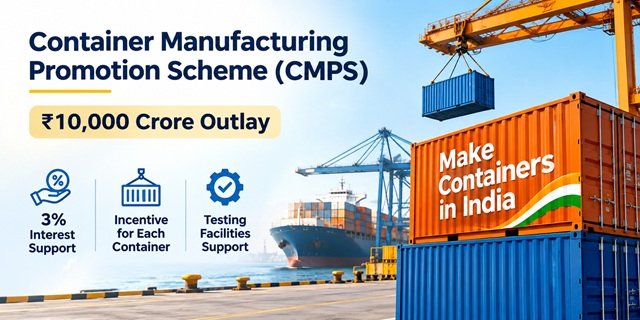
The Container Manufacturing Promotion Scheme (CMPS), implemented by the Ministry of Ports, Shipping and Waterways, received Union Cabinet approval on 28 October 2026 with a total outlay of ₹10,000 crore up to FY 2039-40. It offers eligible container manufacturers a 3% annual interest subvention on term loans and financial assistance of ₹49,500 to ₹86,625 for each eligible container manufactured and sold. The Ministry will announce the application procedure after finalising the detailed guidelines.
Container Manufacturing Promotion Scheme Highlights | |
|---|---|
| Scheme Name | Container Manufacturing Promotion Scheme (CMPS) |
| Announced | Union Budget 2026-27 |
| Cabinet Approval | 28 October 2026 |
| Implementing Ministry | Ministry of Ports, Shipping and Waterways, Government of India |
| Scheme Type | Financial support for container manufacturing through interest subvention, production assistance and testing facilities |
| Objective | To develop a globally competitive container manufacturing industry, reduce import dependence and strengthen the domestic supply chain |
| Total Financial Outlay | ₹10,000 crore, up to FY 2039-40 |
| Scheme Period | FY 2027-28 to FY 2039-40, including three years for setting up facilities and ten years of production support |
| Interest Subvention Assistance | ₹859 crore, providing 3% annual interest support on eligible term loans |
| Operational Expenditure Assistance | ₹8,891 crore for eligible containers manufactured to global shipping standards and sold |
| Assistance for 20-Foot Container | ₹49,500 per container |
| Assistance for 40-Foot Container | ₹86,625 per container |
| Assistance for Specialised 20-Foot Container | ₹37,125 to ₹74,250 per container |
| Testing and Certification Support | ₹150 crore for common testing facilities, including the dynamic longitudinal impact test |
| Administration and Monitoring | ₹100 crore for scheme administration, monitoring and capacity building |
| Major Port Land Support | Leasing support at 25% of the notified rate |
| Eligible Applicants | Container manufacturers establishing new greenfield facilities or expanding existing brownfield facilities |
| Minimum Greenfield Capacity | 1,00,000 TEUs per year |
| Minimum Brownfield Expansion | Additional capacity of 25,000 TEUs per year |
| Project Commissioning Deadline | Within three years of receiving in-principle approval |
| Local Content Requirement | At least 70% up to FY 2031-32, increasing to 90% from FY 2032-33 |
| Target Manufacturing Capacity | Increase from around 70,000 TEUs to 7.5 lakh TEUs annually |
| Employment Target | Approximately 3,000 direct jobs and more than 50,000 indirect jobs |
| Expected Economic Output | Approximately ₹75,000 crore by FY 2039-40 |
| Approving Authority | Inter-Ministerial Steering Committee headed by the Secretary of the Ministry of Ports, Shipping and Waterways |
| Application Process | The Ministry will announce the application procedure after issuing the detailed implementation guidelines |
| Contact Number | 011-23356712 |
| Email Address | jscord-psw@gov.in |
| Official Scheme Information | PIB Backgrounder and Ministry of Ports, Shipping and Waterways |
Introduction of Container Manufacturing Promotion Scheme (CMPS): A Brief Insight
Every product transported by sea, from mobile phones to food grains, travels in shipping containers. India needs millions of these containers, but most are currently manufactured abroad. This dependence on imports can increase costs and create supply challenges for Indian exporters. The Container Manufacturing Promotion Scheme (CMPS) aims to change this by encouraging domestic production of quality shipping containers.
The Government announced the scheme in the Union Budget 2026-27. The Union Cabinet, chaired by Prime Minister Narendra Modi, approved it on 28 October 2026, with a total outlay of ₹10,000 crore up to FY 2039-40.
The Ministry of Ports, Shipping and Waterways implements the scheme. An Inter-Ministerial Steering Committee, headed by the Ministry’s Secretary, will frame the detailed guidelines, oversee implementation and approve financial assistance.
The main objective is to develop a globally competitive container manufacturing industry in India. The scheme also aims to reduce dependence on imported containers and strengthen the supply chain for ports, exporters and shipping lines.
Under CMPS, manufacturers can receive three major forms of support. The Government has allocated ₹859 crore for a 3% annual interest subvention on eligible term loans, ₹8,891 crore for assistance on containers manufactured and sold, and ₹150 crore for common testing facilities.
The proposed assistance rates are ₹49,500 for each 20-foot container, ₹86,625 for each 40-foot container and ₹37,125 to ₹74,250 for each specialised 20-foot container. The scheme also supports manufacturers in leasing land at major ports for 25% of the notified rate.
The scheme specifically targets container manufacturers. A new greenfield facility must have an annual production capacity of at least 1,00,000 TEUs, while a brownfield expansion must add at least 25,000 TEUs of annual capacity. Manufacturers must commission the approved facility within three years of receiving in-principle approval.
Manufacturers must also maintain at least 70% local content up to FY 2031-32. This requirement will increase to 90% from FY 2032-33. It is expected to create more demand for Indian suppliers of corner castings, specialised steel, wooden frames, paints and other container components.
The Government aims to increase India’s annual container manufacturing capacity nearly tenfold, from around 70,000 TEUs to 7.5 lakh TEUs. It also expects the scheme to generate approximately 3,000 direct jobs and more than 50,000 indirect jobs.
The Ministry will announce the application procedure and other requirements after the Steering Committee finalises the detailed guidelines. Until then, interested manufacturers can prepare their project reports, identify suitable land, explore bank financing and establish connections with Indian suppliers. For assistance, contact the Ministry at Transport Bhawan, New Delhi, or call 011-23356712.
Manufacturers interested in financial incentives for producing goods in India can also explore the Production Linked Incentive Scheme. Entrepreneurs planning to establish a small manufacturing unit with financial assistance can read about the Prime Minister’s Employment Generation Programme.
Manufacturers, entrepreneurs, exporters and readers looking for more industry, manufacturing and enterprise support programmes can explore our dedicated page on List of Welfare Schemes of the Central Government.
Benefits Provided to Eligible Beneficiaries
India depends heavily on imported shipping containers, while domestic manufacturing remains limited. The Container Manufacturing Promotion Scheme (CMPS) aims to strengthen local production by reducing factory setup costs, providing financial support for containers manufactured and sold, and developing common testing facilities. The Government has approved a total outlay of ₹10,000 crore for the scheme.
Financial Support for Setting Up Manufacturing Facilities
- Interest Subvention Assistance: A total allocation of ₹859 crore to provide an annual interest subsidy of 3% on eligible term loans
- The loan support covers both new greenfield manufacturing facilities and brownfield expansion projects
- Concessional port land lease: Manufacturers can lease land at major ports at 25% of the notified rate, reducing the cost of establishing a plant
Financial Assistance for Each Container Manufactured and Sold
- Operational Expenditure Assistance: The scheme allocates ₹8,891 crore for production-linked support, making it the largest component of the total outlay
- 20-foot container: Eligible manufacturers can receive ₹49,500 for each container manufactured to global standards and sold
- 40-foot container: The assistance is ₹86,625 per container, which is 1.75 times the amount provided for a 20-foot container. A 40-foot container represents two TEUs
- Specialised 20-foot container: The assistance ranges from ₹37,125 to ₹74,250 per container
- This support aims to reduce the cost difference between domestically manufactured containers and imported alternatives, making Indian products more competitive
- Production support will continue during the scheme’s ten-year assistance period, up to FY 2039-40
Support for Common Testing and Certification Facilities
- ₹150 crore is allocated to establish common testing facilities, including facilities for the dynamic longitudinal impact test
- Domestic manufacturers can use these facilities for testing and certification instead of depending on overseas testing arrangements, helping reduce testing costs and delays
Administrative and Monitoring Support
- ₹100 crore is earmarked for scheme administration, monitoring and capacity building
- An Inter-Ministerial Steering Committee, chaired by the Secretary of the Ministry of Ports, Shipping and Waterways, will oversee implementation, frame detailed rules and sanction assistance
How the ₹10,000 Crore Outlay Is Distributed
- ₹859 crore: Interest subvention assistance
- ₹8,891 crore: Operational expenditure assistance for containers manufactured and sold
- ₹150 crore: Common testing facilities
- ₹100 crore: Administration, monitoring and capacity building
For example, if a manufacturer produces and sells 1,00,000 eligible 20-foot containers, the assistance calculated at ₹49,500 per container would amount to ₹495 crore. This is an illustrative calculation, not a guaranteed payment. Actual assistance will depend on the final scheme guidelines and the manufacturer’s eligibility.
Benefits for India, Industries and Employment
- Domestic container manufacturing capacity is expected to increase nearly tenfold, from around 70,000 TEUs to 7.5 lakh TEUs
- The scheme aims to generate around 3,000 direct jobs and more than 50,000 indirect jobs across manufacturing, steel, components and logistics
- Indian suppliers of corner castings, specialised steel, wooden frames and paints may gain from higher demand for locally sourced materials
- Greater domestic production can reduce dependence on imported containers and strengthen the supply chain for ports, exporters and shipping lines
- The scheme aims to develop India into a global export hub for quality shipping containers
- It projects economic output of around ₹75,000 crore by FY 2039-40, equivalent to 7.5 times the Government’s financial support
Eligibility Conditions Required to be Fulfilled
The Container Manufacturing Promotion Scheme (CMPS) targets companies that manufacture shipping containers in India or plan to establish new manufacturing facilities. Individual applicants, traders and shipping lines that only purchase or use containers cannot apply.
The following conditions are based on the Cabinet approval and the Press Information Bureau backgrounder. The Inter-Ministerial Steering Committee will issue detailed implementation guidelines, so manufacturers should also check the final rules before applying.
Who Can Apply
- Container manufacturers setting up a new greenfield manufacturing facility in India
- Existing container manufacturers expanding their production capacity through a brownfield project
- Manufacturers producing containers that meet global shipping standards and selling the finished containers
Minimum Production Capacity
- Greenfield project: Minimum annual manufacturing capacity of 1,00,000 TEUs
- Brownfield project: Additional annual capacity of at least 25,000 TEUs
- TEU: Twenty-foot Equivalent Unit, a standard measure of container capacity equal to one 20-foot container
Project Completion Timeline
- The manufacturer must commission the facility within three years from the date of in-principle approval
- The scheme will operate from FY 2027-28 to FY 2039-40, with three years for setting up facilities and ten years of production support
Eligibility for Interest Subvention
- The proposed 3% annual interest subvention applies to eligible term loans taken for setting up a greenfield facility or expanding an existing brownfield facility
- The container manufacturer must take the loan specifically for the approved project
- The project must meet the prescribed minimum annual capacity requirements
Eligibility for Per-Container Assistance
- Manufactured containers must comply with global shipping standards
- The manufacturer must sell the containers to qualify for assistance on production and sales
- The manufacturer must maintain at least 70% local content up to FY 2031-32
- Local content must increase to 90% from FY 2032-33
Benefits for Allied Industries
- Indian suppliers of corner castings, specialised steel, wooden frames and paints may benefit from increased domestic demand for these inputs
- These suppliers do not directly apply for CMPS assistance. They support eligible container manufacturers by supplying locally sourced materials and components
Who Cannot Apply
- Individuals and households, as the scheme targets container manufacturing companies
- Traders and shipping lines that only purchase, sell or use containers without manufacturing them
- Greenfield projects with an annual capacity below 1,00,000 TEUs
- Brownfield projects adding less than 25,000 TEUs of annual capacity
- Facilities that fail to meet the three-year commissioning deadline after in-principle approval
- Manufacturers producing containers that do not meet global shipping standards or are not sold
- Manufacturers that fail to meet the prescribed local content requirements
Documents Required to be Attached
The Union Cabinet approved the Container Manufacturing Promotion Scheme (CMPS) on 28 October 2026. The Inter-Ministerial Steering Committee under the Ministry of Ports, Shipping and Waterways will frame the detailed implementation guidelines.
The Ministry has not yet released the official document checklist. The following list covers the documents a container manufacturer may need based on the scheme’s proposed support. Treat it as a preparatory checklist and follow the final requirements once the Ministry publishes them.
Company Documents
- Certificate of Incorporation or registration certificate of the company, partnership firm or limited liability partnership
- Memorandum and Articles of Association or partnership deed, as applicable
- PAN Card of the company
- GST registration certificate
- Board resolution authorising the scheme application and naming the authorised signatory
- Audited financial statements for the previous financial years
- Details of promoters, directors and shareholding pattern
Project Documents
- Detailed project report for the proposed container manufacturing facility
- Proposed annual manufacturing capacity in TEUs, with at least 1,00,000 TEUs for a new greenfield facility or an additional capacity of at least 25,000 TEUs for a brownfield expansion
- Plant layout and list of machinery and equipment
- Project implementation schedule showing the proposed commissioning of the plant within three years of in-principle approval
- Estimated project cost and details of funding sources
- Workforce, skill development and raw material procurement plans
- Marketing and sales plan for domestic and export markets
Land and Site Documents
- Land ownership deed, lease deed or allotment letter for the proposed site
- Lease documents for major port land, if the facility will operate on port premises, considering the proposed lease support at 25% of the notified rate
- Applicable land-use, electricity and water approvals
- Environmental and pollution control clearances required for the facility
Loan Documents
- Loan sanction letter issued by the bank or financial institution for the term loan, if claiming the proposed 3% annual interest subvention
- Loan repayment schedule
- Loan account statements showing the interest paid
- Details of the lending institution and loan sanction date
Standards and Testing Documents
- Technical documents showing that the container design follows global shipping standards
- Container testing reports, including the dynamic longitudinal impact test
- Plant quality manuals and inspection records
- Details of the proposed use of common testing facilities, once these facilities become operational
Local Content Documents
- Local content calculation showing at least 70% domestic content up to FY 2031-32
- Plan to increase domestic content to 90% from FY 2032-33
- List of Indian suppliers providing steel, corner castings, wooden floorboards, paints and other components
- Chartered Accountant’s certificate confirming input costs, if required by the Ministry
Documents for Claiming Per-Container Assistance
- Production records of containers manufactured at the facility
- Sales invoices and delivery records for containers sold
- Container-wise production details, including 20-foot, 40-foot and specialised 20-foot containers
- Test certificates or other proof confirming compliance with global shipping standards
- Bank account details of the manufacturing company for receiving financial assistance
How Beneficiaries Can Apply to Avail the Benefit of this Scheme
The Union Cabinet approved the Container Manufacturing Promotion Scheme (CMPS) on 28 October 2026. The Ministry of Ports, Shipping and Waterways will now prepare the detailed guidelines through an Inter-Ministerial Steering Committee headed by the Ministry’s Secretary. This committee will also examine applications and approve financial assistance.
The application process will involve several stages, starting with checking the scheme conditions and preparing the project, followed by applying for approval, setting up the factory, manufacturing containers and claiming the assistance. Follow the steps below to understand what your company needs to do at each stage.
Step 1: Read the Official Scheme Information
Step 1: First, read the Ministry of Ports, Shipping and Waterways’ release on the Cabinet decision to understand why the Government introduced the scheme.
Step 2: Go through the Press Information Bureau backgrounder on CMPS to understand the proposed financial assistance, capacity requirements and other conditions.
Step 3: You can also read the Cabinet approval announcement on the Prime Minister’s website for an overview of the scheme.
Step 4: Check whether your company manufactures shipping containers or plans to establish a new manufacturing facility. The scheme is meant for eligible container manufacturers, not individual applicants or traders.
Step 5: Note the scheme period, which runs from FY 2027-28 to FY 2039-40. The proposed timeline includes three years to establish the facility and ten years of production support.
Step 2: Choose Between a New Plant and an Existing Plant
Step 1: Select the greenfield category if your company plans to build a completely new container manufacturing factory.
Step 2: Make sure the proposed new factory can achieve an annual production capacity of at least 1,00,000 TEUs.
Step 3: Select the brownfield category if your company already operates a container manufacturing plant and wants to increase its production capacity.
Step 4: Check that the proposed expansion will add at least 25,000 TEUs of annual manufacturing capacity.
Step 5: Prepare a realistic construction and installation plan. Your company must be able to commission the facility within three years from the date of in-principle approval.
Step 3: Prepare Your Factory Project Before Applying
Step 1: Ask your technical team or project consultants to prepare a detailed project report (DPR). It should explain the proposed production capacity, factory layout, machinery, equipment and estimated investment.
Step 2: Identify suitable land for the factory. Keep the ownership documents, lease deed or allotment letter ready.
Step 3: Explore the option of leasing land at a major port. The scheme proposes port land at 25% of the notified rate, which may help reduce the cost of setting up the factory.
Step 4: Discuss the project with your bank or financial institution if you need a term loan. The scheme proposes a 3% annual interest subvention on eligible term loans.
Step 5: Decide how your factory will manufacture containers according to global shipping standards. Also identify the testing and certification requirements for the finished containers.
Step 6: Identify Indian suppliers of steel, corner castings, wooden floorboards, paints and other components. You must plan to meet the scheme’s local content requirement of at least 70%.
Step 7: Organise your company’s basic documents, including its certificate of incorporation, PAN, GST registration, board resolution and audited financial statements.
Step 4: Check the Final Application Rules
Step 1: Regularly visit the official website of the Ministry of Ports, Shipping and Waterways and the Press Information Bureau for updates on the scheme.
Step 2: Once the Ministry publishes the detailed guidelines, read them carefully. They will explain the application procedure, submission method, required documents and important deadlines.
Step 3: Download the prescribed application form or use the online application facility, depending on the method notified by the Ministry.
Step 4: Fill in the company and project details, attach the required documents and check that all the information is correct.
Step 5: Submit the application through the notified channel before the deadline. Keep a copy of the submitted application and its acknowledgement for future reference.
Step 5: Get Your Project Approved
Step 1: After submission, the Inter-Ministerial Steering Committee will examine your application and check whether the project meets the scheme conditions.
Step 2: If the Ministry asks for additional documents or clarification, provide the required information within the given time.
Step 3: Wait for the committee’s decision. If your project receives in-principle approval, note the approval date carefully because the three-year commissioning period will begin from that date.
Step 6: Arrange Finance and Set Up the Factory
Step 1: Arrange the required funds and obtain an eligible term loan from a bank or financial institution, if needed.
Step 2: Begin construction or expansion work according to the approved project plan. Install the required machinery and production equipment.
Step 3: Follow the Ministry’s procedure to claim the proposed 3% interest subvention on the eligible loan.
Step 4: Complete the construction, installation and other necessary work, and commission the factory within the prescribed three-year period.
Step 7: Manufacture, Test and Sell Your Containers
Step 1: Start manufacturing containers that meet the required global shipping standards.
Step 2: Get the containers tested as required. You may use the common testing facilities supported under the scheme, including facilities for the dynamic longitudinal impact test.
Step 3: Maintain at least 70% local content up to FY 2031-32. Plan your sourcing and production in advance to increase this share to 90% from FY 2032-33.
Step 4: Sell the finished containers to shipping lines, container leasing companies, exporters or other buyers.
Step 5: Maintain proper production and sales records. Keep separate details of the number and type of containers manufactured and sold, along with their testing and quality documents.
Step 8: Submit Your Claim for Container-Based Assistance
Step 1: Once you manufacture and sell eligible containers, submit your claim for Operational Expenditure Assistance according to the procedure notified by the Ministry.
Step 2: Keep the proposed assistance rates in mind: ₹49,500 for a 20-foot container, ₹86,625 for a 40-foot container and ₹37,125 to ₹74,250 for a specialised 20-foot container.
Step 3: Attach the sales invoices, production records, testing certificates and other documents required to support your claim.
Step 4: Follow the Ministry’s verification and payment procedure to receive the approved assistance.
Where to Seek Guidance About the Scheme
Step 1: For official updates and clarification, contact the Ministry of Ports, Shipping and Waterways. Its office is located at Transport Bhawan, New Delhi.
Step 2: You can also consult your bank or industry association about project finance, manufacturing requirements and the detailed scheme guidelines once the Ministry publishes them.
Important: The detailed application procedure and official document checklist are yet to be notified. Do not pay any agent or intermediary who promises guaranteed approval or financial assistance. Follow only the application process announced by the Ministry through its official channels. The application opening date has not yet been confirmed.
What Shipping Containers Are and Why India Needs to Make Them
Shipping containers are the steel boxes that carry goods across countries and continents. Although most people rarely see them, international trade depends on their availability. Understanding what these containers do also explains why India wants to develop its own manufacturing capacity.
What Is a Shipping Container?
- A shipping container is a standardised steel box designed to transport goods by ships, trains and trucks
- Goods remain packed inside the same container from the factory to their destination, avoiding repeated unloading and repacking during transit
- Containers follow ISO specifications, allowing ports, ships and transport vehicles across the world to handle them
- The most commonly used container sizes are 20 feet and 40 feet
Why Shipping Containers Matter to India’s Economy
- As of February 2026, India’s maritime sector handled around 95% of the country’s trade by volume and 70% by value
- The maritime sector contributes approximately 4% to 5% of India’s GDP
- According to UNCTAD, around 80% of global merchandise trade by volume moves through sea routes
- India’s container traffic is projected to increase from around 24 million TEUs in 2024 to 175 million TEUs by 2047 under the Maritime Amrit Kaal Vision
Why India Needs Domestic Container Manufacturing
- India imports approximately 20 lakh empty containers every year, as most containers used in the country are manufactured abroad
- Shortages or price increases in international markets can raise transportation costs and delay shipments for Indian exporters
- Domestic manufacturing can keep more investment, industrial activity and employment within India
- It can also increase demand for Indian-made steel, wooden floorboards, corner castings and paints, supporting several allied industries
How Container Manufacturing Connects with India’s Maritime Plans
- The proposed Bharat Container Shipping Line, involving the Shipping Corporation of India, CONCOR and several port authorities, is expected to create demand for Indian-made shipping containers
- Upcoming major port projects, including Vadhavan Port and Galathea Bay, are also expected to support the country’s growing container trade and shipping requirements
Important Links Available of the Scheme
- Cabinet Approval of the ₹10,000 Crore Container Manufacturing Promotion Scheme, Press Information Bureau
- CMPS Backgrounder: Eligibility, Financial Assistance, Per-Container Rates and Local Content Requirements
- Official Cabinet Announcement on the Container Manufacturing Promotion Scheme, Prime Minister of India
- Ministry of Ports, Shipping and Waterways, Government of India
- Contact Details of the Ministry of Ports, Shipping and Waterways
- Ministry of Ports, Shipping and Waterways Citizens’ Charter 2024-25
- Ministry of Ports, Shipping and Waterways: Officers and Contact Details, Government of India Web Directory
- Sagarmala Programme: Official Portal for Port-Led Development
- Make in India: Official Portal for Manufacturing and Investment
Contact Details in Case of Help Needed
- Ministry: Ministry of Ports, Shipping and Waterways, Government of India, Transport Bhawan, 1, Parliament Street, New Delhi – 110001
- Phone: 011-23356712
- Email: jscord-psw@gov.in
- Secretary’s Office Email: secyship@nic.in
- Steering Committee: The Inter-Ministerial Steering Committee, chaired by the Secretary of the Ministry, which will approve the detailed rules and sanction the assistance
- Bank Level: The branch of your bank or financial institution, for a term loan on which the interest subvention is claimed
- Industry Level: Your industry association or chamber of commerce, which can tell you when the Ministry announces the rules
Frequently Asked Questions (FAQs)
Ans. The Container Manufacturing Promotion Scheme is a Government of India initiative to develop a globally competitive container manufacturing industry in the country. It aims to reduce dependence on imported shipping containers, strengthen the domestic supply chain and support companies setting up new factories or expanding existing facilities.
Ans. The Union Cabinet approved the scheme on 28 October 2026. The Government had also announced the initiative earlier in the Union Budget 2026-27.
Ans. The Ministry of Ports, Shipping and Waterways, Government of India, is responsible for the scheme. Visit its official website for updates.
Ans. The Government has approved a total outlay of ₹10,000 crore for CMPS, covering the scheme period up to FY 2039-40.
Ans. The scheme will run from FY 2027-28 to FY 2039-40. It provides three years for setting up manufacturing facilities, followed by ten years of production support.
Ans. The scheme has four major components: ₹859 crore for Interest Subvention Assistance, ₹8,891 crore for Operational Expenditure Assistance, ₹150 crore for common testing facilities and ₹100 crore for administration, monitoring and capacity building.
Ans. Eligible manufacturers can receive an annual interest subvention of 3% on qualifying term loans taken to establish a new greenfield facility or expand an existing brownfield plant.
Ans. The proposed assistance rates are ₹49,500 for a 20-foot container, ₹86,625 for a 40-foot container and ₹37,125 to ₹74,250 for a specialised 20-foot container. The manufacturer must produce the containers according to global shipping standards and sell them to qualify.
Ans. Container manufacturers establishing a new greenfield facility with an annual capacity of at least 1,00,000 TEUs or expanding an existing facility by at least 25,000 TEUs can qualify, subject to the detailed scheme conditions.
Ans. TEU stands for Twenty-foot Equivalent Unit, a standard measure of container capacity. One 20-foot container equals one TEU, while a 40-foot container equals two TEUs.
Ans. The manufacturer must commission the approved facility within three years from the date of in-principle approval.
Ans. Manufacturers must maintain at least 70% local content up to FY 2031-32. The requirement will increase to 90% from FY 2032-33.
Ans. CMPS aims to increase India’s annual container manufacturing capacity nearly tenfold, from around 70,000 TEUs to 7.5 lakh TEUs. It also targets approximately 3,000 direct jobs and more than 50,000 indirect jobs.
Ans. The Inter-Ministerial Steering Committee will prepare the detailed implementation and application guidelines. The Ministry will announce the application method and opening date through its official channels. Companies can follow the PIB backgrounder and the Ministry’s official website for updates.
Ans. No. The scheme targets container manufacturers. However, Indian suppliers of corner castings, specialised steel, wooden frames and paints may benefit from increased demand for locally sourced materials.
Ans. Manufacturers can contact the Ministry of Ports, Shipping and Waterways at Transport Bhawan, New Delhi. The contact details provided are 011-23356712 and jscord-psw@gov.in. They can also visit the Ministry’s contact page for official details.

Tabassum is a government schemes researcher and writer with 5 years of experience tracking Central and State welfare scheme programmes across India. She has covered 500+ schemes spanning agriculture, women welfare, education, and housing, helping lakhs of beneficiaries understand their entitlements in simple language.