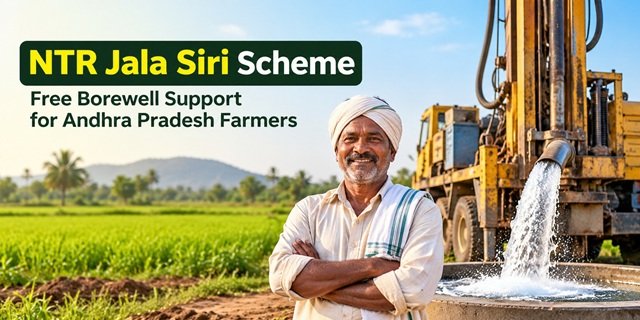
The NTR Jala Siri Scheme is implemented by the Panchayat Raj and Rural Development Department, Government of Andhra Pradesh, through the District Water Management Agency (DWMA). The scheme provides eligible farmers with free borewell drilling, while small and marginal farmers can also receive support for free energisation and submersible pump set installation, subject to the applicable guidelines. Farmers with 2.5 to 10 acres of eligible dry agricultural land can apply through their Village Secretariat.
Andhra Pradesh NTR Jala Siri Scheme Highlights | |
|---|---|
| Scheme Name | NTR Jala Siri Scheme |
| Implementing Department | Panchayat Raj and Rural Development Department |
| District-Level Agency | District Water Management Agency (DWMA) |
| Earlier Name | YSR Jala Kala (under the previous government) |
| Main Benefit | Free borewell drilling for eligible farmers |
| Additional Benefits | Free energisation and submersible pump set installation for eligible small and marginal farmers |
| Land Requirement | 2.5 to 10 acres, with a group application option for smaller landholdings |
| Borewell Limit | One borewell per family |
| Borewell Site Selection | Groundwater survey and site assessment by a geologist in accordance with APWALTA norms |
| Not Eligible | Farmers with a working borewell, land in submergence areas, Lanka lands and land in villages notified as over-exploited for groundwater |
| Application Location | Village Secretariat (online or offline, as available) |
| Sanctioning Authority | District Collector |
| Official Portal | ntrjalasiri.ap.gov.in |
Introduction of Andhra Pradesh NTR Jala Siri Scheme: A Brief Insight
Many farmers in Andhra Pradesh depend on rainfall to grow their crops. When the monsoon fails, farmers with dry agricultural land may lose their harvest and a major part of their yearly income. A borewell can provide an additional source of irrigation, but the cost of groundwater surveys, drilling, electricity connections and pump sets can be difficult for small farmers to afford. The NTR Jala Siri Scheme aims to reduce this financial burden by supporting borewell development for eligible farmers.
The Government of Andhra Pradesh introduced the scheme under Chief Minister N. Chandrababu Naidu, with its Phase-II guidelines issued in 2015 and 2016. The Panchayat Raj and Rural Development Department, Government of Andhra Pradesh, implements the programme through the District Water Management Agency (DWMA) in each district.
The scheme aims to improve irrigation facilities, bring more agricultural land under cultivation and help farmers increase their income. It also requires officials to assess groundwater availability before approving borewell drilling, supporting the responsible use of available water resources.
Eligible farmers can receive a free borewell at a location selected by a geologist after a groundwater survey. Small and marginal farmers can also receive support for free energisation, which means providing an electricity connection to operate the borewell, along with a submersible pump set, subject to the applicable guidelines. The programme has supported the installation of thousands of borewells and solar pump sets across Andhra Pradesh.
Farmers who own between 2.5 and 10 acres of land and do not have a working borewell can apply under the stated eligibility conditions. Farmers with smaller landholdings can apply together as a group if their combined land meets the minimum requirement. Tribal farmers holding eligible forest land rights are also covered, while submergence areas, Lanka lands and villages notified as over-exploited for groundwater are excluded.
Farmers can submit their applications online or offline through their Village Secretariat. Officials then verify the land records, arrange a groundwater survey and process the proposal through the District Water Management Agency and the District Collector. Applicants can contact their Village Secretariat or the DWMA office in their district for assistance with the application process.
The same borewell programme previously operated under the name YSR Jala Kala Scheme during the earlier government. Farmers can also receive annual income support through the PM Kisan Samman Nidhi Scheme and protect their crops against eligible risks under the PM Fasal Bima Yojana.
Farmers planning to use solar power for irrigation can also explore the PM KUSUM Yojana for information about applicable solar energy support.
Farmers, rural families and others looking for more agricultural and welfare programmes can visit our List of Welfare Schemes of the Andhra Pradesh Government page to explore schemes offered by the Government.
Latest Update of the Scheme
- Current Status: The NTR Jala Siri application is listed on Google Play under the Panchayat Raj and Rural Development Department, Government of Andhra Pradesh. Farmers should check with their Village Secretariat or the concerned District Water Management Agency to confirm whether applications and borewell work are currently being processed in their area.
- Eligibility Guidelines: The official app lists key conditions, including a landholding of 2.5 to 10 acres, one borewell per family, and a groundwater survey to assess site suitability. Farmers should confirm the latest applicable guidelines before applying.
- Application Information: Farmers can visit the official NTR Jala Siri portal or contact their Village Secretariat for information about the application process, pending requests and the availability of borewell drilling or pump-related assistance.
Benefits Provided to Eligible Beneficiaries
For farmers with dry agricultural land, a borewell can provide a more reliable source of irrigation and help them grow crops beyond the rainy season. The NTR Jala Siri Scheme aims to reduce the cost of setting up a borewell by supporting key activities, including groundwater surveys, drilling and pump-related facilities, subject to the applicable scheme guidelines.
Main Benefits
- Free borewell drilling: Eligible farmers can receive borewell drilling support on their agricultural land.
- Scientific site selection: A geologist identifies a suitable drilling location after conducting a groundwater survey in accordance with APWALTA norms.
- Free energisation: Small and marginal farmers can receive support for an electricity connection to operate the borewell.
- Free submersible pump set installation: Eligible small and marginal farmers can receive support for installing a submersible pump set.
- Geo-tagged monitoring: Geo-tagged photographs are taken at different stages, from borewell drilling to pump installation, to help verify the location and progress of the work.
Support Under Earlier Phase-II Guidelines
Under the earlier Phase-II guidelines, the scheme provided financial support for different components of borewell development. The component-wise assistance was as follows:
| Component | Support |
|---|---|
| Drilling cost (up to 200 feet in command areas) | Rs. 24,000 through MGNREGS |
| Energisation | Up to Rs. 50,000 |
| Motor and accessories | Up to Rs. 40,000 |
| Recharge pit near the borewell | Rs. 5,000 through MGNREGS |
| Farmer’s contribution towards energisation and motor costs | 5% for SC and ST farmers and 20% for other farmers |
These earlier guidelines recommended borewell drilling only at sites where the expected groundwater yield exceeded 4,500 litres per hour. They also encouraged farmers to adopt drip or sprinkler irrigation to use available water efficiently.
What the Scheme Has Achieved
- According to NREDCAP, around 29,525 solar pump sets were installed under the general solar programme and the NTR Jala Siri Scheme combined.
- 700 solar pump sets were commissioned under NTR Jala Siri in West Godavari district alone.
- In parts of Srikakulam district, officials drilled 2,639 borewells free of cost under the scheme.
Eligibility Conditions Required to be Fulfilled
The NTR Jala Siri Scheme aims to help farmers in Andhra Pradesh who own dry agricultural land but lack a working source of irrigation. According to the official app of the Panchayat Raj and Rural Development Department, applicants must meet the following eligibility conditions to qualify for the scheme.
Who Can Apply
- Small and marginal farmers in Andhra Pradesh
- Farmers owning at least 2.5 acres and up to 10 acres of land
- Farmers who do not have a functional borewell or tube well on their land
- Farmers whose land has an abandoned borewell or tube well
- Tribal farmers holding RoFR land titles in tribal areas
Group Application for Small Landholders
Farmers who individually own less than 2.5 acres in one location can apply together with neighbouring farmers. If their combined land covers at least 2.5 contiguous acres, they can submit a group application for one borewell, subject to the scheme’s other conditions.
Key Conditions
- Only one borewell per family is allowed under the scheme.
- The proposed borewell site must be found suitable through a groundwater survey.
- Borewell drilling must follow the applicable rules under the Andhra Pradesh Water, Land and Trees Act (APWALTA).
Who Is Not Eligible
- Farmers who already have a working borewell or tube well
- Land located in submergence areas
- Lanka lands, which are islands formed in riverbeds
- Land in revenue villages that the Government has notified as over-exploited for groundwater
Documents Required to be Attached
Farmers applying for the NTR Jala Siri Scheme need to submit a few basic documents to verify their identity and land ownership. The department carries out technical activities, including the groundwater survey, as part of the process. Applicants must submit the required documents at their Village Secretariat.
Documents to Submit While Applying
- Application form obtained from the Village Secretariat
- Copy of the Pattadar Passbook as proof of land ownership
- Aadhaar Card of the applicant
- Active mobile number to receive application updates
Documents in Special Cases
| Situation | Additional Documents |
|---|---|
| Group application by farmers who own less than 2.5 acres each | Pattadar Passbook and Aadhaar Card of each farmer in the group, confirming that their combined landholding covers at least 2.5 contiguous acres |
| Tribal farmers in agency areas | RoFR title issued under the Recognition of Forest Rights Act |
| Land with an old, abandoned borewell | Details of the abandoned borewell or tube well for verification by the concerned officials |
Document Prepared During the Process
- Site feasibility certificate: Issued after officials conduct a groundwater survey to assess whether borewell drilling is feasible on the applicant’s land.
How Beneficiaries Can Apply to Avail the Benefit of this Scheme
Farmers can apply for the NTR Jala Siri Scheme through their Village Secretariat, either online or offline, depending on the available facility. After submitting the application, officials check the farmer’s land records, conduct a groundwater survey and obtain approval from the district authorities. Borewell drilling begins only after the required checks and approvals are complete. Follow the steps below to understand the entire process.
Submitting Your Application
Step 1: Visit your nearest Village Secretariat and ask for the application form for a free borewell under the NTR Jala Siri Scheme.
Step 2: Fill in the form with the required details, including your name, Aadhaar number, mobile number and agricultural land information.
Step 3: Attach copies of your Pattadar Passbook and Aadhaar Card. If you are applying as part of a group, include the required documents for every farmer in the group.
Step 4: Submit the completed application with the required documents. Keep the acknowledgement or receipt safely so you can refer to it later.
How Your Application Is Processed
Step 1: The Village Revenue Officer (VRO) checks your land records and verifies whether you meet the scheme’s eligibility conditions.
Step 2: If your application meets the requirements, officials forward it to the Assistant Project Director of the District Water Management Agency (DWMA).
Step 3: The DWMA sends the application to an authorised drilling agency. A geologist or the concerned technical team then conducts a groundwater survey to check whether your land is suitable for borewell drilling.
Step 4: After receiving the survey report, the Assistant Project Director prepares an estimate of the expected drilling cost.
Step 5: The Project Director of the DWMA obtains administrative approval from the District Collector before the work proceeds.
Drilling and Pump Installation
Step 1: Once the required approval is granted, the authorised agency drills the borewell at the location recommended by the geologist.
Step 2: Officials take geo-tagged photographs during drilling. These photographs help verify that the work is being carried out at the approved location.
Step 3: Technical staff record the drilling measurements and details. Senior engineers check these records to verify the work.
Step 4: For eligible small and marginal farmers, the process may include providing an electricity connection to operate the borewell and installing a submersible pump set, subject to the applicable scheme provisions. Officials record photographs at each stage.
Step 5: The Government processes payments to the authorised drilling agency through its financial system. Under this process, the farmer does not need to handle the drilling agency’s payment directly.
Important: Approval depends on groundwater availability, the status of your village and the funds available in your district. Before applying, confirm the latest application procedure and benefits with your Village Secretariat. You can also visit the official NTR Jala Siri portal for further information.
NTR Jala Siri and YSR Jala Kala: Same Scheme, Different Names
| Period | Scheme Name | Key Features or Changes |
|---|---|---|
| 2016 to 2019 | NTR Jala Siri | Provided borewell drilling support, along with energisation and pump-related assistance for eligible small and marginal farmers, using MGNREGS funds. |
| 2019 to 2024 | YSR Jala Kala | Continued the free borewell programme, with applications handled through Village Secretariats, a minimum land requirement of 2.5 acres and a group application option for eligible farmers with smaller holdings. |
| Current Programme Name | NTR Jala Siri | The borewell programme is referred to as NTR Jala Siri again. Farmers should check the latest official guidelines to confirm the currently applicable benefits, eligibility conditions and application process. |
Farmers who previously searched for the YSR Jala Kala Scheme may also come across information about NTR Jala Siri, the earlier name associated with the borewell programme in Andhra Pradesh. However, scheme names and implementation rules can change over time. Before applying, farmers should confirm the current status and applicable provisions through the official NTR Jala Siri portal or their local Village Secretariat.
Important Links Available of the Scheme
- NTR Jala Siri Scheme Official portal
- NTR Jala Siri Scheme Mobile App, PR&RD Department
- NTR Jala Siri Scheme Solar Pumpset Progress, West Godavari district
Contact Details in Case of Help Needed
- Department: Panchayat Raj and Rural Development Department, Government of Andhra Pradesh
- District Level: Project Director or Assistant Project Director, District Water Management Agency (DWMA) of your district
- Village Level: Your Village Secretariat or the Village Revenue Officer (VRO)

Tabassum is a government schemes researcher and writer with 5 years of experience tracking Central and State welfare scheme programmes across India. She has covered 500+ schemes spanning agriculture, women welfare, education, and housing, helping lakhs of beneficiaries understand their entitlements in simple language.