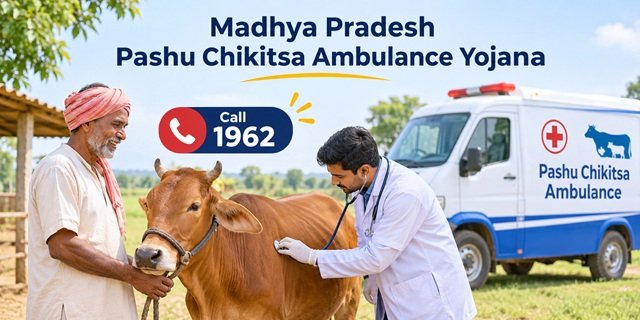
The Madhya Pradesh Pashu Chikitsa Ambulance Yojana, run by the Government of Madhya Pradesh, provides veterinary treatment at the animal owner’s doorstep. If an animal falls sick or gets injured, its owner can call 1962 to request a veterinary ambulance with a doctor.
The State has 406 mobile veterinary units, with one unit for each development block. Reports mention a visit fee of ₹150 for each large animal. You do not need to fill out any form or visit a government office to use this service.
Madhya Pradesh Pashu Chikitsa Ambulance Yojana Highlights | |
|---|---|
| Scheme Name | Pashu Chikitsa Ambulance Yojana, also known as the Mobile Veterinary Unit service |
| Type | State veterinary service for the doorstep treatment of sick and injured animals, under the Central Government’s Mobile Veterinary Unit scheme |
| Launched By | Then Chief Minister Shivraj Singh Chouhan on 12 May 2023 at Lal Parade Ground, Bhopal |
| Department | Animal Husbandry and Dairying Department, Government of Madhya Pradesh |
| Run Through | District Pashu Kalyan Samitis, headed by the district collectors. The Deputy Director of Animal Husbandry serves as the member secretary. |
| Aim | To provide veterinary care at the animal owner’s doorstep and reduce animal deaths and losses in milk production |
| Helpline | 1962 (State call centre) |
| Number of Ambulances | 406 Mobile Veterinary Units, with one unit in each development block. Each unit is planned to serve approximately one lakh livestock. |
| Crew | One veterinary doctor, one paravet and one driver who also works as an attendant |
| Services | Animal treatment, minor surgery, disease testing and artificial insemination. The team can also help arrange hospital care for serious cases. |
| Who Can Use It | Farmers, dairy keepers, animal owners and gaushalas in Madhya Pradesh |
| Animals Covered | Cows, buffaloes, horses and other domestic animals, including goats and sheep |
| Visit Fee | ₹150 per large animal, such as a cow, buffalo or horse, according to reports. The team provides a receipt. No confirmed fee is available for smaller animals. |
| Treatment and Medicines | No additional charge for treatment and medicines, as reported |
| Time to Reach You | Approximately 30 minutes after the call, as reported. Actual arrival time may vary. |
| Call Timing | Approximately 7 AM or 8 AM to 5 PM, according to reports. Confirm the current timings with your local veterinary doctor. |
| Tracking and Records | GPS tracking of ambulances. Doctors record cases in the 1962 Sanjeevani app and use an OTP for case confirmation. |
| Cost of the Scheme | Approximately ₹77 crore per year, with the Centre and State sharing the cost in a 60:40 ratio, as reported |
| How to Get It | Call 1962. No application form, online registration or office visit is required. |
| Contact | Helpline 1962, your block veterinary doctor or the Deputy Director of Animal Husbandry and Dairying in your district |
Introduction of Madhya Pradesh Pashu Chikitsa Ambulance Yojana: A Brief Insight
For a farmer who depends on one or two cows or buffaloes, a sick animal can become a serious problem for the entire family. The nearest veterinary hospital may be many kilometres away, and moving a sick or injured animal is not always possible. The Pashu Chikitsa Ambulance Yojana helps solve this problem by bringing veterinary care directly to the animal’s location.
Under this service, animal owners can call 1962 and request a veterinary ambulance. A team that includes a veterinary doctor visits the location to examine and treat the sick or injured animal.
The then Chief Minister of Madhya Pradesh Shri Shivraj Singh Chouhan launched the service on 12 May 2023 at Lal Parade Ground in Bhopal. During the launch, he flagged off 406 mobile veterinary ambulances and introduced the helpline number 1962.
The service operates under the Government of India’s scheme for Mobile Veterinary Units, with the Central and Madhya Pradesh Governments sharing its cost.
The Animal Husbandry and Dairying Department, Government of Madhya Pradesh, runs the service through its Mobile Veterinary Units. District-level Pashu Kalyan Samitis look after these units, and the district collectors head these committees.
The main aim is to provide veterinary treatment at the animal owner’s doorstep. The service encourages early treatment to reduce animal deaths, health-related losses and loss of milk production. It also helps small farmers and livestock keepers in remote areas access veterinary care without having to travel long distances.
Madhya Pradesh has 406 Mobile Veterinary Units, with one unit assigned to each development block. Each ambulance carries a veterinary doctor, a paravet and a driver who also works as an attendant.
The vehicles also carry medicines and equipment for animal treatment, minor surgical procedures, disease testing and artificial insemination.
Farmers, dairy keepers and animal owners across Madhya Pradesh can use this service. Gaushalas can also request veterinary assistance. The service covers cows, buffaloes, horses and other domestic animals. The department has not announced any income, land ownership or registration condition for using it.
According to reports, the department charges a visit fee of ₹150 per large animal, such as a cow, buffalo or horse, and provides a receipt for the payment. The reports also state that animal treatment and medicines do not require any additional payment.
The service aims to send an ambulance to the animal’s location within approximately 30 minutes, although the actual arrival time may vary.
Getting veterinary assistance is simple. You do not need to fill out an application or visit a government office. Just call 1962, provide your name and location, and explain the animal’s health problem. The call centre forwards your request to the Mobile Veterinary Unit assigned to your block.
Reports mention that the call centre operates from around 7 AM or 8 AM to 5 PM. However, the reported opening times differ, so confirm the current timings with your local veterinary doctor.
If you need assistance, call 1962 or contact the veterinary doctor of your block. You can also approach the Deputy Director of Animal Husbandry in your district. The contact section below provides further details.
Animal owners who want to protect their livestock against financial losses can read about the Rashtriya Pashudhan Bima Yojana. Farmers who need financial assistance to purchase or maintain animals can also explore the Kisan Credit Card Scheme.
Dairy farmers who want to expand their milk production and dairy business can explore the Mukhyamantri Dairy Plus Scheme, which supports dairy development in Madhya Pradesh.
Farmers, dairy keepers, gaushala managers, livestock owners and rural families can also explore other agriculture and animal husbandry programmes through our Madhya Pradesh Government Welfare Schemes page.
Latest Update on Pashu Chikitsa Ambulance Yojana
The Madhya Pradesh Government’s Pashu Chikitsa Ambulance Yojana was launched in May 2023 to provide veterinary treatment to sick and injured animals at their owners’ locations. Available reports describe the service as operational. However, we have not found a fresh official update confirming its current status, revised fees or any change in service rules.
The table below highlights the major developments reported since the launch of the service.
| Date | What Happened |
|---|---|
| March and April 2023 | Reports announced plans to start a veterinary ambulance service in Madhya Pradesh in April 2023. The initial plan included around 400 ambulances and the 1962 helpline. |
| 12 May 2023 | Chief Minister Shivraj Singh Chouhan flagged off 406 ambulances at Lal Parade Ground in Bhopal and officially launched the service. |
| June 2024 | A district veterinary officer in Shahdol explained how animal owners could use the service. The report also mentioned the helpline timings and the visit fee with a receipt. |
| 26 August 2024 | A report from Bhopal highlighted the use of the ambulance service in Katni district. It also stated that an outside agency was operating the service for the department. |
| Late 2024 | Reports stated that the Animal Husbandry Minister directed officials to keep the veterinary ambulances in proper working condition so that animal owners could receive timely assistance. |
| November 2026 | We have not found a fresh official update confirming the number of animals treated, the current visit fee or any change in the number of ambulances since the earlier reports. |
- Current Service Status: Earlier department information and reports describe the 1962 helpline as the contact point for veterinary assistance. However, confirm the current availability of the service with your local veterinary department.
- Visit Fee: Earlier reports mentioned a fee of ₹150 for each large animal, along with a payment receipt. They also stated that treatment and medicines required no additional payment. Confirm the applicable fee before the veterinary team starts treatment.
- Helpline Timings: Earlier reports mentioned call centre timings of around 7 AM or 8 AM to 5 PM. Since the reported timings differ, contact your local veterinary doctor to confirm the current schedule.
- Maintenance of Ambulances: The service depends on the availability of mobile veterinary units in different blocks. If your area’s ambulance remains unavailable, contact the block veterinary doctor or the Deputy Director of Animal Husbandry in your district.
- Future Updates: Look for official announcements about changes in the visit fee, helpline timings, the number of ambulances and the number of animals treated. Check the Animal Husbandry and Dairying Department’s official website for such updates.
- Keep the Helpline Ready: Save 1962 in your phone. Also, remember a nearby landmark for your cattle shed and inform your family members, neighbours and gaushala staff about the helpline.
Benefits Provided to Eligible Beneficiaries
When a cow falls ill in a village far from the nearest veterinary hospital, its owner may struggle to arrange treatment. Transporting a sick animal over a long distance can be difficult and expensive. Finding a private veterinarian at short notice can also be a challenge.
The Pashu Chikitsa Ambulance Yojana helps solve this problem through doorstep veterinary care. Animal owners can call 1962 and request a veterinary ambulance with a doctor. The team visits the animal’s location and provides treatment without requiring the owner to take the animal to a hospital first.
The following benefits and service details are based on information from the Animal Husbandry and Dairying Department and reports about the scheme.
What the Animal Keeper Gets
- Doorstep veterinary treatment without taking a sick or injured animal to a hospital.
- A veterinary doctor and a paravet in every ambulance, along with a driver who also works as an attendant.
- Medicines and medical equipment for treatment, minor surgical procedures, disease tests and artificial insemination.
- Treatment and medicines without any additional charge after payment of the applicable visit fee, as reported.
- A nominal visit fee of ₹150 for each large animal, as reported, with a payment receipt.
- Assistance with hospital visits when an animal needs treatment beyond the facilities available in the ambulance.
- Veterinary assistance for gaushalas as well as individual farmers and animal owners.
- A State-operated call centre that allows animal owners across Madhya Pradesh to request assistance through one helpline number.
The Service at a Glance
| Point | Detail |
|---|---|
| Helpline Number | 1962 |
| Number of Ambulances | 406 Mobile Veterinary Units, with one unit for each development block |
| Launch Date | 12 May 2023, by Chief Minister Shivraj Singh Chouhan at Lal Parade Ground, Bhopal |
| Ambulance Team | One veterinary doctor, one paravet and one driver who also works as an attendant |
| Services Provided | Animal treatment, minor surgery, disease tests and artificial insemination |
| Expected Response Time | Approximately 30 minutes after receiving a call, as reported |
| Visit Fee | ₹150 for each large animal, with a receipt, as reported |
| Treatment and Medicines | Provided without an additional charge, as reported |
| Vehicle Tracking | GPS-enabled vehicles monitored by the State call centre |
| Case Closure | A one-time password (OTP) sent to the animal owner’s mobile number |
How Much You Save, in a Simple Example
Suppose your village is 15 kilometres away from the nearest veterinary hospital. If you hire a vehicle for ₹1,000 each way to take your sick buffalo to the hospital, the total transport cost comes to ₹2,000. You may also lose a day’s work and spend several hours arranging the journey and treatment.
Under the ambulance service, you may need to pay only the reported visit fee of ₹150 for a large animal. The veterinary team comes to your cattle shed and starts treatment there. This example uses assumed transport charges to explain the possible savings. Actual costs depend on your village, distance and local transport rates.
Besides saving money and travel time, doorstep treatment can help animal owners seek veterinary assistance sooner, which is important when an animal is seriously ill or injured.
How the Service Is Run
- The service operates under a Government of India scheme for Mobile Veterinary Units. Madhya Pradesh received approval for 406 units, based on the reported norm of one unit for approximately every 1 lakh livestock.
- The Animal Husbandry and Dairying Department of Madhya Pradesh manages the service through district-level Pashu Kalyan Samitis, which are headed by the district collector.
- The Department selects an agency through a tender process to provide staff for the units in each district, as required under the Central Government’s scheme.
- The Government transfers funds for medicines and fuel to the districts through the Public Financial Management System.
- Veterinarians record treatment details through the 1962 Sanjeevani mobile app. The animal owner confirms the visit through a one-time password.
- Reports estimate the annual cost of the service at approximately ₹77 crore, shared between the Central and State Governments in a 60:40 ratio.
- Reports state that the service provides employment to approximately 1,238 people. This includes ambulance staff and call centre personnel.
What It Has Done So Far
- A report dated 26 August 2024 stated that approximately 8,000 animals in Katni district had received doorstep treatment. Seven ambulances were serving all six blocks and the city.
- The same report stated that the service had collected approximately ₹12 lakh in visit fees in Katni district, while treatment and medicines carried no additional charge.
- Shahdol district has seven ambulances, according to a statement by a district veterinary officer.
How the Service Helps You
- Early veterinary attention can help reduce milk production losses and the risk of losing animals.
- You save the transport cost and effort involved in taking a sick animal to a distant veterinary hospital.
- A gaushala can request veterinary assistance at its premises, helping the staff seek timely treatment for sick animals and manage possible disease outbreaks.
- A small animal keeper with one or two animals can also request the same doorstep service as a large dairy owner.
- The one-time password and payment receipt help maintain transparency by recording the veterinary visit and the amount paid.
Good to Know
- The service focuses on the treatment of sick and injured animals. Routine veterinary services, such as scheduled vaccination activities, may be handled by the local government veterinary dispensary.
- The call centre operates during specified hours, according to reports. For non-emergency cases, contact the helpline during its operating hours and confirm the current schedule.
- Always collect the receipt for the visit fee and pay only the officially applicable amount.
- Never share the one-time password before the veterinarian completes the treatment.
- You can also consider insuring your livestock against possible losses. Read our guide to the Rashtriya Pashudhan Bima Yojana to learn more.
Eligibility Conditions Required to be Fulfilled
The Government’s Madhya Pradesh’s Pashu Chikitsa Ambulance Yojana is a doorstep veterinary service, not a scheme that requires beneficiaries to submit an application. Farmers and animal owners across Madhya Pradesh can call the helpline to request treatment for sick or injured animals.
The service mainly depends on the animal’s location, its medical condition and the availability of a veterinary ambulance in the area. The following conditions are based on the information released by the Animal Husbandry and Dairying Department and reports about the service.
Who Can Use the Service
- Any farmer, dairy keeper or animal owner living in Madhya Pradesh.
- A gaushala or cow shelter, as the Chief Minister stated during the launch that ambulances would also visit gaushalas that request assistance.
- A person who looks after an animal on behalf of its owner, such as a herder or cattle shed worker, provided they can share the animal’s details and location.
- No specific condition related to income, land ownership, caste, ration card or prior registration has been announced. Therefore, small animal keepers and large dairy owners can both request the service.
Which Animals Are Covered
- Cows and buffaloes, which are the main animals covered by the service.
- Horses, which are also included in the reported list of large animals subject to the visit fee.
- Other domestic animals, including goats and sheep, as the Chief Minister stated that the ambulance would provide treatment to cows and other animals.
- Animals that are sick, injured or in distress due to conditions such as accidents, difficult delivery, bloating or high fever.
- The service reports do not clearly specify the fee for smaller animals. Confirm the applicable charges with the call centre or veterinarian.
Where the Service Is Available
- Across Madhya Pradesh, which has 406 Mobile Veterinary Units.
- In each development block, as the State plans to provide approximately one mobile veterinary unit for every 1 lakh livestock population.
- In both rural and urban areas, subject to the service coverage of the respective block.
- At the location of the animal, including your home, cattle shed, field or gaushala.
When You Can Call
- You can call the veterinary helpline at 1962 to request assistance. The State call centre receives these service requests.
- Reports quoting a district veterinary officer mention call centre timings of approximately 7 AM to 5 PM. However, an earlier report mentions timings of 8 AM to 5 PM. Confirm the current operating hours with your local veterinary doctor.
- The service aims to send an ambulance within approximately 30 minutes of receiving a call. However, the actual arrival time may vary depending on distance, location and the number of pending requests.
What the Ambulance Does
- On-the-spot treatment for sick and injured animals using the medicines available with the veterinary team.
- Minor surgical procedures and disease-related tests.
- Artificial insemination, as mentioned in reports about the service.
- Assistance in taking the animal to the nearest government veterinary hospital if it requires further treatment.
Conditions of the Service
- The service reportedly charges ₹150 per large animal, such as a cow, buffalo or horse, for a home visit. The veterinarian provides a receipt for the payment.
- The treatment and medicines provided during the visit are reported to be available without any additional charge.
- The caller must provide correct information about the animal, its medical condition and its location.
- After the visit, a one-time password (OTP) is sent to the caller’s mobile number. The caller shares it with the veterinarian to close the service request.
- The ambulance provides veterinary assistance to animals only, not human patients.
Who May Not Get the Service
- An animal located outside Madhya Pradesh, as this is a veterinary service of the State Government.
- A caller who cannot provide the animal’s location, making it difficult for the ambulance team to reach the spot.
- A request for a routine veterinary service when no animal is sick or injured, which may need to be handled by the nearest government veterinary dispensary.
- A person who refuses to pay the applicable visit fee for a large animal, as reported service charges apply to such visits.
- These conditions are based on the available service information. Contact the 1962 call centre if you are unsure whether your case qualifies.
Check Before You Call
- Make sure the animal is located in Madhya Pradesh and you can provide its exact location.
- Keep your mobile number active and phone charged so the veterinarian can contact you.
- Keep ₹150 for each large animal ready and collect the payment receipt.
- Keep the animal’s age and last vaccination date ready, if available.
- If your call does not connect, try again or contact your nearest government veterinary dispensary.
- Do not pay any agent or middleman to arrange an ambulance. You can request the service directly by calling 1962.
Documents Required to be Attached
The Madhya Pradesh Government’s Pashu Chikitsa Ambulance Yojana is a veterinary service run by the Animal Husbandry and Dairying Department through Mobile Veterinary Units. Farmers can call the state helpline at 1962 to request veterinary assistance at their doorstep. They do not need to fill out an application form or upload any documents.
However, farmers should keep some basic information about themselves and their animals ready before making the call. They should also keep the applicable visit fee ready. The following details will help the call centre register the case and guide the veterinary team to the correct location.
Details to Give on the Call to 1962
- Your name and active mobile number so the call centre and veterinary doctor can contact you.
- Your village or ward, gram panchayat, block and district to help identify the correct service area.
- A clear nearby landmark, such as a school, temple, well or shop, to help the ambulance reach your location.
- The type of animal, such as a cow, buffalo, goat, sheep or horse, and the number of animals requiring treatment.
- The animal’s health problem, such as fever, bloating, difficult delivery, injury, skin swelling or loss of appetite.
- Whether the animal can stand and walk or is lying down.
Information About the Animal That Helps the Doctor
- The animal’s age and whether it is a milch animal, pregnant animal or calf.
- The date of its last vaccination and deworming, if known, along with its vaccination card, if available.
- The ear tag number, if the animal has one.
- Details of any previous treatment or medicines given to the animal.
For a Gaushala or a Large Shed
- The name of the gaushala and the name and mobile number of the person responsible for its management.
- The number of sick animals and details of any animal showing signs of an infectious disease.
Money to Keep Ready
- Reports state that the service charges ₹150 per large animal, such as a cow, buffalo or horse, for a home visit. Keep the amount ready and ask the veterinarian for a receipt.
- The treatment and medicines provided by the ambulance are reported to be available without any additional charge.
- The applicable fee for smaller animals, such as goats and sheep, has not been clearly specified. Confirm the charges with the call centre or veterinarian.
- Always collect the payment receipt and keep it for your records.
At the End of the Visit
- The veterinarian records the case through the 1962 Sanjeevani mobile app. A one-time password (OTP) is sent to your registered mobile number, so keep your phone with you.
- Share the OTP with the veterinarian only after the treatment is completed and you are satisfied with the service.
- Never share the OTP with an unknown person or anyone who contacts you unexpectedly.
What You Do Not Need
- An application form, since you can request the service by calling 1962.
- An Aadhaar card, ration card or income certificate, as the Department has not announced these as mandatory requirements for requesting the service.
- A smartphone or internet connection, since you can call 1962 from a basic mobile phone.
- An agent or middleman, since you can directly contact the helpline.
Important: Call 1962 only when an animal needs veterinary assistance and provide accurate information about its condition and location. Keep your phone switched on after registering the request, as the veterinarian assigned to your block may call you for directions.
If the helpline is busy or the ambulance does not reach you within a reasonable time, try calling again or contact your nearest government veterinary dispensary. Pay only the officially applicable service charge and always collect a receipt.
How Beneficiaries Can Apply to Avail the Benefit of this Scheme
The Madhya Pradesh Government’s Pashu Chikitsa Ambulance Yojana works like a fire brigade service, but for sick and injured animals. When you need a fire brigade, you simply call its number and tell it where help is needed. You do not have to visit an office or fill out a form.
The same process applies to this veterinary ambulance service. If your cow, buffalo or another animal falls ill, call 1962 and tell the call centre where the animal is and what has happened. The veterinary ambulance will come to your location with a doctor and other staff.
You do not need to submit an application or visit any government office to request this service. Follow the instructions below to get veterinary assistance. You can also read the Official note of the Animal Husbandry and Dairying Department on Mobile Veterinary Units to understand how the service works.
Before You Start
Keep a few things ready before calling the helpline.
Step 1: Keep your mobile phone with you. You do not need to visit an office, fill out a form or register on a website.
Step 2: Make sure your phone has enough battery and a working mobile network.
Step 3: Keep ₹150 in cash for each large animal, such as a cow or buffalo. Reports mention this as the visit fee. Always ask for a receipt after payment.
Step 4: Check the animal and remember what is wrong with it, such as fever, a swollen belly, an injury or difficulty in giving birth.
Step 5: Remember a nearby landmark, such as a school, temple or well, so the ambulance driver can find your location easily.
Call 1962 and Get the Ambulance
Step 1: Open the dial pad on your phone and dial 1962.
Step 2: Wait for the call centre representative to answer your call.
Step 3: Tell the representative your name and mobile number.
Step 4: Give your village or ward, gram panchayat, block and district details.
Step 5: Tell the representative about a nearby landmark so the driver can find your animal’s location.
Step 6: Explain which animal is sick, how many animals need treatment and what health problem they are facing.
Step 7: Tell the representative whether the animal can stand and walk or is lying on the ground.
Step 8: Listen carefully to the instructions given by the call centre. If you do not understand something, ask the representative to explain it again.
Step 9: Note down the time of your call and any reference number provided by the call centre.
Step 10: Keep your phone switched on after the call. The veterinary doctor assigned to your area may contact you for directions.
What Happens After Your Call
Step 1: The call centre forwards your request to the Mobile Veterinary Unit responsible for your development block.
Step 2: The veterinary team receives your request and starts travelling to your location.
Step 3: Reports mention an expected arrival time of approximately 30 minutes after the call. However, the ambulance may take longer to reach remote villages or during busy hours.
Step 4: The department uses GPS to track the ambulance and monitor its location.
Step 5: Reports mention call centre timings of around 7 AM or 8 AM to 5 PM. Since the reported timings differ, confirm the current schedule with your local veterinary doctor.
While You Wait for the Ambulance
Step 1: Keep the sick animal in a clean and comfortable place. If the weather is hot, try to keep it in the shade.
Step 2: Do not give the animal any medicine without proper veterinary advice. The wrong medicine may make its condition worse.
Step 3: Keep fresh water nearby if the animal can drink, but do not force it to eat or drink.
Step 4: If the animal is restless, keep it in a safe place where it cannot hurt itself or other animals.
Step 5: If the animal has an injury with bleeding, use a clean cloth to apply gentle pressure to the wound while waiting for the doctor. Keep other animals away.
Step 6: If possible, ask someone to wait near the main road and guide the ambulance driver to your cattle shed or house.
When the Doctor Comes
Step 1: Show the veterinary doctor the sick or injured animal and explain its condition.
Step 2: Tell the doctor when the problem started and whether you have already given the animal any medicine or treatment.
Step 3: Share the animal’s age and last vaccination date, if you know them.
Step 4: Allow the doctor to examine and treat the animal. You can also ask questions if you do not understand the treatment or instructions.
Step 5: Pay the applicable visit fee of ₹150 for each large animal, as reported, and collect the receipt.
Step 6: Reports state that the treatment and medicines are provided without an additional charge. Confirm the applicable charges with the veterinary team before making any payment.
After the Treatment
Step 1: Ask the doctor how to take care of the animal after treatment. The doctor may suggest rest, changes in feeding or another visit.
Step 2: If you think you may forget the instructions, ask the doctor to write them down for you.
Step 3: The doctor records the treatment details in the 1962 Sanjeevani mobile app. A one-time password (OTP) is then sent to your mobile number.
Step 4: Share the OTP with the doctor only after the treatment is complete and you are satisfied with the service.
Step 5: Never share the OTP with an unknown person or someone who contacts you unexpectedly.
Step 6: Keep the payment receipt safely for future reference.
If You Run a Gaushala
Step 1: Call 1962 from your gaushala and request veterinary assistance. The Chief Minister stated during the launch that gaushalas could also request ambulance services.
Step 2: Tell the call centre the name and location of your gaushala, the number of sick animals and the problems they are facing.
Step 3: Inform the representative if any animal shows signs of an infectious disease so the veterinary team can take suitable precautions.
Step 4: Keep sick animals separate from healthy animals until the doctor arrives, if it is safe to do so.
Step 5: Ask the doctor about the applicable visit fee and collect a receipt after payment.
If You Are Not the Owner
Step 1: If you find a sick or injured animal belonging to a neighbour or lying on the roadside, you can call 1962 to request assistance.
Step 2: Give the call centre the exact location, a nearby landmark and your mobile number.
Step 3: If you know the animal’s owner, inform them about the call so they can be present when the veterinary team arrives and arrange the applicable visit fee.
If the Call Does Not Connect or the Ambulance Does Not Come
Step 1: If the helpline is busy or your call does not connect, wait a few minutes and try again.
Step 2: If the ambulance does not arrive within a reasonable time, call 1962 again and tell the representative when you first registered the request.
Step 3: Contact your block veterinary doctor or visit the nearest government veterinary dispensary. Explain the animal’s condition and tell them that you have already requested an ambulance.
Step 4: You can also contact the Deputy Director of Animal Husbandry in your district and request help. The Deputy Director serves as the member secretary of the district committee responsible for the mobile veterinary units.
Step 5: If the animal’s condition is serious, seek help from the nearest veterinary hospital without waiting unnecessarily. Arrange safe transportation if possible.
If the Animal Needs a Hospital
Step 1: Sometimes an animal needs more treatment than the ambulance team can provide at your home or cattle shed. Follow the doctor’s advice if the animal needs hospital care.
Step 2: Ask the doctor to help arrange transportation to the nearest government veterinary hospital, if this facility is available for your case.
Step 3: Ask the doctor to share the animal’s treatment details with the hospital. Keep any medical notes or treatment records with you.
For Routine Care, Not an Emergency
Step 1: Remember that the 1962 ambulance service mainly provides treatment for sick and injured animals. It may not handle every routine veterinary requirement.
Step 2: Visit your nearest government veterinary dispensary for routine services such as vaccination, deworming and general animal health advice.
Step 3: You can also consider livestock insurance to protect yourself against financial losses. Read our guide to the Rashtriya Pashudhan Bima Yojana.
Step 4: If you need financial assistance to purchase or maintain livestock, read about the Kisan Credit Card Scheme.
How to Avoid Cheats
Step 1: Pay only the applicable visit fee fixed by the department and always collect a receipt.
Step 2: Do not pay any agent or middleman to arrange an ambulance. You can request the service directly by calling 1962.
Step 3: Never share the one-time password before the doctor completes the treatment. Do not share it with strangers.
Step 4: Do not share your bank details or Aadhaar number with anyone who calls you claiming to represent the ambulance service.
Important Links Available of the Scheme
- Mobile Veterinary Units in Madhya Pradesh Official Department PDF
- Animal Husbandry and Dairying Department, Government of Madhya Pradesh Official Website
Contact Details in Case of Help Needed
- Ambulance Helpline: 1962, the call centre of the State for the veterinary ambulance, which takes calls for a sick or injured animal
- Your Block: The veterinary doctor of your development block, or your nearest government veterinary dispensary, who runs the mobile veterinary unit of your block and can tell you about your case
- Your District: The Deputy Director of Animal Husbandry and Dairying of your district, who is the member secretary of the committee that runs the units in the district
Frequently Asked Questions (FAQs)
Ans. It is a veterinary ambulance service run by the Government of Madhya Pradesh. If an animal falls sick or gets injured, its owner can call 1962 and request a veterinary doctor to visit the animal’s location. The Animal Husbandry and Dairying Department operates this service through Mobile Veterinary Units.
Ans. Former Chief Minister Shivraj Singh Chouhan launched the service on 12 May 2023 at Lal Parade Ground in Bhopal. He flagged off 406 mobile veterinary ambulances and launched the 1962 helpline.
Ans. Madhya Pradesh has 406 Mobile Veterinary Units, with one unit assigned to each development block. The department planned these units to serve approximately one lakh livestock each. You can read the Official department note on Mobile Veterinary Units for more details.
Ans. No. You do not need to fill out a form, register on a portal or visit a government office. Simply call 1962, tell the representative where the animal is and explain its health problem. The call centre will forward your request to the veterinary unit in your area.
Ans. Farmers, dairy owners, livestock keepers and other animal owners in Madhya Pradesh can request veterinary assistance. Gaushalas can also use the service. No income, land ownership, caste or ration card condition has been announced for using this service.
Ans. The service mainly covers large domestic animals such as cows, buffaloes and horses. Other domestic animals, including goats and sheep, may also receive assistance. You can call 1962 if an animal is sick, injured or facing a serious health problem. Ask the call centre about the applicable fee for smaller animals.
Ans. No. You can call 1962 using a basic mobile phone. You do not need to upload documents or submit an application. Keep your name, mobile number, address and information about the sick animal ready when you call.
Ans. A veterinary doctor, a paravet and a driver or attendant travel in the ambulance. The vehicle carries medicines and equipment for animal treatment, minor surgical procedures, disease tests and artificial insemination.
Ans. Reports state that the department charges a visit fee of ₹150 per large animal, such as a cow, buffalo or horse. The veterinary team provides a receipt after payment. Reports also state that treatment and medicines do not carry an additional charge. The fee for smaller animals is not clearly reported, so confirm it with the call centre or doctor before payment.
Ans. Reports mention that the call centre operates from around 7 AM or 8 AM to 5 PM, but the reported opening times differ. Confirm the current timings with your local veterinary doctor. The service aims to send an ambulance within approximately 30 minutes, although the actual arrival time may be longer in remote areas or during busy periods.
Ans. The veterinary doctor records the treatment details in the 1962 Sanjeevani mobile app. The system then sends a one-time password (OTP) to your registered mobile number. Share it with the doctor only after the treatment is complete and you are satisfied with the service. Never share it with an unknown person.
Ans. If the animal needs more treatment than the ambulance team can provide at your location, the doctor can guide you about taking it to the nearest government veterinary hospital. Ask the doctor for help with the next steps and keep the treatment details with you.
Ans. If the helpline is busy, wait for a few minutes and call again. If the ambulance does not arrive, contact 1962 again and explain when you first called. You can also contact your block veterinary doctor, the nearest government veterinary dispensary or the Deputy Director of Animal Husbandry in your district. If the animal is in serious danger, seek immediate help from the nearest veterinary hospital.
Ans. The ambulance service mainly provides treatment for sick and injured animals. For routine vaccination, deworming and general veterinary advice, visit your nearest government veterinary dispensary. You can also read our guide to the Rashtriya Pashudhan Bima Yojana to learn about livestock insurance.
Ans. Pay only the applicable visit fee and always collect a receipt. Do not pay any agent or middleman to arrange the ambulance. Never share the OTP before the treatment is complete, and do not provide your bank details or Aadhaar number to unknown callers. For assistance, call 1962 or contact your local veterinary doctor or district Deputy Director of Animal Husbandry.

Tabassum is a government schemes researcher and writer with 5 years of experience tracking Central and State welfare scheme programmes across India. She has covered 500+ schemes spanning agriculture, women welfare, education, and housing, helping lakhs of beneficiaries understand their entitlements in simple language.