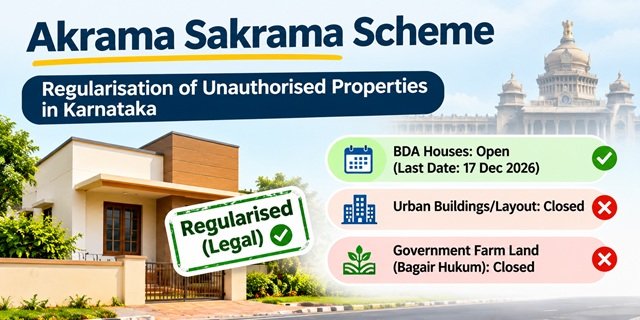
The Akrama Sakrama Scheme of the Government of Karnataka aims to regularise certain unauthorised properties by allowing eligible owners to pay a prescribed fee. Currently, only the category covering houses built before 10 July 2008 on BDA-acquired land is reported to be open. The Government has reportedly reduced the regularisation fee by 50%, with 17 December 2026 as the application deadline. Eligible owners can check the Seva One portal for application services.
Karnataka Akrama Sakrama Scheme Highlights | |
|---|---|
| Scheme Name | Akrama Sakrama Scheme (Akrama means unauthorised, while Sakrama means legalisation) |
| Implemented By | Government of Karnataka, through the BDA, Urban Development Department and Revenue Department for the three categories |
| Scheme Type | Regularisation of eligible unauthorised buildings and land on payment of a prescribed fee |
| Objective | To provide legal recognition to eligible properties and improve ownership security |
| Part 1: Houses on BDA Land | Reportedly open, with 17 December 2026 as the last date to apply |
| Eligibility for Part 1 | Owners of houses built before 10 July 2008 on land acquired by the BDA |
| Legal Provision for Part 1 | Section 38(D) of the BDA Act, as amended |
| Regularisation Fee Reduction | 50% reduction in the previously fixed fee, as reported |
| Reported Fee Rates | 12.5% of the guidance value for sites above 20×30 feet and up to 30×40 feet; 20% for sites above 30×40 feet and up to 40×60 feet; and 25% for sites above 40×60 feet and up to 50×80 feet |
| Expected Beneficiaries | Nearly 1 lakh property owners, as reported |
| Part 2: Unauthorised City Buildings and Layouts | Closed; the Supreme Court stayed the scheme in January 2017 |
| Cut-Off Date for Part 2 | 19 October 2013, as reported |
| Reported Violation Limits for Part 2 | Up to 50% setback or floor area violation for residential buildings and up to 25% for non-residential buildings |
| Part 3: Government Agricultural Land (Bagair Hukum) | Closed to new applications since April 2023 |
| Forms for Part 3 | Form 50 (1991), Form 53 (1999) and Form 57 (2018), under the Karnataka Land Revenue Act |
| Reported Cultivation Requirement | At least 15 years of cultivation |
| Application Mode for Part 1 | Online through the Seva One portal or offline at a Grama One, Bangalore One or Karnataka One centre |
| Separate BDA Facility | Clean Sale Deed Mela, with registration targeted within 60 days of an application submitted with the required site documents by 17 December 2026 |
| BDA Office Address | T. Chowdaiah Road, Kumara Park West, Bengaluru – 560020 |
| Official Websites | Seva One Portal and Bangalore Development Authority |
Introduction of Karnataka Akrama Sakrama Scheme: A Brief Insight
Many families in Karnataka live in houses that do not have complete legal approval. Some houses stand on land acquired by an authority, while others have construction violations. This can make it difficult for owners to sell their property, obtain bank loans or feel secure about their homes. The Akrama Sakrama Scheme aims to address these issues by regularising eligible properties after payment of the prescribed fee.
The scheme gets its name from two Kannada words. Akrama means unauthorised, while Sakrama means legalisation. The Government of Karnataka uses this name for three different property regularisation arrangements, each with separate rules and application status.
The first arrangement covers houses built on land acquired by the Bangalore Development Authority (BDA). The Bangalore Development Authority handles this category. It is currently reported to be open, with 17 December 2026 as the last date to apply.
The second arrangement covers unauthorised buildings and layouts in urban areas. The Urban Development Department and concerned city authorities handled this category. However, the Supreme Court stayed the scheme in January 2017, so authorities cannot process applications at present.
The third arrangement relates to government agricultural land cultivated by farmers under Bagair Hukum. The Revenue Department handled these cases and accepted Form 57 applications until April 2023. This category is now closed to new applicants.
The main objective of Akrama Sakrama is to provide legal recognition to eligible properties and reduce the difficulties faced by their owners. For the BDA category, the Chief Minister has stated that the initiative aims to provide Bengaluru residents with legal security over their land ownership.
Reports state that the Government has reduced the BDA regularisation fee by 50% for houses built before 10 July 2008. Nearly one lakh property owners may benefit from this decision. The fee depends on the site size and the guidance value of the land.
Owners of houses built on BDA-acquired land before 10 July 2008 may apply, subject to the prescribed conditions. They need documents to establish their identity, property ownership or possession, and the construction date. However, the Government has not released an official document checklist.
Eligible owners can check the Seva One portal for online application services. They can also visit a Grama One, Bangalore One or Karnataka One centre for assistance. For BDA-related matters, applicants can contact the concerned BDA office in Bengaluru, while farmers can approach their local Tahsildar’s office for Bagair Hukum application updates.
Families looking for government assistance to build a house can also explore the Pradhan Mantri Awas Yojana Gramin, which supports eligible rural households. Urban families can check the Pradhan Mantri Awas Yojana Urban for housing assistance.
Property owners, homeowners, farmers and B khata holders can also explore other housing, land and welfare programmes through our Karnataka Government Welfare and Popular Schemes List page.
Benefits Provided to Eligible Beneficiaries
The Akrama Sakrama Scheme aims to provide legal recognition to certain unauthorised properties in Karnataka. It can help eligible property owners secure their ownership rights and reduce the risk of legal action. However, the benefits depend on the type of regularisation, and some categories remain closed or under a court stay.
For a House on BDA Land (Open Until 17 December 2026)
- Eligible owners can obtain legal recognition for their houses built on BDA-acquired land
- The Government has reportedly reduced the regularisation fee by 50% for houses built before 10 July 2008
- Reports suggest that nearly one lakh property owners may benefit
- The initiative aims to provide Bengaluru residents with legal security over their property
- The facility follows an amendment to Section 38(D) of the BDA Act. Eligible owners must apply by 17 December 2026
Other Help the BDA Announced at the Same Time
The BDA has also announced some separate facilities that may benefit property owners and farmers.
- A Clean Sale Deed Mela for BDA site owners whose lease period has ended. The BDA aims to register the absolute sale deed within 60 days of receiving an application with the required site documents by 17 December 2026
- Eligible site owners can seek up to 600 square feet of available marginal land adjoining or behind their allotted sites
- Farmers who voluntarily gave their land to the BDA without litigation may receive incentive sites. Reports also mention absolute sale deeds for more than 20,000 existing site owners
For an Unauthorised Building or Layout in a City (Closed)
- When operational, the scheme allowed property owners to regularise certain setback and floor area violations by paying the prescribed fee
- In Bengaluru, regularisation of eligible B khata properties was expected to help owners obtain a better khata status, access bank loans and seek building approvals
- These benefits are currently unavailable because the Supreme Court has stayed the scheme since January 2017
For Government Farm Land Under Bagair Hukum (Closed)
- Eligible farmers could obtain a cultivation certificate (Saguvali Chit) and legal recognition of their rights over the cultivated government land
- The Revenue Department accepted Form 57 applications until April 2023
- Farmers who applied earlier cannot be evicted until the authorities decide their applications, as stated by the Revenue Minister
- New applications are not being accepted, and reports indicate that the Department has rejected many applications under its revised rules
Good to Know
- The regularisation fee depends on the site size and the land’s guidance value. Contact the BDA to confirm the amount for your property
- Check the official BDA order before paying any fee, as the reported fee reduction and deadline must be confirmed through the applicable notification
- Regularisation does not automatically resolve ownership disputes or other legal issues related to the property
- Do not pay agents or middlemen. Only the BDA or the concerned authority can process and approve regularisation
Eligibility Conditions Required to be Fulfilled
The Akrama Sakrama Scheme has three separate categories, each with different eligibility conditions and cut-off dates. The rules also depend on the type of property and the regularisation process involved. Check the relevant category below to understand whether your property meets the required conditions.
House on BDA Land (Open Until 17 December 2026)
- The house must be built on land acquired by the Bangalore Development Authority (BDA) before 10 July 2008, as reported
- The owner must apply by 17 December 2026, the deadline announced by the Chief Minister
- The regularisation fee depends on the site size and is calculated as a percentage of the land’s guidance value
- Reported rates are 12.5% for sites above 20×30 feet and up to 30×40 feet, 20% for sites above 30×40 feet and up to 40×60 feet, and 25% for sites above 40×60 feet and up to 50×80 feet
- These rates are reportedly 50% lower than those fixed by the previous Government in 2021
- The facility follows an amendment to Section 38(D) of the BDA Act. The Chief Minister has warned that buildings on BDA land may face clearance action if owners do not use this opportunity within the deadline
Unauthorised Building or Layout in a City (Stayed Since 2017)
- This category is currently not open. The Supreme Court stayed the scheme in January 2017, and authorities cannot process applications until the case is decided
- When operational, the scheme covered buildings and layouts constructed before 19 October 2013, as reported
- Residential buildings could qualify if setback or floor area violations were within 50%, while non-residential buildings could qualify for violations within 25%
- Buildings with more than 50% setback violations on any one side were not eligible
- Buildings on government land, parks, lake beds, stormwater drains or road alignments were excluded, as reported
- In 2026, the Supreme Court also directed the Government not to use the Premium FAR scheme to regularise illegal buildings
Government Farm Land Under Bagair Hukum (Closed Since April 2023)
- New applications are not being accepted. The Revenue Department accepted Form 57 applications until April 2023
- The farmer must have cultivated the government land for at least 15 years, as reported
- The Department reportedly verifies cultivation claims through satellite images and may reject applications if the images do not show cultivation
- Under the reported 2023 rules, forest land and other public land are not eligible for approval
- Land within 5 km of a City Municipal Council or 10 km of a municipal corporation is reportedly excluded
- Farmers whose families already own more than 5 acres are reportedly not eligible for an additional land grant
- According to the Revenue Minister, farmers who applied earlier cannot be evicted until the authorities decide their applications
Check Before You Apply
- Identify the correct category, as each one has different rules, deadlines and concerned authorities
- Confirm the latest requirements with the BDA, your city’s urban local body or the Tahsildar’s office
- Do not make further construction or sell the property assuming that the Government will regularise it
- Never pay an agent or middleman who promises guaranteed property regularisation
Documents Required to be Attached
The Akrama Sakrama Scheme covers three types of regularisation: houses on BDA-acquired land, unauthorised buildings and layouts in urban areas, and government agricultural land cultivated by farmers. Each category has different document requirements. Since the Government has not released a common official checklist, the documents below are based on reported or expected requirements.
For a House on BDA Land
This category is currently open for applications. According to reports, the Government has reduced the regularisation fee by 50% for houses constructed before 10 July 2008 on land acquired by the BDA. The reported last date to apply is 17 December 2026. Since the Government has not yet released an official document checklist, applicants should keep the following papers ready.
- Aadhaar Card of the property owner as identity proof
- Proof of ownership or possession, such as a sale deed, allotment letter or any other document showing how the applicant acquired the site
- Proof that the house was constructed before 10 July 2008, such as an old property tax receipt, electricity bill or water bill
- Details of the site and house dimensions, along with a basic plan or measurement record
- Recent photograph of the house
- Any previous notice or order issued by the BDA regarding the property, if available
For an Unauthorised Building or Layout in a City
This category is currently closed. The Supreme Court stayed the scheme in January 2017, and the authorities cannot process applications until the Court decides the matter. Therefore, no document checklist is currently applicable for fresh applications. If the scheme becomes operational again, the Government is expected to publish the required document list. Until then, property owners should keep their basic property records सुरक्षित and organised.
- Sale deed and property khata
- Latest property tax payment receipt
- Approved building plan or licence, if available
- Documents showing the date of construction, as the scheme covered buildings constructed before 19 October 2013
For Government Farm Land Under Bagair Hukum
This category is also closed to new applications. Farmers cultivating government land without formal ownership documents submitted their claims through Form 50, Form 53 and Form 57. The Revenue Department accepted Form 57 applications until April 2023 from farmers who had cultivated the land for at least 15 years. Reports also indicate that the Department verifies such claims through satellite images and has rejected a large number of applications under its revised rules. Farmers who have already applied should keep the following documents ready.
- Copy of the Form 57 application, or the earlier Form 50 or Form 53 application, along with its acknowledgement receipt
- Aadhaar Card of the farmer
- Proof of cultivation, such as the RTC (Record of Rights), crop details or land-related tax receipts
- Documents or records showing the period of cultivation
- Land details, including the survey number and village name
Important: The document lists provided above are not official checklists. Before arranging documents or spending money, confirm the requirements with the BDA, the urban local body concerned, or the Tahsildar’s office in your taluk. Do not pay any agent or middleman who promises to legalise your property or guarantee approval under the scheme.
How Beneficiaries Can Apply to Avail the Benefit of the Scheme
Eligible property owners can apply for the Akrama Sakrama Scheme through the Seva One portal or visit a Grama One, Bangalore One or Karnataka One service centre for assistance. However, only the regularisation of houses on BDA-acquired land is currently open, with a reported deadline of 17 December 2026. Follow the steps below to understand the process and prepare your documents before applying.
Before You Start
Step 1: First, identify your category: a house on BDA land built before 10 July 2008, an unauthorised building or layout in a city, or government farm land under Bagair Hukum.
Step 2: If your house falls under the BDA land category, follow the application steps below. If your case relates to either of the other two categories, check the section titled “If Your Case Is Closed”.
Step 3: Keep your Aadhaar card, property ownership papers, old tax receipt or utility bill, site and house measurements, and a recent photograph of the house ready.
Step 4: Make clear copies of all documents and keep the original papers with you for verification.
Step 5: Keep your registered mobile phone active so you can receive application updates or verification messages.
Apply Online for Akrama Sakrama on the Seva One Portal
Step 1: Visit the Seva One portal of the Government of Karnataka.
Step 2: Register on the portal if you are a new user. Existing users can log in with their account details.
Step 3: Search for the Akrama Sakrama service and check whether the relevant application option is available.
Step 4: Open the service details and select the application option, if available.
Step 5: Enter your name, address and property details exactly as they appear in your documents.
Step 6: Upload the required documents, including your Aadhaar card, property papers and proof of the house’s construction date.
Step 7: Review all the information carefully and submit the application.
Step 8: Save the acknowledgement number or application receipt. You will need it to check your application status.
Apply Offline at a Grama One, Bangalore One or Karnataka One Centre
Step 1: Visit your nearest Grama One centre in rural areas, Bangalore One centre in Bengaluru, or Karnataka One centre in other covered areas.
Step 2: Tell the operator that you want to apply for house regularisation under the Akrama Sakrama Scheme for BDA land.
Step 3: Submit your document copies and show the original papers if the operator asks for verification.
Step 4: Provide your personal and property details. Check that the operator enters your name, site measurements and construction year correctly.
Step 5: Ask the operator to submit the application through the available official service.
Step 6: Collect the acknowledgement receipt and keep it safe for future reference.
Step 7: Pay only the applicable service charge, if any, and always collect a receipt.
Track Your Application
Step 1: Keep your application acknowledgement number ready.
Step 2: Visit the Seva One portal and look for the application status or tracking option.
Step 3: Enter your acknowledgement number and check the latest status, if the tracking facility is available.
Step 4: If you cannot check the status online, contact the service centre or the concerned BDA office for assistance.
What Happens After You Apply
Step 1: The BDA officials examine your application, submitted documents and property details.
Step 2: They may inspect your house or ask you to submit additional documents. Respond to their requests and keep your mobile number active.
Step 3: The concerned office calculates the regularisation fee based on the site size and applicable guidance value.
Step 4: Pay the fee only through the authorised payment method and keep the receipt safely.
Step 5: After approval, collect the regularisation order or certificate issued by the BDA and keep it with your property documents.
If Your Case Is Closed
Step 1: If your case concerns an unauthorised building or layout in a city, you cannot apply under this category at present. The Supreme Court stayed the scheme in January 2017. Check with your urban local body for any official update.
Step 2: If your case relates to government farm land under Bagair Hukum, new applications have been closed since April 2023. Farmers who previously applied through Form 57, Form 53 or Form 50 can contact their Tahsildar’s office for an application update.
Step 3: Do not pay anyone who claims they can reopen a closed application process or guarantee approval.
If You Need Help
Step 1: Contact the operator at your nearest Grama One, Bangalore One or Karnataka One centre for application-related assistance.
Step 2: For a house on BDA-acquired land, contact the concerned BDA office to confirm the applicable rules, documents and regularisation fee.
Step 3: Visit the official Karnataka Government portal for government announcements and updates about the scheme.
Important: Do not pay agents or middlemen who promise guaranteed regularisation. Apply only through an authorised channel and confirm the latest procedure, fee and deadline with the BDA before submitting your application.
A Khata and B Khata: How They Link to the Akrama Sakrama Scheme
Many Bengaluru property owners look into the Akrama Sakrama Scheme because they hold a B Khata for their property. However, A Khata and B Khata have different meanings. Understanding this difference will help you know whether the scheme can benefit your property.
| Point | A Khata | B Khata |
|---|---|---|
| What it means | The local authority records the property as meeting the applicable planning and building requirements | The local authority records the property separately, mainly for property tax collection, despite certain planning, layout or land-use issues |
| Does it prove ownership? | It serves as a municipal property record but does not replace the legal ownership documents | No. A B Khata does not establish ownership or regularise an unauthorised building |
| Bank Loan and Building Approval | Generally makes it easier to seek bank loans and building approvals, subject to other requirements | Obtaining bank loans and building approvals can be difficult |
Many B Khata property owners hope that regularisation under the Akrama Sakrama Scheme will help them obtain an A Khata. However, the scheme covers three different categories, and regularisation does not automatically guarantee a change in khata status.
- The urban building and layout regularisation category remains closed because the Supreme Court stayed it in January 2017. Therefore, B Khata owners cannot use this route at present
- The BDA land category applies only to eligible houses built on land acquired by the BDA. It does not cover every B Khata property
- Regularisation does not automatically settle ownership disputes or resolve other legal issues related to the land
- Contact the BDA or your concerned urban local body to confirm whether your property qualifies for regularisation and whether approval can lead to a change in khata status
Important Links Available of the Scheme
- Seva One Portal, Government of Karnataka – Online Application for Akrama Sakrama
- Bangalore Development Authority (BDA) – BDA Land Regularisation and Sale Deed Updates
- Bangalore Development Authority – National Portal of India
- Bhoomi Land Records Portal – RTC and Agricultural Land Records
- Karnataka Government Official Portal – Government Schemes, Departments and Services
Contact Details in Case of Help Needed
- Bangalore Development Authority: Head Office, T. Chowdaiah Road, Kumara Park West, Bengaluru – 560020, for houses on BDA land
- Urban Local Body: The office of your city corporation, municipality or planning authority, for buildings and layouts in a city
- Revenue Department: The Tahsildar office of your taluk, for government farm land under Bagair Hukum
- Local Help: The staff of your nearest Grama One, Bangalore One or Karnataka One centre
Frequently Asked Questions (FAQs)
Ans. Akrama means unauthorised, while Sakrama means legalisation. The scheme allows the Government of Karnataka to regularise certain unauthorised properties after the owner pays the prescribed fee and fulfils the required conditions.
Ans. No. The name covers three categories: houses on BDA-acquired land, unauthorised buildings and layouts in cities, and government agricultural land cultivated under Bagair Hukum. Each category has separate rules and application status.
Ans. Only the regularisation of houses on BDA-acquired land is reported to be open. The reported last date to apply is 17 December 2026. The other two categories remain closed.
Ans. Owners of houses built on land acquired by the BDA before 10 July 2008 may apply, subject to the applicable conditions.
Ans. Reports state that the Government has reduced the fee by 50%. The reported rates are 12.5% of the guidance value for sites above 20×30 feet and up to 30×40 feet, 20% for sites above 30×40 feet and up to 40×60 feet, and 25% for sites above 40×60 feet and up to 50×80 feet. Confirm the exact amount with the BDA.
Ans. Eligible applicants can check the Seva One portal for online application services. They can also seek assistance at a Grama One, Bangalore One or Karnataka One centre.
Ans. The Government has not published a common official checklist. Applicants should keep their Aadhaar card, property ownership papers, old tax receipts or utility bills, site and house measurements, and house photographs ready. Confirm the exact requirements with the BDA.
Ans. No. It is a separate BDA facility for owners of BDA sites whose lease period has ended. The BDA has announced registration of absolute sale deeds within 60 days of receiving an application with the required site documents by 17 December 2026.
Ans. The Supreme Court stayed this category of the scheme in January 2017. Authorities cannot process applications until the Court decides the matter.
Ans. No. Premium FAR allows eligible builders to purchase additional floor space by paying a prescribed charge. In 2026, the Supreme Court directed the Government not to use this scheme to regularise illegal buildings.
Ans. Bagair Hukum relates to government agricultural land cultivated by farmers without formal ownership documents. The Revenue Department accepted Form 57 applications until April 2023. New applications are currently closed.
Ans. No. Property regularisation does not automatically settle ownership disputes or court cases. Such matters require separate legal resolution.
Ans. No. Reported exclusions include buildings on government land, parks, lake beds, stormwater drains and road alignments. Other eligibility conditions also apply.
Ans. Contact the BDA for houses on BDA land, the Tahsildar’s office for Bagair Hukum land matters, or your nearest Grama One, Bangalore One or Karnataka One centre for assistance. Never pay anyone who promises guaranteed property regularisation.

Tabassum is a government schemes researcher and writer with 5 years of experience tracking Central and State welfare scheme programmes across India. She has covered 500+ schemes spanning agriculture, women welfare, education, and housing, helping lakhs of beneficiaries understand their entitlements in simple language.