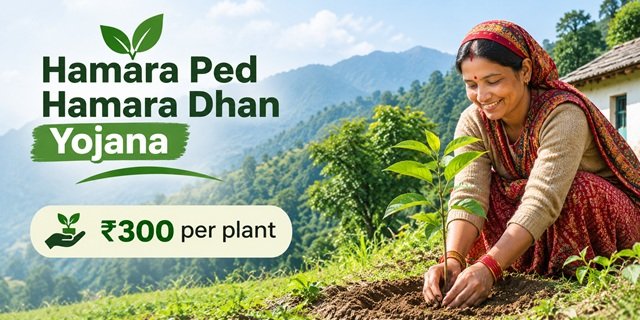
The Hamara Ped Hamara Dhan Yojana (हमारा पेड़ हमारा धन योजना) is an initiative of the Uttarakhand Government, implemented by the Forest Department. It provides an incentive of ₹300 for every eligible plant that a resident grows and protects on private land. The department prepares a Fixed Deposit Receipt (FDR) for each eligible plant in the name of the Divisional Forest Officer (DFO). Beneficiaries receive the eligible amount after three years, depending on the number of plants that survive. An individual or family can plant up to 100 plants per year.
Uttarakhand Hamara Ped Hamara Dhan Yojana Highlights | |
|---|---|
| Scheme Name | Hamara Ped Hamara Dhan Yojana (हमारा पेड़ हमारा धन योजना) |
| Launch Date | 22 September 2014 |
| Implementing Department | Forest Department, Government of Uttarakhand |
| Scheme Type | Financial incentive for planting and protecting trees on private land |
| Main Objective | To increase tree cover on private land, reduce dependence on natural forests and encourage environmental conservation through financial incentives |
| Incentive Amount | ₹300 for each eligible surviving plant |
| Payment Method | Fixed Deposit Receipt (FDR) of ₹300 per eligible plant, maintained in the name of the Divisional Forest Officer |
| Payment Period | After three years, subject to plantation inspection |
| Maximum Plantation Limit | Up to 100 plants per applicant or family in a year |
| Maximum Incentive | ₹30,000 for one year’s plantation, if all 100 plants survive |
| Eligibility | Uttarakhand residents who own private land or hold a share in jointly owned land |
| Minimum Land Requirement | No minimum land area prescribed |
| Eligible Tree Categories | Fuelwood, fodder, fruit-bearing and timber species |
| Source of Saplings | Forest Department nurseries, Horticulture Department nurseries and registered women’s or farmers’ nurseries |
| Plantation and Maintenance Expenses | To be borne by the applicant |
| Plantation Inspection | Joint inspection by the village head, Van Panchayat Sarpanch, Forest Range Officer and a Revenue Department representative |
| Documents Required | Identity proof, address proof, land ownership records, plantation details, agreement on ₹10 stamp paper and other supporting documents |
| Online Application | Apuni Sarkar e-Services Portal |
| Offline Application | Office of the concerned Divisional Forest Officer (DFO) |
| Application Status | Contact the concerned DFO office for the latest application status, deadline and applicable incentive rate |
| Contact Number | 0135-2741462 |
| Email Address | itgc-forest-uk@nic.in |
| Apuni Sarkar Helpline | 1905 (Press 4) |
| Official Websites | Uttarakhand Forest Department | Apuni Sarkar Portal |
Introduction of Uttarakhand Hamara Ped Hamara Dhan Yojana: A Brief Insight
In many hill villages of Uttarakhand, families spend hours collecting firewood and fodder from nearby forests. Growing these resources on their own land can save time and reduce pressure on natural forests. However, trees take years to grow, and families need an incentive to protect them during this period. The Hamara Ped Hamara Dhan Yojana addresses this need by rewarding families for planting and protecting trees on their private land.
Chief Minister Harish Rawat launched the scheme on 22 September 2014 and described it as his dream project. The name Hamara Ped Hamara Dhan means “Our Tree, Our Wealth”, highlighting the value of trees as a long-term asset for families.
The Uttarakhand Forest Department implements the scheme. The Divisional Forest Officer (DFO) of the concerned area handles applications and manages the financial incentive linked to the plantation.
The main objective is to increase tree cover on private land and reduce villagers’ dependence on natural forests for fuelwood, fodder and timber. The scheme also connects environmental protection with the economic interests of rural families.
Under the scheme, an eligible resident receives ₹300 for each plant that survives for three years. The Forest Department prepares a Fixed Deposit Receipt (FDR) of ₹300 for each eligible plant in the name of the Divisional Forest Officer. The beneficiary receives the eligible amount after three years, based on the number of surviving plants.
An individual or family can plant up to 100 plants in a year. If all 100 plants survive the three-year period, the beneficiary can receive a total incentive of ₹30,000.
To qualify, the applicant must be a resident of Uttarakhand and own private land or hold a share in jointly owned land. The scheme does not prescribe any minimum land area, so even a small plot or field boundary may qualify.
Beneficiaries can choose from fuelwood, fodder, fruit-bearing and timber species. They must purchase saplings at concessional rates from a Forest Department nursery, Horticulture Department nursery or registered women’s or farmers’ nursery. The applicant must arrange the plantation and protect the trees at their own expense.
After three years, a joint inspection team checks the plantation. The team includes the village head, Van Panchayat Sarpanch, Forest Range Officer and a representative of the Revenue Department. The final incentive depends on the number of healthy plants found during this inspection.
Applicants can submit their applications online through the Apuni Sarkar portal or offline at the office of the Divisional Forest Officer. They must also sign an agreement with the Forest Department on a ₹10 stamp paper, accepting responsibility for planting and protecting the trees.
For assistance, applicants can contact the Forest Department at 0135-2741462 or call the Apuni Sarkar helpline at 1905. Before applying, they should confirm the current scheme status, applicable incentive rate and application procedure with their area’s Divisional Forest Officer.
Farmers looking for additional yearly income support can explore the PM Kisan Samman Nidhi Yojana. Those seeking protection against crop losses can read about the PM Fasal Bima Yojana. Women’s groups interested in using drones for agricultural activities can also explore the NAMO Drone Didi Yojana.
Farmers, rural families and other readers interested in agriculture, forestry and rural development programmes can explore more schemes offered by the Uttarakhand Government on our Welfare Schemes of the Uttarakhand Government page.
Benefits Provided to Eligible Beneficiaries
Families in Uttarakhand often depend on nearby forests for firewood, fodder and timber. The Hamara Ped Hamara Dhan Yojana, launched by the Uttarakhand Forest Department, encourages them to grow useful trees on their own land instead. The department provides a financial incentive for every eligible plant that survives for three years. This way, families can earn from their plantation while helping protect natural forests.
Financial Incentive Under the Scheme
- ₹300 for each surviving plant that the applicant plants and protects on private land.
- The Forest Department prepares a Fixed Deposit Receipt (FDR) of ₹300 for every eligible plant.
- The FDR remains in the name of the Divisional Forest Officer (DFO) while the plants grow.
- After three years, the beneficiary receives the eligible amount based on the number of healthy plants found during inspection.
- An applicant or family can plant up to 100 plants in a year under the scheme.
How Much Money Can You Receive?
- If 10 plants survive, the incentive will be ₹3,000.
- If 25 plants survive, the incentive will be ₹7,500.
- If 50 plants survive, the incentive will be ₹15,000.
- If 75 plants survive, the incentive will be ₹22,500.
- If all 100 plants survive, the beneficiary can receive up to ₹30,000 for that year’s plantation.
- These are examples based on the ₹300 incentive per surviving plant. The actual payment depends on the final inspection report.
Support for Plantation Activities
- Concessional saplings: Applicants can purchase saplings at concessional rates from Forest Department nurseries, Horticulture Department nurseries or registered women’s and farmers’ nurseries.
- Technical guidance: The Forest Department provides technical assistance to help applicants with plantation activities.
- Choice of tree species: Applicants can select suitable fuelwood, fodder, fruit-bearing or timber species according to their land and requirements.
- No minimum land requirement: Even people with a small private plot or field boundary can participate, subject to the scheme conditions.
Long-Term Benefits for Families
- Fuelwood: Trees grown on private land can provide fuelwood for household use and reduce dependence on nearby forests.
- Fodder: Fodder trees can provide feed for cattle and other livestock close to home.
- Fruits: Fruit-bearing trees can provide food for the family and a possible source of additional income.
- Timber: Timber trees can become a long-term asset for the landowner.
- Environmental benefits: Trees provide shade, help protect soil on slopes and improve green cover around villages.
Benefits for Forest Conservation and Local Communities
- Reduced pressure on natural forests: Growing fuelwood, fodder and timber trees on private land can reduce the need to collect these resources from forests.
- More green cover: Plantation on private land can increase tree cover across Uttarakhand’s hills and plains.
- Financial incentive for conservation: Payment depends on plant survival, encouraging beneficiaries to protect and maintain their trees for three years.
- Community-based inspection: A joint team involving the village head, Van Panchayat Sarpanch, Forest Range Officer and Revenue Department representative checks the plantation after three years.
Important Points Beneficiaries Should Know
- The scheme provides a one-time incentive of ₹300 per surviving plant. It does not pay ₹300 every year.
- Applicants must bear the expenses of purchasing and transporting saplings, plantation and plant maintenance.
- Beneficiaries must sign an agreement on a ₹10 stamp paper and take responsibility for protecting the plants for three years.
- Applicants should confirm the latest incentive rate, approved nursery list and current scheme status with their area’s Divisional Forest Officer before applying.
Eligibility Conditions Required to be Fulfilled
The Hamara Ped Hamara Dhan Yojana is meant for Uttarakhand residents who own private land and are willing to plant and protect trees on it. Applicants must meet the land, plantation and maintenance conditions set by the Forest Department to receive financial assistance.
Who Can Apply
- Residents of Uttarakhand, whether they live in the hill districts or the plains.
- Individuals who own private land.
- People who hold land jointly as joint khatedars.
- An individual or a family. The scheme counts the family as one applicant for the annual plantation limit.
Land Conditions
- The applicant must own private land or hold a share in jointly owned land suitable for plantation.
- No minimum land area is prescribed, so a small plot or field boundary may also qualify.
- The applicant must plant trees on their own or jointly held land, not on forest land or public land.
Conditions for the Plants
- Applicants can plant approved species belonging to the fuelwood, fodder, fruit or timber categories.
- An individual or family can plant up to 100 saplings in a year.
- The planted trees must remain alive and healthy after three years to qualify for payment.
- The scheme provides ₹300 per surviving plant through a Fixed Deposit Receipt (FDR) maintained in the name of the Divisional Forest Officer (DFO).
Duties of the Applicant
- Purchase saplings at the concessional rate from an approved Forest Department nursery, Horticulture Department nursery or registered women’s or farmers’ nursery.
- Transport the saplings to the plantation site and plant them at your own expense.
- Take responsibility for watering, fencing and protecting the plants throughout the three-year period.
- Sign the required agreement on a ₹10 stamp paper with the Forest Department.
- Seek technical guidance from the Forest Department whenever required for plantation and tree care.
How the Forest Department Checks the Plants
- A joint inspection team checks the plantation after three years.
- The inspection team includes the village head, Sarpanch of the Van Panchayat, Forest Range Officer and a representative of the Revenue Department.
- The final payment depends on the number of healthy plants found during the inspection.
Who Is Not Eligible?
- People who are not residents of Uttarakhand.
- Applicants who neither own private land nor hold a share in jointly owned land.
- People who want to plant trees on forest land, public land or another person’s private land without having ownership rights.
- Applicants seeking assistance for more than 100 plants per year under the scheme limit.
- Applicants cannot claim payment for plants that do not survive the three-year period.
- People planting species outside the approved fuelwood, fodder, fruit and timber categories.
Confirm the Latest Conditions With the Forest Office
- Contact the Divisional Forest Officer (DFO) of your area to confirm whether applications are currently being accepted.
- Ask whether the department uses a lottery system if applications exceed the available budget.
- Confirm the latest sapling rates and obtain the list of approved nurseries in your area.
Documents Required to be Attached
The Hamara Ped Hamara Dhan Yojana (हमारा पेड़ हमारा धन योजना), run by the Uttarakhand Forest Department, provides financial incentives to people who plant and protect trees on their private land. Applicants must submit documents to establish their identity, Uttarakhand residence, land ownership and proposed plantation details.
The Forest Department has listed six categories of documents for the application. However, the Divisional Forest Officer (DFO) of your area may ask for additional papers, depending on your application. Therefore, check the required documents with the concerned forest office before submitting your application.
Identity and Residence Proof
- Identity proof: Aadhaar Card or another accepted identity document.
- Address proof: Permanent Residence Certificate of Uttarakhand or another accepted document showing residence in the State.
- Recent passport-size photograph of the applicant.
- Active mobile number of the applicant.
Land Ownership Documents
- Khatauni or Khasra copy showing ownership of the private land where you plan to plant trees.
- Land records showing the applicant as a joint khatedar, if the property has multiple owners.
- Consent from other joint landholders to carry out plantation activities on jointly owned land.
- Details of the proposed plantation plot, including the village name, plot number and land area.
Plantation Details
- Names of the proposed plant species, such as fuelwood, fodder, fruit-bearing or timber trees.
- Proposed number of saplings, subject to the limit of up to 100 plants per applicant or family in a year.
- Name of the nursery from which you plan to purchase saplings, such as a Forest Department nursery, Horticulture Department nursery or registered women’s or farmers’ nursery.
Contract Agreement
- Contract agreement prepared on a ₹10 stamp paper.
- Applicant’s signature on the agreement, confirming the responsibility to plant and protect the trees.
Other Supporting Documents
- Any additional documents required by the concerned Forest Department office.
- Photographs of the proposed plantation site, if requested by the department.
- Bank account details, including the account number and IFSC code, for receiving the payment after completion of the three-year period.
Documents to Preserve After Plantation
- Purchase bill or receipt for saplings bought at the concessional rate.
- Dated photographs showing the saplings planted on your land.
- Copies of the submitted application form and signed contract agreement for future reference and inspection after three years.
How Beneficiaries Can Apply to Avail the Benefit of this Scheme
You can apply for the Hamara Ped Hamara Dhan Yojana in two ways: online through the Uttarakhand Government’s Apuni Sarkar portal or offline by visiting the office of the Divisional Forest Officer (DFO) in your area.
In both methods, you need to provide your personal details, land ownership records and information about the trees you want to plant. You also have to sign an agreement on a ₹10 stamp paper with the Forest Department. After the department accepts your application, you must plant the saplings and protect them for three years to receive the financial incentive.
Before You Start
Step 1: Make sure you are a resident of Uttarakhand.
Step 2: Check that you own private land or hold a share in jointly owned land as a joint khatedar.
Step 3: Decide how many saplings you want to plant. You can plant up to 100 plants per year as an individual or family.
Step 4: Choose the type of trees you want to grow. The scheme covers fuelwood, fodder, fruit-bearing and timber species.
Step 5: Keep your identity proof, address proof, land ownership documents and passport-size photograph ready.
Apply Online Through the Apuni Sarkar Portal
Step 1: Open the Apuni Sarkar e-Services portal of Uttarakhand on your mobile phone or computer.
Step 2: Open the List of Services and look for the Hamara Ped Hamara Dhan Scheme.
Step 3: Select the scheme and click on Apply Now, if the application service is available.
Step 4: If you are a new user, click on New to Apuni Sarkar? Register Now to create your account.
Step 5: Enter your name, gender, email ID and mobile number in the registration form. Click on Submit to complete registration.
Step 6: Log in to the portal using your User ID, password and captcha code.
Step 7: Open the scheme application form and enter your personal details, including your name and residential address.
Step 8: Provide your land details, such as ownership information, plot number and land area.
Step 9: Enter the names and categories of the tree species you want to plant.
Step 10: Upload the required documents, including your photograph, Aadhaar card and Khasra or Khatauni copy.
Step 11: Upload a photograph of the proposed plantation site, if the application form asks for it.
Step 12: Check all the information and uploaded documents carefully before submitting the form.
Step 13: Click on Submit and save your application number or acknowledgement for future reference.
Step 14: If you do not have a smartphone or computer, visit a nearby Common Service Centre (CSC) or e-District Centre. The operator can help you access the online service, subject to its availability.
Apply Offline at the Divisional Forest Officer’s Office
Step 1: Find the office of the Divisional Forest Officer (DFO) responsible for your area.
Step 2: Visit the office with your identity proof, address proof, land records and other required documents. You can also check the Uttarakhand Forest Department website for information about the application form.
Step 3: Ask the office staff for the application form of the Hamara Ped Hamara Dhan Yojana. Confirm whether the form is available and whether any application fee applies.
Step 4: Enter your name, address and contact details in the application form.
Step 5: Fill in the details of your private land, including the owner’s name, plot number and total area.
Step 6: Mention the tree species and the number of saplings you plan to plant.
Step 7: Attach copies of your identity proof, address proof and land ownership documents. Include any other papers requested by the DFO office.
Step 8: Submit the completed application form to the concerned DFO office and collect an acknowledgement or receipt.
Step 9: Allow the Forest Department to check your documents and proposed plantation land, if required.
Step 10: Sign the required agreement on a ₹10 stamp paper when the department asks you to complete this step.
After Your Application Is Accepted
Step 1: Purchase saplings at the concessional rate from an approved Forest Department nursery, Horticulture Department nursery or registered women’s or farmers’ nursery.
Step 2: Collect and safely keep the purchase bill or receipt for the saplings.
Step 3: Transport the saplings to your private land at your own expense.
Step 4: If you are unsure about the correct planting method, ask the Forest Department for technical guidance.
Step 5: Plant the saplings on the land mentioned in your application and follow the instructions given by the department.
Step 6: Take dated photographs of the planted saplings and keep them safely for future reference.
Step 7: Confirm with the Forest Department that the ₹300 Fixed Deposit Receipt (FDR) for each eligible plant has been prepared in the name of the DFO, as required under the scheme.
Protect the Plants for Three Years
Step 1: Water the saplings when needed, especially during dry months. Arrange fencing or other protection to prevent cattle and animals from damaging them.
Step 2: Check the plants regularly and take proper care of them. If a sapling dies, ask the Forest Department whether you can replace it under the scheme rules.
Step 3: Continue protecting and maintaining the plantation throughout the complete three-year period.
Step 4: After three years, the department arranges a joint inspection involving the village head, Van Panchayat Sarpanch, Forest Range Officer and a Revenue Department representative.
Step 5: Show the inspection team your plantation. Keep your application copy, agreement, sapling purchase bills and dated photographs ready.
Step 6: After the inspection, the department determines the eligible amount according to the number of healthy plants. You can receive ₹300 for each eligible surviving plant, subject to verification and completion of the required formalities.
Where to Get Help With Your Application
Step 1: Contact the staff at your area’s Divisional Forest Officer (DFO) office for help with eligibility, documents, plantation and application status.
Step 2: If you face a problem with the Apuni Sarkar portal, call its helpline at 1905 and press 4, as mentioned for portal assistance.
Step 3: You can also approach your Van Panchayat Sarpanch or village head to find the concerned forest office and get local guidance.
Important: Do not pay unauthorised agents or middlemen to submit your application or arrange the incentive. Before starting, confirm with the DFO office whether the scheme is currently accepting applications, the applicable deadline, the latest sapling rates and the approved nursery list. Online service availability and application instructions should also be checked before proceeding.
Hamara Ped Hamara Dhan, Hamara School Hamara Vriksh and Mahila Nursery: Which Scheme Is for You?
The Uttarakhand Forest Department runs several plantation-related schemes for different groups of beneficiaries. Although their names are similar, each programme serves a different purpose. The comparison below will help you identify the scheme that matches your needs and approach the correct office.
| Point | Hamara Ped Hamara Dhan | Hamara School Hamara Vriksh | Mahila Nursery |
|---|---|---|---|
| Who Is It For? | Uttarakhand residents who own private land | Government and non-government schools | Women interested in raising and supplying saplings through nurseries |
| Main Purpose | Provides a financial incentive for planting and protecting trees on private land | Encourages schools to plant trees on their campuses | Promotes women-managed nurseries and increases the availability of saplings |
| Who Can Apply? | Private landowners and joint khatedars | School principal or authorised school manager | Eligible women or women’s groups operating or planning to establish a nursery |
| Where to Apply? | Apuni Sarkar portal or the concerned Divisional Forest Officer (DFO) office | Concerned DFO office through the prescribed form available from the Forest Range Officer’s office | Contact the concerned DFO office for application details |
| How Are the Schemes Connected? | Beneficiaries can purchase saplings from registered women’s nurseries | Saplings are supplied through the Forest Department | Registered nurseries can supply saplings to beneficiaries under Hamara Ped Hamara Dhan |
Which scheme should you choose? If you own private land and want to earn an incentive by planting and protecting trees, consider Hamara Ped Hamara Dhan Yojana. If you represent a school and want to develop a plantation on its campus, look at Hamara School Hamara Vriksh. Women interested in raising and supplying saplings can enquire about the Mahila Nursery programme.
Important Links Available of the Scheme
- Apuni Sarkar Portal
- Uttarakhand Forest Department
- Hamara Ped Hamara Dhan Yojana: Official FAQs and Scheme Details
- Apuni Sarkar: Information Technology Development Agency
- Apuni Sarkar e-Services Information
- Uttarakhand Government Official Portal
Contact Details in Case of Help Needed
- Department: Uttarakhand Forest Department, Office of the Principal Chief Conservator of Forests (Head of Forest Force), 85, Rajpur Road, Dehradun, Uttarakhand
- Phone: 0135-2741462
- Email: itgc-forest-uk@nic.in
- Apuni Sarkar Helpline: 1905, and press 4
- Apuni Sarkar Helpdesk Email: e-helpdesk@uk.gov.in
- Local Office: The Divisional Forest Officer of your area, who takes the application and looks after the scheme in your division
- Village Level: The village head and the Sarpanch of your Van Panchayat, who can guide you and who take part in the inspection
Frequently Asked Questions (FAQs)
Ans. The Hamara Ped Hamara Dhan Yojana is an initiative of the Uttarakhand Forest Department that encourages residents to grow trees on their private land. Beneficiaries can receive ₹300 for each eligible plant that survives for three years.
Ans. The Forest Department, Government of Uttarakhand, implements the scheme. Visit its official website for information and updates.
Ans. The Forest Department prepares a Fixed Deposit Receipt (FDR) of ₹300 for each eligible plant in the name of the Divisional Forest Officer (DFO). The beneficiary receives the eligible amount after three years, subject to the plantation inspection.
Ans. An individual or family can plant up to 100 saplings in a year under the scheme.
Ans. A beneficiary can receive up to ₹30,000 if all 100 plants survive for three years. For example, 50 surviving plants qualify for ₹15,000, while 25 surviving plants qualify for ₹7,500.
Ans. No. The scheme provides a one-time incentive of ₹300 per eligible plant after the three-year period and successful inspection. It is not an annual payment.
Ans. A resident of Uttarakhand who owns private land or holds a share in jointly owned land as a joint khatedar can apply, subject to the scheme conditions.
Ans. The scheme prescribes no minimum land area. Even a small private plot or field boundary may qualify for plantation, subject to the other eligibility conditions.
Ans. Applicants can plant approved tree species belonging to four categories: fuelwood, fodder, fruit-bearing and timber species.
Ans. You can apply online through the Apuni Sarkar e-Services portal, if the scheme’s online application service is available. You can also contact the Divisional Forest Officer (DFO) of your area to enquire about the offline application process.
Ans. Applicants generally need identity proof, Uttarakhand residence proof, land ownership records, plantation details and a recent photograph. They must also complete the required agreement on a ₹10 stamp paper and provide any additional documents requested by the Forest Department.
Ans. The agreement records the applicant’s responsibility to plant and protect the trees for the required three-year period. It serves as an undertaking between the applicant and the Forest Department.
Ans. You can purchase saplings at concessional rates from a Forest Department nursery, Horticulture Department nursery or registered women’s or farmers’ nursery. You must pay for the saplings and arrange their transportation to your plantation site.
Ans. A joint inspection team checks the plantation after three years. The team includes the village head, Van Panchayat Sarpanch, Forest Range Officer and a representative of the Revenue Department. The final incentive depends on the number of healthy plants found during the inspection.
Ans. Contact the Divisional Forest Officer (DFO) of your area to confirm the current application status, deadline and applicable incentive rate. You can also call the Apuni Sarkar helpline at 1905 and press 4, or contact the Forest Department at 0135-2741462.

Tabassum is a government schemes researcher and writer with 5 years of experience tracking Central and State welfare scheme programmes across India. She has covered 500+ schemes spanning agriculture, women welfare, education, and housing, helping lakhs of beneficiaries understand their entitlements in simple language.