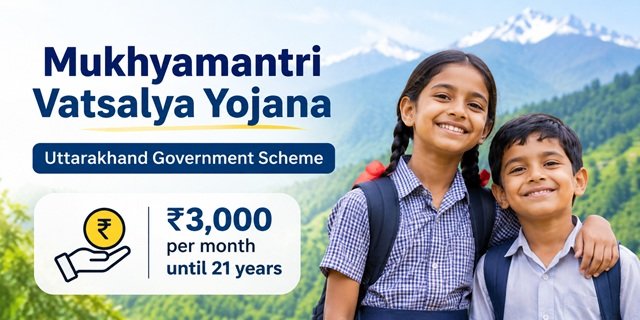
The Mukhyamantri Vatsalya Yojana is a welfare scheme of the Government of Uttarakhand, implemented by the Women Empowerment and Child Development Department. It provides ₹3,000 per month to eligible children up to the age of 21 years who lost a parent, guardian or the family’s earning member due to COVID-19 or another illness between 1 March 2020 and 31 March 2022. The parent or guardian must submit the prescribed application form offline through the District Child Protection Unit or the concerned district office.
Uttarakhand Mukhyamantri Vatsalya Yojana Highlights | |
|---|---|
| Scheme Name | Mukhyamantri Vatsalya Yojana |
| Announced | 22 May 2021, by Chief Minister Tirath Singh Rawat |
| Launched | 2 August 2021, by Chief Minister Pushkar Singh Dhami |
| Departmental Order Date | 11 June 2021 |
| Implementing Department | Women Empowerment and Child Development Department, Government of Uttarakhand |
| Scheme Type | Monthly financial assistance and child protection scheme |
| Objective | To support children’s care, rehabilitation and protection, while safeguarding their property, inheritance and legal rights |
| Monthly Financial Assistance | ₹3,000 per child (₹36,000 per year) |
| Assistance Period | Until the beneficiary turns 21 years old |
| Payment Method | Direct Benefit Transfer (DBT) to the bank account held jointly by the child and the mother, father or guardian |
| Eligible Death Period | 1 March 2020 to 31 March 2022 |
| Covered Cause of Death | COVID-19 or another illness |
| Eligible Beneficiaries | Children who are permanent or original residents of Uttarakhand and meet the prescribed conditions |
| Ineligible Beneficiaries | Children whose surviving parent is in government service, receives a pension or falls within the income tax limit |
| Other Support Announced | Education and healthcare facilities, skill development and 5% horizontal reservation in Uttarakhand government jobs for orphan children |
| Application Mode | Offline, through the District Child Protection Unit or the concerned district office |
| Initial Disbursement | 1,062 children received assistance for July 2021 on the scheme’s launch day |
| September 2025 Disbursement | 5,211 beneficiaries received ₹1,56,33,000 through DBT |
| Assistance from April to June 2026 | Approximately 4,812 to 4,848 children received assistance, with around ₹4.39 crore released |
| Child Helpline | 1098 |
| Official Website | wecd.uk.gov.in |
Introduction of Uttarakhand Mukhyamantri Vatsalya Yojana: A Brief Insight
When a child loses a parent or the family’s earning member, the family may struggle to manage the child’s education, food and daily needs. To support such children, the Government of Uttarakhand introduced the Mukhyamantri Vatsalya Yojana, which provides monthly financial assistance and focuses on their care and protection.
Chief Minister Tirath Singh Rawat announced the scheme on 22 May 2021, during the COVID-19 pandemic. Chief Minister Pushkar Singh Dhami formally launched it on 2 August 2021, following the order issued by the Women Empowerment and Child Development Department on 11 June 2021.
The Women Empowerment and Child Development Department, Uttarakhand implements the scheme. District Child Protection Units and concerned district offices manage its implementation at the district level.
The scheme aims to support, rehabilitate and protect children up to 21 years of age who lost a parent, guardian or the family’s earning member. It also seeks to safeguard their property, inheritance and legal rights.
Under the scheme, each eligible child receives ₹3,000 per month, amounting to ₹36,000 per year, until they turn 21 years old. The Government transfers the assistance directly to the beneficiary’s bank account through Direct Benefit Transfer (DBT).
The scheme also focuses on children’s education, healthcare and skill development. The Government further announced a 5% horizontal reservation in Uttarakhand government jobs for orphan children. In September 2025, a total of 5,211 beneficiaries received financial assistance worth ₹1,56,33,000 at an official event.
To qualify, the child must be a permanent or original resident of Uttarakhand. The parent, guardian or earning family member must have died due to COVID-19 or another illness between 1 March 2020 and 31 March 2022. Children whose surviving parent is in government service, receives a pension or falls within the income tax limit are not eligible.
The prescribed application form requires details and supporting documents such as the child’s birth certificate, permanent residence certificate, death certificate, Aadhaar details, bank account information and property records. The parent or guardian must collect the form from the District Child Protection Unit or the concerned district office, complete it and submit it offline.
Since the scheme covers deaths that occurred within a specified period, applicants should contact the District Probation Officer to confirm whether their case qualifies and whether the district office is accepting applications. For urgent child protection assistance, they can also call Child Helpline 1098.
Families looking for other welfare programmes can also explore the Mukhyamantri Mahila Poshan Yojana and the Mukhyamantri Bal Poshan Yojana. New mothers may find the Mukhyamantri Mahalaxmi Kit Yojana useful, while students seeking financial support for higher education can read about the PM Vidyalaxmi Scheme.
To explore more child welfare, education and social security programmes, visit our dedicated page on Uttarakhand Government Welfare Schemes.
Benefits Provided to Eligible Beneficiaries
When a child loses a parent or the family’s earning member, managing food, education and everyday expenses becomes difficult. The Mukhyamantri Vatsalya Yojana of the Government of Uttarakhand provides monthly financial assistance to eligible children up to the age of 21. Along with financial support, the scheme also focuses on their protection, education, health and future well-being.
Monthly Financial Assistance
- Each eligible child receives ₹3,000 per month, amounting to ₹36,000 annually.
- The financial assistance is applicable from 1 July 2021 for children covered under the scheme.
- The monthly support continues until the beneficiary turns 21 years old, subject to the scheme conditions.
- The amount is transferred to the bank account held by the child jointly with the mother, father or guardian, as recorded in the application.
- The Government releases the assistance through Direct Benefit Transfer (DBT).
- The Chief Minister described this financial support as a maintenance allowance to help with the child’s care and upbringing.
Care, Protection and Property Rights
- The scheme focuses on the care, rehabilitation and protection of children from birth to 21 years who have lost a parent or guardian.
- It also emphasises safeguarding the child’s movable and immovable property, inheritance and legal rights, as announced by the Chief Minister.
- The application form records details of land, houses and other assets belonging to the child or parents to help the administration identify and protect the child’s property interests.
- The District Child Protection Unit and the concerned district administration oversee the implementation and related support activities.
Support for Education, Health and Skill Development
- Beneficiary children are intended to receive support for their education and healthcare in addition to the monthly allowance.
- The Government has also highlighted skill development as an important part of the scheme’s support for children’s future.
- The application form collects the child’s current class and school details, allowing the district authorities to keep track of their educational status.
Reservation in Government Jobs
- The Government announced a 5% horizontal reservation in Uttarakhand government jobs for orphan children covered under the scheme. At the time of its announcement, Uttarakhand was described as the first state to introduce such a reservation.
Number of Beneficiaries and Financial Assistance Released
- 1,062 children received the first instalment of assistance for July 2021 on the scheme’s launch day.
- In September 2025, 5,211 beneficiaries received a total of ₹1,56,33,000 through Direct Benefit Transfer during an event organised under Rashtriya Poshan Maah.
- During April to June 2026, approximately 4,812 to 4,848 children received assistance, with around ₹4.39 crore released for the quarter.
Eligibility Conditions Required to be Fulfilled
The Mukhyamantri Vatsalya Yojana of the Government of Uttarakhand supports children who lost a parent, guardian or earning family member during a specified period. The eligibility conditions below are based on the application form and the order dated 11 June 2021 issued by the Women Empowerment and Child Development Department. Check these requirements carefully before submitting an application.
Basic Eligibility
- The child must be a permanent or original resident of Uttarakhand.
- The child must be between birth and 21 years of age.
- The parent, guardian or earning family member must have died between 1 March 2020 and 31 March 2022.
- The death must have occurred due to COVID-19 or another illness.
- The child must have lost parental or guardian support, or the family’s earning member during the specified period.
Which Children Are Covered?
- Children who lost both parents during the specified period.
- Children whose one parent had already died and whose surviving parent passed away during the covered period.
- Children who lost their sole earning parent during the specified period.
- Children living under a guardian’s care after losing both parents, where the guardian also died during the covered period.
- Children with disabilities can also be covered, subject to the scheme’s other eligibility conditions.
Conditions That May Make a Child Ineligible
- If one parent is alive and that parent works in government service, the child is not eligible under the conditions stated in the application form.
- The child is not eligible if the surviving parent receives an old-age pension or family pension.
- The child is also excluded if the family falls within the income tax limit.
Family Details Considered During Verification
The application form also collects information about the family’s financial and living conditions. Applicants may need to provide the following details:
- Occupation and annual income of both parents from all sources.
- Details of the parents’ movable and immovable property, including land, houses, shops, vehicles and bank accounts.
- Information about the person currently caring for the child.
- Guardian’s personal and residential details, if both parents have died.
Who Is Not Eligible?
- Children whose parent or guardian died before 1 March 2020 or after 31 March 2022, unless their case falls under another category covered by the scheme.
- Children who are not permanent or original residents of Uttarakhand.
- Individuals who are above 21 years of age.
- Children whose surviving parent is employed in government service, receives an old-age or family pension, or falls within the income tax limit.
- Children already receiving similar assistance under another scheme should confirm their eligibility and the applicable benefit rules with the district office before applying. In particular, they should clarify whether assistance under Mission Vatsalya affects their eligibility for this scheme.
Documents Required to be Attached
The Mukhyamantri Vatsalya Yojana of the Government of Uttarakhand provides financial support to children who have lost their parents or guardian due to COVID-19 or other illnesses. Applicants need to provide documents that establish the child’s identity, the parents’ death details, the guardian’s information and the bank account for receiving assistance.
The application form was issued along with the order dated 11 June 2021 by the Women Empowerment and Child Development Department. Keep the required documents ready before applying. You should also confirm the latest document checklist with your District Child Protection Unit or the concerned district office.
Documents of the Child
- Birth certificate or another valid document showing the child’s age
- Uttarakhand permanent residence certificate
- Aadhaar Card of the child, if available
- Current residential address and mobile number of the guardian
- Religion and caste details, as required in the application form
- Educational details, including the current class and name of the school or college
- Disability certificate, if applicable
Documents of the Father
- Death certificate mentioning the date of death
- Details of the cause of death
- Aadhaar Card, if available
- Occupation details and annual income from all sources
- Date of birth or age details
Documents of the Mother
- Death certificate mentioning the date of death, if the mother has passed away
- Details of the cause of death
- Aadhaar Card of the mother
- Occupation and annual income details from all sources
- Date of birth or age details
- Permanent residence proof of the surviving parent, if one parent is alive
Documents of the Guardian, if Both Parents Have Died
- Name of the guardian and relationship with the child
- Age and gender of the guardian
- Aadhaar Card of the guardian
- Occupation details
- Residential address, mobile number and permanent residence certificate
- Death certificate of the previous guardian, if applicable
Bank Account Details
- Account number of the nationalised bank account held by the child jointly with the mother, father or guardian
- Name of the bank and its IFSC code
- Address of the bank branch
- Copy of the first page of the bank passbook
Property Details
- Details of the parents’ immovable property, such as agricultural land, a house or a shop, including its area, location and owner’s name
- Relationship of the property owner with the child
- Details of movable assets, such as vehicles and bank accounts, along with their estimated value and owner’s name
Declarations and Other Required Papers
- Declaration confirming that the surviving parent or guardian is not employed in government service, does not receive an old-age pension or family pension, and does not fall within the income tax limit
- Declaration stating that the child is not receiving assistance under another similar scheme
- Completed and signed application form containing the applicant’s name, address, mobile number and date
How Beneficiaries Can Apply to Avail the Benefit of this Scheme
Eligible children can apply for the Mukhyamantri Vatsalya Yojana through the concerned district office. The application process is offline, which means the child’s parent or guardian must collect a form, fill it in, attach the required documents and submit it to the district authorities. The officials verify the details before processing the financial assistance.
Before starting, check whether the child’s case falls within the period covered by the scheme. Follow the steps below to understand the complete application process.
Before You Start
Step 1: First, confirm that your child is a permanent or original resident of Uttarakhand.
Step 2: Check that the child is below 21 years of age.
Step 3: Look at the date mentioned on the death certificate. The death of the parent or guardian must have occurred between 1 March 2020 and 31 March 2022.
Step 4: Check the status of the surviving parent or guardian. If the living parent works in government service, receives a pension or falls within the income tax limit, the child may not qualify under the conditions stated in the application form.
Step 5: Visit the official website of the Women Empowerment and Child Development Department, Uttarakhand to read the available scheme information.
Step 6: Keep in mind that the scheme provides ₹3,000 per month to each eligible child until the age of 21, subject to the applicable conditions.
Collect the Papers
Step 1: Keep the child’s birth certificate ready. If it is unavailable, arrange another valid document that confirms the child’s age.
Step 2: Arrange the child’s permanent residence certificate issued for Uttarakhand.
Step 3: Keep the death certificate of the deceased parent or guardian. Check that the date of death is clearly visible.
Step 4: Arrange the Aadhaar cards of the child, parents and guardian, wherever available.
Step 5: Keep a copy of the first page of the bank passbook for the account held by the child jointly with the parent or guardian.
Step 6: Collect information about the land, house and other property left by the parents. You may need these details while filling in the application form.
Go to the District Office
Step 1: Visit the District Child Protection Unit (DCPU) in your district.
Step 2: Ask to meet the District Probation Officer. If you cannot locate the unit, seek help from the concerned district administration.
Step 3: Tell the official that you want to apply for the Mukhyamantri Vatsalya Yojana.
Step 4: Before collecting the form, ask whether the district office is currently accepting applications. The scheme covers deaths that occurred between March 2020 and March 2022, so confirm whether your case can still be considered.
Step 5: Collect the application form and ask the official for the latest document checklist applicable to your case.
Fill In the Application Form
Step 1: Enter the child’s name, date of birth, religion and caste in the prescribed fields.
Step 2: Provide the child’s Aadhaar number, permanent address and current residential address, wherever applicable.
Step 3: Mention the child’s current class and the name of the school or college.
Step 4: Provide the child’s health and disability details, if applicable.
Step 5: Fill in the details of the father and mother, including their dates and causes of death, occupations and annual income.
Step 6: Mention who currently takes care of the child. If both parents have died, provide the required details of the guardian.
Step 7: Enter the bank account number, bank name, IFSC code and branch address carefully.
Step 8: Provide the details of the parents’ land, house and other movable or immovable property, as requested in the form.
Step 9: At the end, enter the applicant’s name, address, mobile number and date, and sign the form wherever required.
Attach the Papers and Submit
Step 1: Attach copies of all the required documents to the completed application form. Arrange them in the order requested by the district office.
Step 2: Check each document carefully. Make sure the copies are clear and the dates and other details match the information entered in the form.
Step 3: Submit the application and supporting documents to the concerned district official.
Step 4: Ask for a submission receipt or a stamped copy of the application. Keep it safely so you can refer to it later.
After You Submit Form
Step 1: The district authorities will examine your application and verify the documents. Wait for the verification process to move forward.
Step 2: If an official asks for additional information or documents, provide them as soon as possible. Cooperate if the authorities need to meet the child or guardian for verification.
Step 3: Visit the concerned district office from time to time to check the progress of your application.
Step 4: Once the application is approved and the payment is processed, check the bank account for the monthly assistance of ₹3,000 through Direct Benefit Transfer.
Step 5: Keep the bank account active and inform the concerned office if any bank details change, so that future payments do not face problems.
If You Need Help
Step 1: Contact the District Probation Officer in your district for guidance about the application and document verification.
Step 2: If you need further assistance, approach the concerned district administration.
Step 3: If a child needs immediate care or protection, call 1098, the Child Helpline.
Important: Do not pay any broker or middleman to fill in the application or arrange the financial assistance. Submit your application directly through the concerned government office and keep the submission receipt safely.
Mukhyamantri Vatsalya Yojana and Mission Vatsalya: Which One Is for You
Mukhyamantri Vatsalya Yojana and Mission Vatsalya have similar names, but they serve different purposes. The Uttarakhand Government introduced the first scheme to support children affected by the death of a parent, guardian or earning family member during a specified period. Mission Vatsalya is a Central Government initiative that provides care and protection to children in need.
The following table highlights the key differences between the two schemes and helps families identify the appropriate programme.
| Point | Mukhyamantri Vatsalya Yojana | Mission Vatsalya |
|---|---|---|
| Implemented By | Government of Uttarakhand | Ministry of Women and Child Development, Government of India |
| Implementing Authority | Women Empowerment and Child Development Department, Uttarakhand | Central Government in coordination with State Governments and district child protection authorities |
| Main Objective | To provide financial assistance, care and protection to children who lost a parent, guardian or the family’s earning member | To provide care, protection, rehabilitation and support to children in need through services such as child care institutions, sponsorship, foster care and adoption |
| Eligible Children | Children whose parent, guardian or earning family member died due to COVID-19 or another illness between 1 March 2020 and 31 March 2022, subject to the scheme’s conditions | Children who need care and protection under the applicable provisions, without a fixed death-period requirement |
| Nature of Assistance | ₹3,000 per month until the beneficiary turns 21, along with measures to protect the child’s property and legal rights | Child care and protection services, with support determined according to the child’s circumstances and applicable provisions |
| Where to Approach | District Child Protection Unit or the concerned district office | District Child Protection Unit or Child Welfare Committee, as applicable |
If you are unsure which programme applies to your child’s circumstances, contact the District Probation Officer or District Child Protection Unit. The officials can explain the applicable conditions and clarify whether the child can receive support under both schemes.
Important Links Available of the Scheme
- Women Empowerment and Child Development Department, Uttarakhand: Official Website and Government Schemes
- Introduction to the Women Empowerment and Child Development Department, Uttarakhand
- Contact Details of the Women Empowerment and Child Development Department, Uttarakhand
- Uttarakhand Women Empowerment and Child Development Department: Official Contact Directory
- Government of Uttarakhand: Official State Portal
- Mission Vatsalya: Child Protection Scheme of the Government of India
- Ministry of Women and Child Development, Government of India Official Website
Contact Details in Case of Help Needed
- Directorate: Directorate of Women Empowerment and Child Development, Government of Uttarakhand, Nanda Ki Chowki, P.O. Suddhowala, Dehradun – 248007
- Email: dir.icds.ua@gmail.com
- District Level: The District Probation Officer or the District Child Protection Unit in the office of your district, who takes the application and looks after the child
- District Administration: The office of the District Magistrate of your district, which checks the applications in the district
- Block Level: The Child Development Project Officer of your block and the Anganwadi worker of your village, who can guide you to the district office
- Emergency Help for a Child: Childline 1098, the national helpline for a child who needs urgent care
Frequently Asked Questions (FAQs)
Ans. The Mukhyamantri Vatsalya Yojana is a welfare scheme of the Government of Uttarakhand that provides a monthly allowance to eligible children up to 21 years of age who lost a parent, guardian or the family’s earning member due to COVID-19 or another illness during the specified period.
Ans. Former Chief Minister Tirath Singh Rawat announced the scheme on 22 May 2021. Chief Minister Pushkar Singh Dhami formally launched it on 2 August 2021.
Ans. The Women Empowerment and Child Development Department, Government of Uttarakhand, implements the scheme. Visit its official website for departmental information.
Ans. Each eligible child receives ₹3,000 per month, which amounts to ₹36,000 in a year.
Ans. The monthly assistance continues until the beneficiary turns 21 years old, subject to the scheme’s applicable conditions.
Ans. The Government transfers the assistance through Direct Benefit Transfer (DBT) to the bank account held by the child jointly with the mother, father or guardian.
Ans. A child from birth to 21 years of age who is a permanent or original resident of Uttarakhand can qualify if their parent, guardian or earning family member died due to COVID-19 or another illness between 1 March 2020 and 31 March 2022, subject to the other eligibility conditions.
Ans. Yes. The scheme also covers children whose one parent had already died and whose surviving parent passed away during the specified period. It includes cases where the sole earning parent or eligible guardian died during the covered period.
Ans. Children may not qualify if their surviving parent works in government service, receives an old-age or family pension, or falls within the income tax limit. Children who are not permanent or original residents of Uttarakhand are also excluded.
Ans. The order dated 11 June 2021 specifies the covered period as 1 March 2020 to 31 March 2022. If the death occurred after this period, contact the District Probation Officer to check whether any other provision applies and whether the district office is accepting applications.
Ans. The application process is offline. Collect the prescribed form from the District Child Protection Unit or the concerned district office. Fill in the child’s, parents’ and guardian’s details, attach the required documents and submit the application for verification.
Ans. Applicants generally need the child’s birth certificate, Uttarakhand permanent residence certificate, death certificate of the deceased parent or guardian, available Aadhaar cards, bank passbook details and information about the family’s property. The district office may provide an additional checklist.
Ans. The Government announced a 5% horizontal reservation in Uttarakhand government jobs for orphan children at the time of the scheme’s launch.
Ans. Yes. The Government announced provisions to safeguard the child’s movable and immovable property, inheritance and legal rights. The application form also collects details of the property left by the parents.
Ans. According to the figures provided, 1,062 children received the first payment in 2021. In September 2025, 5,211 beneficiaries received ₹1,56,33,000 through DBT. During April to June 2026, approximately 4,812 to 4,848 children received assistance.
Ans. No. Mukhyamantri Vatsalya Yojana is a scheme of the Uttarakhand Government, whereas Mission Vatsalya is a separate child protection initiative of the Central Government. Visit the official Mission Vatsalya portal to learn more about the Central scheme.

Tabassum is a government schemes researcher and writer with 5 years of experience tracking Central and State welfare scheme programmes across India. She has covered 500+ schemes spanning agriculture, women welfare, education, and housing, helping lakhs of beneficiaries understand their entitlements in simple language.