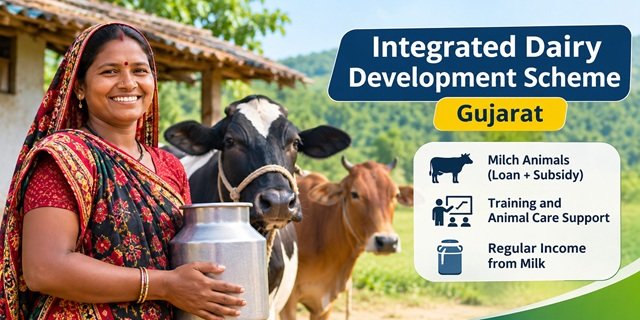
The Integrated Dairy Development Scheme, also known as the Integrated Dairy Development Project, has been implemented by the Tribal Development Department, Government of Gujarat, since 2007-08. It supports poor Scheduled Tribe families by providing milch animals through loan and subsidy assistance. Under the State’s announced structure for 2026-27, each animal unit costs ₹90,000, of which the beneficiary contributes ₹3,000. A woman can become eligible for the second animal after repaying more than 60% of the loan on time.
Gujarat Integrated Dairy Development Scheme Highlights | |
|---|---|
| Scheme Name | Integrated Dairy Development Scheme (Integrated Dairy Development Project) |
| Launch Year | 2007-08 |
| Implementing Department | Tribal Development Department, Government of Gujarat |
| Sponsored By | National Scheduled Tribes Finance and Development Corporation, New Delhi |
| Loan Provider | Gujarat Tribal Development Corporation |
| Implementation Support | District cooperative milk producers’ unions, with recommendations from the Project Administrator |
| Scheme Type | Loan and subsidy assistance for milch animals to poor tribal families |
| Objective | To promote dairy farming as a regular source of income and encourage at least four animals in each household |
| Eligible Beneficiaries | Scheduled Tribe members from BPL families who belong to a Milk Producer Cooperative Society |
| Women and BPL Score | Tribal women with a BPL score of 0 to 20, as mentioned in the State’s statement dated 27 October 2026 |
| Area of Coverage | Tribal districts of Gujarat, identified by the State as 14 districts, within the specified milk union clusters |
| Milk Unions Covered | Panchmahal, Baroda, Banas, Sabar, Dudhdhara, Sumul and Vansda Vasudhara |
| Earlier Investment per Beneficiary | Approximately ₹80,000 to ₹84,000 |
| Corporation Loan | ₹20,000 per unit at an annual interest rate of 6% |
| Loan Repayment | 30 equal monthly instalments, starting 3 months after loan disbursement |
| Financial Structure for 2026-27 | ₹90,000 per unit, comprising a ₹29,000 loan, ₹29,000 Central subsidy, ₹29,000 State grant and ₹3,000 beneficiary contribution |
| Expenses Covered | Milch animal purchase, insurance, transportation, cattle feed, veterinary treatment and training |
| Number of Animals | Two milch animals per beneficiary, with the second animal subject to repayment of more than 60% of the loan on time |
| Budget for 2026-27 | ₹65 crore for 11,206 tribal women |
| Reported Results | Approximately 1,42,250 cattle provided to Scheduled Tribe families; reported monthly earnings of ₹3,500 to ₹4,000 |
| Application Mode | Proposal through the district milk union or online application through the D-SAG Sahay portal |
| Documents Required | ST caste certificate, BPL card, ration card, bank details, age proof, photograph, mobile number and milk society membership proof |
| Contact Numbers | (079) 23253891, (079) 23253893 |
| Email Address | ed-gtdc@gujarat.gov.in |
| Official Scheme Pages | Tribal Development Department and Gujarat Tribal Development Corporation |
Introduction of Gujarat Integrated Dairy Development Scheme: A Brief Insight
In many tribal villages of Gujarat, families depend on one milch animal or have no animal at all. The limited milk production often fails to meet their household needs or provide a regular income. Without enough animals, proper training and a reliable market for milk, dairy farming remains a small activity. The Integrated Dairy Development Scheme, also known as the Integrated Dairy Development Project, aims to change this by helping tribal families build a regular source of income through dairy farming.
The Tribal Development Department of Gujarat launched the scheme in 2007-08. The National Scheduled Tribes Finance and Development Corporation sponsors the project, while the Gujarat Tribal Development Corporation provides the loan assistance.
The Tribal Development Department, Government of Gujarat, implements the scheme with the support of district cooperative milk unions. The Project Administrator in each tribal district reviews and recommends the proposals received for assistance.
The scheme aims to develop dairy farming into a regular income-generating activity for poor tribal households. It works towards providing at least four milch animals to each household. The project provides two animals, while the family is encouraged to rear two additional animals through better cattle care and management.
Eligible beneficiaries receive milch animals through a combination of loan assistance and subsidies. The Corporation’s earlier loan structure mentions a loan of ₹20,000 at 6% annual interest. Beneficiaries repay this amount in 30 monthly instalments, starting three months after receiving the loan.
For 2026-27, the State has announced a different financial structure, fixing the cost of an animal unit at ₹90,000. This includes a ₹29,000 loan, a ₹29,000 Central subsidy, a ₹29,000 State grant and a ₹3,000 contribution from the beneficiary. The unit cost also covers animal insurance, cattle feed, transportation, veterinary treatment and training.
The scheme also provides an opportunity to receive a second milch animal. A woman can become eligible for it after repaying more than 60% of the loan on time from the income earned through the first animal. The Department reports monthly earnings of around ₹3,500 to ₹4,000 from dairy activities. It also reports that approximately 1,42,250 cattle have been provided to tribal families.
To qualify, an applicant must belong to a Scheduled Tribe, come from a Below Poverty Line (BPL) family and hold membership in the village Milk Producer Cooperative Society. The State’s latest statement specifically mentions tribal women with a BPL score of 0 to 20. The scheme operates across the 14 tribal districts of Gujarat, subject to the specified milk union and cluster coverage.
Applicants can approach their district milk union to get their proposal prepared and recommended by the Project Administrator. The State also provides an online application facility through the D-SAG Sahay portal, with assistance available from the local Tribal Development Office. For further information, beneficiaries can contact the Gujarat Tribal Development Corporation in Gandhinagar at (079) 23253891.
Dairy farmers who want insurance protection for their animals can also explore the Rashtriya Pashudhan Bima Yojana. Those who need credit for cattle feed and other farming expenses can check the Kisan Credit Card Scheme. Farmers can also explore income support under the PM Kisan Samman Nidhi Yojana (PM-KISAN) and crop insurance coverage under the Pradhan Mantri Fasal Bima Yojana (PMFBY).
Tribal families, women, dairy farmers and other eligible residents can explore more agriculture, animal husbandry and welfare programmes on our Gujarat Government Popular and Welfare Schemes List page.
Latest Update on Integrated Dairy Development Scheme
- 27 October 2026: The Gujarat Government released the latest scheme figures under the leadership of Chief Minister Bhupendra Patel and Tribal Development Minister Naresh Patel.
- Increase in Beneficiaries: The scheme supported 6,860 women in 2023-24 with an expenditure of ₹30.87 crore. For 2026-27, the State has set a target of assisting 11,206 women.
- Online Application Facility: The State has announced that eligible tribal women can apply online through the D-SAG Sahay portal with assistance from their local Tribal Development Office.
- Earlier Loan Details: The Department and Corporation websites still mention the earlier loan amount of ₹20,000. Applicants should confirm the latest loan and subsidy structure with their district office before applying.
- Keep Documents Ready: Applicants should keep their ST caste certificate, BPL card and milk society membership proof ready. They can also contact their village milk society secretary to ask about the next application round.
Benefits Provided to Eligible Beneficiaries
Tribal women from poor families often struggle to earn a regular income when they have little or no access to dairy animals. The Integrated Dairy Development Scheme (Integrated Dairy Development Project) of Gujarat’s Tribal Development Department helps them start or expand dairy activities by providing two milch animals through financial assistance. It also supports animal care, dairy management and milk marketing through village cooperative societies.
What the Project Gives (Official Pages)
- Milch animals through a combination of a loan and subsidy
- Financial assistance worth approximately ₹80,000 to ₹84,000 per beneficiary
- Two animals supplied under the project, with a target of building a four-animal dairy unit in each household through improved care and rearing
- Animal healthcare and support services to maintain the health of the cattle
- Financial assistance for clean milk production to help beneficiaries earn a better price for their milk
- Training in scientific cattle rearing, feeding and dairy management practices
- Better connections with dairy cooperatives for selling milk and accessing cattle-related inputs and services
Loan Terms of the Gujarat Tribal Development Corporation
- A loan of ₹20,000 per unit, as mentioned on the Corporation’s official page
- Annual interest rate of 6%
- Repayment begins 3 months after the loan is disbursed
- Repayment through 30 equal monthly instalments, including interest
The Structure Announced for 2026-27
- A total cost of ₹90,000 per animal unit, covering the animal, insurance, transportation, cattle feed, veterinary care and trade-related training
- A ₹29,000 loan from the Gujarat Tribal Development Corporation
- A Central Government subsidy of ₹29,000
- A State Government grant of ₹29,000, taking the combined government assistance to ₹58,000 per beneficiary
- Beneficiary contribution of only ₹3,000
- A budget allocation of ₹65 crore to support 11,206 women during 2026-27
A Second Animal and Regular Income
- Eligibility for a second milch animal after the beneficiary repays more than 60% of the loan on time using the income earned from the first animal
- Opportunity to earn a regular monthly income by supplying milk to the local dairy cooperative
- Reported monthly earnings of around ₹3,500 to ₹4,000 from dairy activities, according to the Department
- An opportunity to earn a livelihood within the village, which can reduce the need to migrate elsewhere for employment
Results So Far
- Approximately 1,42,250 cattle distributed to Scheduled Tribe families, as reported on the Department’s official page
- More than 1.96 lakh milch animals provided to tribal women since 2007-08, according to the State Government’s statement
- 29,518 women benefited through assistance worth ₹162.28 crore over the last three years
- 9,042 women received assistance worth ₹52.44 crore during 2025-26
Eligibility Conditions Required to be Fulfilled
The Integrated Dairy Development Scheme (Integrated Dairy Development Project) of Gujarat’s Tribal Development Department supports poor tribal families who are already associated with village milk cooperative societies. Applicants must meet the following conditions related to community, family income, location and dairy activities. These details are based on the Department’s official information, the Gujarat Tribal Development Corporation and the State Government’s statement dated 27 October 2026.
Basic Eligibility
- The applicant must belong to a Scheduled Tribe (ST).
- The applicant must come from a Below Poverty Line (BPL) family.
- The applicant must be a member of a village Milk Producer Cooperative Society.
- The applicant must be a woman from a tribal family, as specified in the State Government’s statement dated 27 October 2026.
- The applicant’s family must have a BPL score between 0 and 20, as mentioned in the same statement.
Area Covered
- The scheme operates in the tribal districts of Gujarat. The State Government has stated that it covers 14 tribal districts.
- At present, the scheme covers selected cluster villages under the following milk unions: Panchmahal Dairy, Baroda Dairy, Banas Dairy, Sabar Dairy and Dudhdhara Dairy.
- It also covers approved projects of Sumul Dairy for Particularly Vulnerable Tribal Groups (PVTGs) and Vansda Vasudhara Dairy.
- Women living outside these clusters should contact their local Tribal Development Office to confirm whether their villages fall under the scheme.
Conditions to Remember
- The District Cooperative Milk Producers’ Union prepares the project proposal, which requires a recommendation from the Project Administrator.
- The beneficiary must repay the loan provided through the Gujarat Tribal Development Corporation. She should be able to pay the instalments as required.
- The scheme aims to provide each household with a dairy unit of at least four animals. The project supplies two animals, while the family is expected to raise two more through improved care and management.
- The beneficiary becomes eligible for the second milch animal after repaying more than 60% of the loan on time using the income earned from the first animal, as stated by the State Government.
- Each eligible tribal family receives two milch animals in total under the scheme.
Who Is Not Eligible
- Applicants who do not belong to a Scheduled Tribe.
- Families that do not fall below the poverty line or have a BPL score above 20.
- Applicants who are not members of a milk cooperative society, unless they first obtain membership as required.
- Applicants living outside the cluster villages covered by the participating milk unions and approved projects.
- People seeking assistance for a large commercial dairy business. They can explore the dairy development schemes offered by the Animal Husbandry Department instead.
Documents Required to be Attached
To apply for the Integrated Dairy Development Scheme (Integrated Dairy Development Project) of Gujarat’s Tribal Development Department, applicants must keep documents ready to establish their Scheduled Tribe status, BPL family status and membership in a village milk cooperative society. The D-SAG Sahay portal lists the following documents. Keep clear and readable copies ready before starting the application.
Proof of Community and Poverty
- Scheduled Tribe certificate issued in the applicant’s name
- BPL card of the family
- BPL score certificate showing a score between 0 and 20
- Family ration card
Proof of Membership in a Milk Society
- Membership certificate or other proof of membership in the village Milk Producer Cooperative Society
- Milk society passbook showing the member’s name and membership number
- Share certificate issued by the milk society, if available
Identity and Age
- Aadhaar Card of the applicant
- Age proof, such as a school leaving certificate or voter ID card
- Recent passport-size photograph
- Active mobile number linked with Aadhaar
Bank Details
- Bank passbook in the applicant’s name
- Cancelled cheque showing the account number and IFSC code
Papers for the Proposal and the Loan
- Project proposal prepared by the District Cooperative Milk Producers’ Union and recommended by the Project Administrator
- Loan application and agreement required by the Gujarat Tribal Development Corporation
- Declaration by the beneficiary confirming her responsibility to repay the loan
- Receipt showing payment of the beneficiary’s own contribution
Papers After the Animals Are Bought
- Purchase receipt for each milch animal
- Insurance documents for each purchased animal
- Photographs showing the beneficiary with the animals
- Milk supply records from the village milk society
How Beneficiaries Can Apply to Avail the Benefit of this Scheme
You can apply for the Integrated Dairy Development Scheme (Integrated Dairy Development Project) through your village milk society and district milk union or online through the D-SAG Sahay portal. The Gujarat Tribal Development Corporation states that the district milk union prepares the proposal after getting a recommendation from the Project Administrator. The State also provides an online application facility through the D-SAG Sahay portal. Before applying, contact your local Tribal Development Office to confirm which application method is available in your area.
Before You Start
Step 1: Make sure that you belong to a Scheduled Tribe (ST) community and your family falls under the Below Poverty Line (BPL) category.
Step 2: Check whether you are a member of your village’s Milk Producer Cooperative Society.
Step 3: Confirm that your village falls under the area covered by one of these milk unions: Panchmahal, Baroda, Banas, Sabar, Dudhdhara, Sumul or Vansda Vasudhara.
Step 4: Visit the Integrated Dairy Development Scheme page of the Gujarat Tribal Development Department to read the scheme details.
Step 5: Read the loan conditions on the Gujarat Tribal Development Corporation website.
Step 6: Keep your ST caste certificate, BPL card, ration card, bank passbook and milk society membership proof ready before starting the application.
Apply Through Your Milk Society and Milk Union
Step 1: Visit your village milk society and tell its secretary that you want to apply for the scheme.
Step 2: Ask the secretary to share your details with the District Cooperative Milk Producers’ Union that covers your area.
Step 3: Submit your required documents to the milk union. The union will use these documents to prepare your scheme proposal.
Step 4: Contact the Project Administrator at your district’s Tribal Development Office. The Project Administrator must review and recommend your proposal.
Step 5: After receiving the recommendation, the milk union will send your proposal to the Gujarat Tribal Development Corporation for further action.
Step 6: Visit your milk union or Tribal Development Office occasionally to check whether the officials have processed your proposal.
Apply Online on the D-SAG Sahay Portal
Step 1: Open the D-SAG Sahay portal on your mobile phone or computer. If you need help, visit your nearest Tribal Development Office or e-Gram centre.
Step 2: On the portal, click on Beneficiary Registration.
Step 3: Select the option New Beneficiary Registration.
Step 4: Enter your Ration Card Number and mobile number in the required fields.
Step 5: You will receive an OTP on your mobile number. Enter this OTP on the portal to complete the registration process.
Step 6: Select your applicant type. Choose Livestock Keeper or Farmer and Livestock Keeper, as applicable, and save your selection.
Step 7: Enter your general information, personal details and bank account details. Check the information and click on Proceed.
Step 8: Upload scanned copies of your required documents. Make sure that every document is readable and the uploaded files open properly.
Step 9: If any document looks unclear or is not uploaded properly, upload a clear copy again.
Step 10: Click on Proceed to complete your profile and open your beneficiary dashboard.
Step 11: Find the Integrated Dairy Development Scheme in the list of available schemes, select it and submit your application.
Step 12: Note down your application number after submission. Keep it safe because you will need it to check your application status.
Check Your Application
Step 1: Open the D-SAG Sahay portal and select Application Status.
Step 2: Choose the Integrated Dairy Development Scheme from the scheme list.
Step 3: Enter your application number and check the current stage of your application.
After Your Application Is Sanctioned
Step 1: Deposit your share of the scheme cost. The State’s announced structure for 2026-27 mentions a beneficiary contribution of ₹3,000.
Step 2: After approval, the district milk union will arrange the purchase of milch animals and their required treatment.
Step 3: Collect the insurance documents and purchase receipts for each animal. Keep these papers safely for future use.
Step 4: Attend the training sessions on animal care, cattle management and clean milk production arranged by the milk union or the Department.
Step 5: Supply your milk regularly to your village milk society. Keep a record of your milk deliveries because you may need it later.
Repay the Loan and Get the Second Animal
Step 1: Start repaying your loan instalments 3 months after receiving the loan, as mentioned on the Corporation’s scheme page.
Step 2: Repay the loan in 30 equal monthly instalments, including interest at the rate of 6% per year, according to the Corporation’s stated loan terms.
Step 3: Repay more than 60% of the loan on time using the income earned from your first animal. Once you meet this condition, you can become eligible for the second milch animal.
If You Need Help
Step 1: First, contact the secretary of your village milk society or the District Cooperative Milk Producers’ Union. They can guide you about the application and proposal process.
Step 2: If you do not get the required help, visit the Project Administrator at your district’s Tribal Development Office.
Important: Do not pay anyone to include your name in the beneficiary list or arrange an animal for you. The milk union, Gujarat Tribal Development Corporation and Tribal Development Department handle the scheme’s proposal, financial assistance and animal distribution through the official process.
Integrated Dairy Development Scheme: Official Pages and the 2026-27 Statement
The official pages of the Gujarat Tribal Development Department and the Gujarat Tribal Development Corporation mention one set of financial and eligibility details for the Integrated Dairy Development Scheme. However, the State Government’s statement dated 27 October 2026 announces a different financial structure and specifies the current beneficiaries. The comparison below highlights these differences so you can check the applicable terms with your district office before applying.
| Point | Department and Corporation’s Official Pages | State Government’s Statement dated 27 October 2026 |
|---|---|---|
| Financial Assistance | Investment of approximately ₹80,000 to ₹84,000 per beneficiary | ₹90,000 for each animal unit |
| Loan Amount | ₹20,000 at an annual interest rate of 6% | ₹29,000 |
| Subsidy | Loan and subsidy assistance, without a separate amount-wise breakdown | ₹29,000 Central subsidy and ₹29,000 State grant |
| Beneficiary Contribution | Not specified on the cited scheme pages | ₹3,000 |
| Eligible Beneficiaries | Scheduled Tribe members from BPL families who belong to a Milk Producer Cooperative Society | Tribal women with a BPL score of 0 to 20 |
| Application Process | Proposal prepared by the district milk union and recommended by the Project Administrator | Online application through the D-SAG Sahay portal, with support from the local Tribal Development Office |
| Number of Animals | Two animals provided under the project, with a target of four animals per household | Two milch animals, with eligibility for the second animal after timely repayment of more than 60% of the loan |
These details come from different official descriptions of the scheme. Before submitting your application, paying your contribution or signing any loan document, contact your district Tribal Development Office or milk union and confirm which financial structure and eligibility conditions currently apply in your village.
Important Links Available of the Scheme
- Integrated Dairy Development Project: Overview, Objectives, Benefits and Achievements
- Integrated Dairy Development Scheme: Eligibility, Loan Amount, Interest Rate and Repayment Terms
- D-SAG Sahay Portal: Online Beneficiary Registration and Scheme Application
- Gujarat Tribal Development Corporation: Official Website
- Gujarat Tribal Development Corporation: Organisation Details
- Tribal Development Department, Government of Gujarat: Official Website
- Gujarat Tribal Women’s Dairy Livelihood Case Study: Ministry of Tribal Affairs
- National Scheduled Tribes Finance and Development Corporation: Official Website
- Government of Gujarat: Directory of Schemes
Contact Details in Case of Help Needed
- Corporation: Executive Director, Gujarat Tribal Development Corporation, Ground Floor, Birsa Munda Bhawan, Sector 10, Gandhinagar – 382010, Gujarat
- Phone: (079) 23253891, (079) 23253893, (079) 23253890
- Email: ed-gtdc@gujarat.gov.in
- Department: Commissioner and Director of Tribal Development, Birsa Munda Bhavan, Sector 10/A, Gandhinagar, and the Tribal Development Department, Sachivalaya, Gandhinagar
- District Level: The Project Administrator of the Tribal Development office of your district, who recommends the proposals of the milk union
- Milk Union Level: The District Cooperative Milk Producers’ Union of your area, such as Panchmahal, Baroda, Banas, Sabar, Dudhdhara, Sumul or Vansda Vasudhara, which prepares the proposal
- Village Level: The secretary of your village Milk Producer Cooperative Society, who can tell you how to join
Frequently Asked Questions (FAQs)
Ans. The Integrated Dairy Development Scheme, also known as the Integrated Dairy Development Project, is run by the Tribal Development Department of Gujarat. It supports poor tribal families by providing milch animals, training and other assistance to help them earn a regular income through dairy farming.
Ans. The scheme started in 2007-08. The Tribal Development Department implements it with the Gujarat Tribal Development Corporation and district cooperative milk unions. The National Scheduled Tribes Finance and Development Corporation sponsors the project.
Ans. The scheme aims to make dairy farming a regular source of income for poor tribal families. It encourages each household to maintain at least four milch animals, including two provided under the project and two additional animals reared by the family through better cattle management.
Ans. Applicants must belong to a Scheduled Tribe, come from a BPL family and hold membership in a village Milk Producer Cooperative Society. According to the State’s statement dated 27 October 2026, the scheme covers tribal women with a BPL score of 0 to 20.
Ans. The State’s latest statement specifically refers to tribal women. However, the Gujarat Tribal Development Corporation’s scheme page mentions Scheduled Tribe BPL members of milk societies. Contact your district Tribal Development Office to confirm the applicable beneficiary criteria before applying.
Ans. Under the State’s announced structure for 2026-27, the cost of one animal unit is ₹90,000. It includes a ₹29,000 loan, a ₹29,000 Central subsidy, a ₹29,000 State grant and a ₹3,000 beneficiary contribution. The Department’s scheme page also mentions an earlier investment of approximately ₹80,000 to ₹84,000 per beneficiary.
Ans. The amount covers the purchase of a milch animal, insurance, transportation, cattle feed, veterinary treatment and training related to dairy farming.
Ans. According to the Gujarat Tribal Development Corporation’s scheme page, the loan carries an annual interest rate of 6%. Beneficiaries must repay it in 30 equal monthly instalments, starting 3 months after receiving the loan.
Ans. A beneficiary receives two milch animals under the project. She can become eligible for the second animal after repaying more than 60% of the loan on time from the income earned through the first animal.
Ans. The scheme covers tribal districts of Gujarat, which the State identifies as 14 districts. Its current coverage includes cluster villages served by Panchmahal, Baroda, Banas, Sabar and Dudhdhara dairies, along with approved projects of Sumul and Vansda Vasudhara dairies.
Ans. You can approach your village milk society and district milk union to start the proposal process. The Project Administrator must recommend the proposal before the union sends it for further action. The State also provides an online application facility through the D-SAG Sahay portal. Contact your local Tribal Development Office to confirm the application method available in your area.
Ans. You generally need an ST caste certificate, BPL card, ration card, bank passbook or cancelled cheque, age proof, photograph, mobile number and proof of membership in your village milk society.
Ans. The Tribal Development Department reports that beneficiaries can earn approximately ₹3,500 to ₹4,000 per month through dairy activities.
Ans. The Department’s scheme page reports that approximately 1,42,250 cattle have been provided to Scheduled Tribe families. The State has separately reported that more than 1.96 lakh milch animals have reached tribal women since 2007-08. You can check the details on the official Integrated Dairy Development Project page.
Ans. First, contact your village milk society or district milk union. You can also approach the Project Administrator at your district Tribal Development Office. For further assistance, contact the Gujarat Tribal Development Corporation at (079) 23253891.

Tabassum is a government schemes researcher and writer with 5 years of experience tracking Central and State welfare scheme programmes across India. She has covered 500+ schemes spanning agriculture, women welfare, education, and housing, helping lakhs of beneficiaries understand their entitlements in simple language.