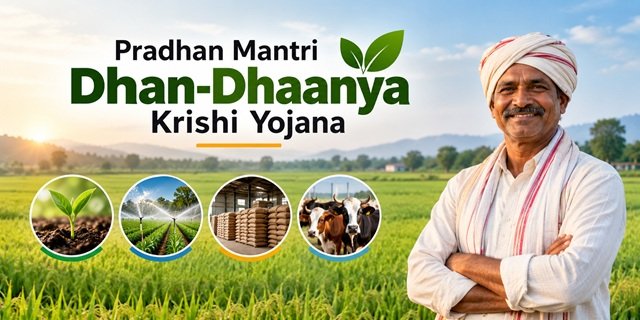
The Pradhan Mantri Dhan-Dhaanya Krishi Yojana (PMDDKY), led by the Ministry of Agriculture and Farmers Welfare, focuses on improving agriculture in 100 Aspirational Agricultural Districts. It brings together 36 schemes run by 11 Ministries and Departments, with an annual outlay of about Rs. 24,000 crore for six years. Farmers in these districts can access benefits through schemes such as PM-KISAN, Kisan Credit Card (KCC) and crop insurance, subject to the eligibility rules of each scheme.
Pradhan Mantri Dhan-Dhaanya Krishi Yojana Highlights | |
|---|---|
| Scheme Name | Pradhan Mantri Dhan-Dhaanya Krishi Yojana (PMDDKY) |
| Cabinet Approval | 16 July 2025 |
| Launched On | 11 October 2025 |
| Launched By | Prime Minister Narendra Modi |
| Nodal Ministry | Ministry of Agriculture and Farmers Welfare |
| Monitoring Partner | NITI Aayog |
| Duration | 6 years, starting from 2025-26 |
| Annual Outlay | About Rs. 24,000 crore through the convergence of existing schemes |
| Coverage | 100 districts across 29 States and Union Territories |
| Schemes Converged | 36 schemes run by 11 Ministries and Departments |
| Expected Beneficiaries | About 1.7 crore farmers |
| Monitoring | Monthly district rankings based on 121 indicators |
| Application | No separate application form; farmers apply through the relevant existing schemes |
| Helpline | 1800-180-1551 (Kisan Call Centre) |
| Official Portal | pmddky.niti.gov.in |
Introduction of Pradhan Mantri Dhan-Dhaanya Krishi Yojana: A Brief Insight
Some districts in India have fertile land and hardworking farmers, yet they struggle with low crop yields, limited irrigation and poor access to agricultural loans. Although the Government runs several schemes for farmers, their benefits may not reach everyone in these areas. The Pradhan Mantri Dhan-Dhaanya Krishi Yojana aims to address these gaps by bringing major agricultural schemes together and focusing on districts that need greater support.
The Government announced the scheme in the Union Budget 2025-26. The Union Cabinet approved it on 16 July 2025, and Prime Minister Narendra Modi launched it on 11 October 2025. The Ministry of Agriculture and Farmers Welfare, Government of India, leads the programme, while NITI Aayog supports its monitoring.
The scheme aims to increase agricultural productivity, encourage crop diversification, improve local storage facilities, expand irrigation and make agricultural credit more accessible in 100 Aspirational Agricultural Districts.
It brings together 36 schemes of 11 Ministries and Departments, with an annual outlay of about Rs. 24,000 crore over six years. Through a single district-level plan, farmers can access support for better seeds, irrigation, Kisan Credit Cards, crop insurance, storage, livestock and fisheries.
In the first year, the average score of the 100 selected districts increased from 18.85 to 46.89. This reflects the progress reported under the programme.
The Government selected these districts based on low agricultural productivity, moderate cropping intensity and below-average access to agricultural credit. The selection also ensures that at least one district from every State is included.
Farmers, women’s Self-Help Groups (SHGs), Farmer Producer Organisations (FPOs), livestock farmers and fish farmers in these districts can benefit through relevant schemes, provided they meet the applicable eligibility conditions.
Farmers do not need to fill out a separate application form for this programme. Instead, they can apply for benefits under the relevant existing schemes with guidance from their District Agriculture Office or nearest Krishi Vigyan Kendra (KVK). They can also call the Kisan Call Centre at 18001801551 for assistance.
Farmers in the selected districts can begin by checking their eligibility for income support under the PM Kisan Samman Nidhi Yojana and crop protection under the PM Fasal Bima Yojana. Women’s Self-Help Groups can explore income opportunities through drone spraying services under the NAMO Drone Didi Scheme.
Fish farmers can also explore insurance and digital registration support through the PM Matsya Kisan Samridhi Sah-Yojana, subject to the scheme’s eligibility requirements.
Farmers, rural families and other readers looking for agricultural assistance or welfare programmes available across India can explore our Central Government Welfare and Popular Schemes List page.
Latest Update
- 11 October 2026: The Pradhan Mantri Dhan-Dhaanya Krishi Yojana completed its first year. All 100 selected districts have prepared their District Action Plans and begun implementation.
- Progress Report: The average score of the 100 districts increased from 18.85 in April 2026 to 46.89 in August 2026, marking an improvement of more than 28 points.
- Dashboard Update: The Government has added a Financial Progress Module to monitor expenditure under the programme. A Beneficiary Progress Module is also planned to track the benefits reaching individual beneficiaries.
- CSR Support: Central Public Sector Enterprises are expected to support the selected districts through Corporate Social Responsibility (CSR) activities during 2026-27 and 2027-28.
Benefits Provided to Eligible Beneficiaries
The Pradhan Mantri Dhan-Dhaanya Krishi Yojana brings together 36 Central Government schemes in 100 selected districts to improve agricultural productivity and farmers’ access to essential services. Instead of treating each problem separately, the programme uses a coordinated district-level plan to address needs such as seeds, irrigation, agricultural credit, storage and market access.
Scale of Support
- Annual outlay of approximately Rs. 24,000 crore through converged schemes
- Estimated expenditure of around Rs. 1.44 lakh crore over 6 years
- Expected to benefit nearly 1.7 crore farmers
What Farmers Get Under Each Objective
| Objective | How Farmers Benefit |
|---|---|
| Higher Productivity | Access to quality and climate-resilient seeds, soil health cards, balanced fertiliser practices and farm mechanisation through custom hiring centres and drones |
| Crop Diversification | Support for growing fruits, vegetables, oilseeds, pulses, mushrooms and honey, along with opportunities for integrated farming |
| Sustainable Farming | Promotion of natural and organic farming, water-efficient agricultural practices and soil conservation |
| Post-Harvest Storage | Improved access to warehouses, cold storage and grain storage facilities at panchayat and block levels, along with processing and packaging units |
| Better Irrigation | Support for drip and sprinkler irrigation, restoration of traditional water bodies and command area development |
| Easy Agricultural Credit | Wider coverage under Kisan Credit Card schemes, including for livestock and fish farmers, along with access to long-term loans |
Support for Allied Sectors
- Livestock: Support for vaccination against major animal diseases, artificial insemination, fodder production and silage units
- Dairy: Improved dairy infrastructure through bulk milk coolers, milk-testing equipment and the formation of new dairy cooperative societies
- Fisheries: Support for cages, biofloc and Recirculating Aquaculture System (RAS) units, ice plants, cold storage and aquaculture insurance
Other Benefits for Farmers
- Improved coverage under PM-KISAN and wider enrolment in crop insurance schemes
- A one-day agricultural awareness event in every selected district at the beginning of each season
- A dedicated mobile app providing scheme-related information in regional languages
- Technical guidance from agricultural universities and Krishi Vigyan Kendras (KVKs)
- Skill development and training in agriculture and allied activities for rural youth and women
- Stronger Farmer Producer Organisations (FPOs), cooperatives and Self-Help Groups (SHGs) to improve market access and farmers’ bargaining power
Benefits at the District Level
- A detailed District Action Plan prepared after assessing local agricultural needs and challenges
- Monthly district rankings to monitor progress and encourage timely implementation
- Additional support through Corporate Social Responsibility (CSR) projects of Central Public Sector Enterprises during 2026-27 and 2027-28
Eligibility Conditions Required to be Fulfilled
Eligibility under the Pradhan Mantri Dhan-Dhaanya Krishi Yojana depends on two main factors. First, the farmer must belong to one of the 100 selected districts. Second, the farmer must satisfy the eligibility conditions of the particular government scheme through which they want to receive assistance.
How the 100 Districts Were Selected
- Low agricultural productivity
- Moderate cropping intensity
- Below-average access to agricultural credit
- The number of districts selected from each State depends on its share of net cropped area and operational landholdings
- At least one district from every State is included
Who Can Benefit
- Farmers residing in any of the 100 selected districts
- Small and marginal farmers, who receive particular attention under efforts to extend scheme coverage
- Livestock, dairy and fish farmers in the selected districts
- Women Self-Help Groups (SHGs), including those eligible for drone-related assistance under the Namo Drone Didi scheme
- Farmer Producer Organisations (FPOs) and Primary Agricultural Credit Societies (PACS)
- Rural youth seeking skill development and training in agriculture and allied activities
List of 100 Districts Covered
| State / UT | Districts |
|---|---|
| Andhra Pradesh (4) | Sri Sathya Sai, Anantapur, Alluri Sitharama Raju, Annamayya |
| Arunachal Pradesh (1) | Anjaw |
| Assam (3) | Sribhumi (Karimganj), Charaideo, Dima Hasao |
| Bihar (7) | Madhubani, Darbhanga, Banka, Gaya, Siwan, Kishanganj, Nawada |
| Chhattisgarh (3) | Dantewada, Jashpur, Korba |
| Goa (1) | South Goa |
| Gujarat (4) | Kachchh, Dahod, Chhotaudepur, Panch Mahals |
| Haryana (1) | Nuh |
| Himachal Pradesh (1) | Bilaspur |
| Jammu and Kashmir (2) | Kishtwar, Baramulla |
| Jharkhand (2) | Simdega, West Singhbhum |
| Karnataka (6) | Tumakuru, Chitradurga, Koppal, Gadag, Haveri, Chikkaballapura |
| Kerala (3) | Kozhikode, Kasaragod, Kannur |
| Madhya Pradesh (8) | Anuppur, Dindori, Alirajpur, Shahdol, Umaria, Sidhi, Niwari, Tikamgarh |
| Maharashtra (9) | Palghar, Yavatmal, Gadchiroli, Dhule, Raigad, Chandrapur, Chhatrapati Sambhajinagar, Nanded, Beed |
| Manipur (1) | Tamenglong |
| Meghalaya (1) | West Jaintia Hills |
| Mizoram (1) | Mamit |
| Nagaland (1) | Mon |
| Odisha (4) | Kandhamal, Malkangiri, Sundargarh, Nuapada |
| Punjab (1) | Fazilka |
| Rajasthan (8) | Barmer, Jaisalmer, Pali, Nagaur, Jodhpur, Bikaner, Churu, Jalore |
| Sikkim (1) | Geyzing |
| Tamil Nadu (4) | Ramanathapuram, Thoothukudi, Sivaganga, Virudhunagar |
| Telangana (4) | Narayanpet, Jogulamba Gadwal, Jangoan, Nagarkurnool |
| Tripura (1) | North Tripura |
| Uttar Pradesh (12) | Mahoba, Sonbhadra, Hamirpur, Banda, Jalaun, Jhansi, Unnao, Prayagraj, Chitrakoot, Pratapgarh, Shravasti, Lalitpur |
| Uttarakhand (2) | Almora, Chamoli |
| West Bengal (4) | Purulia, Darjeeling, Alipurduar, Jhargram |
Conditions for Individual Benefits
- Farmers must meet the eligibility criteria of the specific scheme through which they seek assistance, such as PM-KISAN, Kisan Credit Card (KCC) or PM Fasal Bima Yojana (PMFBY).
- Aadhaar details, bank account information and land records must be updated and linked wherever required by the relevant scheme.
- The availability and delivery of benefits depend on the District Action Plan and the applicable scheme guidelines.
Documents Required to be Attached
The Pradhan Mantri Dhan-Dhaanya Krishi Yojana does not have a separate application form. Farmers in the 100 selected districts can access its benefits through converged government schemes, including PM Kisan Samman Nidhi Yojana, Kisan Credit Card, crop insurance and micro-irrigation programmes. The required documents depend on the specific scheme or benefit a farmer applies for, although some basic documents are commonly needed.
Common Documents for Most Schemes
- Aadhaar Card of the farmer
- Bank account passbook, with Aadhaar linkage for Direct Benefit Transfer (DBT), wherever required
- Land records, such as Khatauni, Khasra or Record of Rights, where applicable
- Farmer ID under AgriStack, if generated in the farmer’s State
- Active mobile number linked with Aadhaar, wherever required
- Recent passport-size photograph, if required by the scheme
Documents Based on the Scheme You Use
| Benefit Through | Additional Documents Usually Needed |
|---|---|
| Kisan Credit Card | Land records or lease documents, crop details and a completed KCC application form submitted to the bank |
| PM Fasal Bima Yojana | Details of the notified crop sown and land records or tenancy proof, as applicable |
| Micro-irrigation and farm machinery | Land records, equipment quotation and caste certificate, if required to claim a higher subsidy |
| Animal husbandry or dairy schemes | Livestock ownership details and bank account information for loan or subsidy assistance |
| Fisheries schemes | Registration on the National Fisheries Digital Platform and details of the pond or other water body, as applicable |
| FPO, SHG and cooperative support | Registration certificate, member list and bank account details of the group or organisation |
For Tenant and Landless Farmers
- Lease agreement or tenancy certificate, wherever permitted under the applicable State rules
- Membership proof of a Self-Help Group (SHG), Farmer Producer Organisation (FPO) or cooperative, when applying for group-based benefits
How Beneficiaries Can Apply to Avail the Benefit of this Scheme
Farmers do not need to fill out a separate application form for the Pradhan Mantri Dhan-Dhaanya Krishi Yojana. Instead, the programme connects farmers in 100 selected districts with existing government schemes through a district-level action plan. If your district is included, you can check which benefits are available in your area and apply under the relevant scheme by following these steps.
Check Whether Your District Is Covered
Step 1: First, check the list of 100 selected districts provided above in this article. Find your district’s name to see whether it is covered under the programme.
Step 2: For official confirmation, read the PM Dhan-Dhaanya Krishi Yojana Operational Guidelines issued by the Ministry of Agriculture and Farmers Welfare.
Step 3: If your district appears on the list, you can contact the local agriculture office to learn about the benefits planned for your area. If your district is not included, you can still apply for eligible national government schemes through their usual application processes.
Find Out What Your District Plan Offers
Step 1: Visit your nearest District Agriculture Office, block agriculture office or Krishi Vigyan Kendra (KVK). These offices can guide you about agricultural schemes and services available in your area.
Step 2: Ask which benefits and activities are included in your district’s District Action Plan. For example, your area may focus on irrigation, farm machinery, agricultural credit, storage or crop diversification.
Step 3: Attend the agricultural awareness event organised in your district at the beginning of each season, where available. These events can help you understand government support, learn about application procedures and seek guidance from agricultural experts.
Apply Under the Relevant Schemes
Step 1: If you are eligible for PM-KISAN but have not registered, visit the official PM-KISAN Portal or seek help from a nearby Common Service Centre (CSC). Follow the scheme’s registration process and provide the required documents.
Step 2: To obtain a >Kisan Credit Card (KCC), contact your bank or Primary Agricultural Credit Society (PACS). Eligible livestock and fish farmers can also enquire about KCC facilities for their activities.
Step 3: If you want crop insurance, check the eligibility rules, notified crops and application deadlines under the PM Fasal Bima Yojana. You can apply through the official portal or an authorised channel, such as your bank or a Common Service Centre, as applicable.
Step 4: For assistance with drip irrigation, farm machinery, quality seeds or horticulture, contact your State agriculture or horticulture department. Officials can explain the available subsidies, eligibility conditions and application procedure.
Step 5: If you need support for dairy farming, animal health or fisheries, contact the District Animal Husbandry Office or District Fisheries Office, as applicable. Ask about the schemes currently available for your activity.
Step 6: You can also join an existing Farmer Producer Organisation (FPO), Self-Help Group (SHG) or cooperative, if eligible. Such groups may help members access shared facilities, equipment, storage, processing support and other group-based benefits.
Track Your District’s Progress
Step 1: Visit the official PMDDKY portal to find programme-related information and district progress details made available through the portal.
Step 2: Check the information available for your district, including its monthly ranking and progress against programme indicators, where published. This can help you understand how the district is progressing under the scheme.
Important: Keep your Aadhaar details, bank account information and land records updated wherever the relevant scheme requires them. Apply through official portals or authorised offices, and do not pay an agent or private person who promises guaranteed enrolment or benefits under the Pradhan Mantri Dhan-Dhaanya Krishi Yojana.
Who Runs the Scheme: Committee Structure
The Pradhan Mantri Dhan-Dhaanya Krishi Yojana follows a multi-level monitoring structure to coordinate its implementation across districts, States and the national level. Each committee oversees the programme at its respective level.
| Level | Committee | Headed By | Meeting Frequency |
|---|---|---|---|
| District | District Dhan-Dhaanya Krishi Yojana Samiti | District Collector | Every month |
| State | State Dhan-Dhaanya Krishi Yojana Samiti | Chief Secretary | Every quarter |
| National | National Monitoring Committee | Secretary, Department of Agriculture and Farmers Welfare | Every quarter |
| National | National Executive Committee | Union Minister of Agriculture and Farmers Welfare | At least twice a year |
The District Dhan-Dhaanya Krishi Yojana Samiti also includes two progressive farmers nominated by the Government of India. Their participation helps bring practical farming experience and local agricultural concerns into the district’s action plan.
Important Links Available of the Scheme
- Prime Minister Dhan-Dhaanya Krishi Yojana Official Portal
- About the scheme, PMDDKY portal
- PMDDKY Operational Guidelines with list of 100 districts (PDF)
- Cabinet approval of the scheme, Press Information Bureau
- Union Budget 2025-26 announcement, Press Information Bureau
Contact Details in Case of Help Needed
- Nodal Department: Department of Agriculture and Farmers Welfare, Ministry of Agriculture and Farmers Welfare, Krishi Bhawan, New Delhi – 110001
- Kisan Call Centre (Toll-Free): 1800-180-1551
- District Level: District Agriculture Officer, who is also the Member Secretary of the District Dhan-Dhaanya Krishi Yojana Samiti
- Local Help: Nearest Krishi Vigyan Kendra or block agriculture office
Frequently Asked Questions (FAQs)
Ans. It is a Central Government programme that aims to improve agriculture in 100 selected districts by coordinating 36 existing schemes run by 11 Ministries and Departments.
Ans. The scheme was announced in the Union Budget 2025-26, approved by the Union Cabinet on 16 July 2025 and launched by Prime Minister Narendra Modi on 11 October 2025.
Ans. The Ministry of Agriculture and Farmers Welfare leads the programme, while NITI Aayog supports monitoring through the district progress dashboard.
Ans. The programme will run for 6 years, starting from the financial year 2025-26.
Ans. The estimated annual outlay is about Rs. 24,000 crore through converged schemes, amounting to around Rs. 1.44 lakh crore over six years.
Ans. No. This amount represents the combined spending of existing schemes focused on the selected districts. Farmers receive benefits under the individual schemes for which they qualify, rather than a separate cash grant under this programme.
Ans. The programme covers 100 districts across 29 States and Union Territories. Uttar Pradesh has the highest number, with 12 selected districts.
Ans. The selection considered low agricultural productivity, moderate cropping intensity and below-average access to agricultural credit. The selection framework also ensures that at least one district from every State is included.
Ans. No. Farmers do not need to submit a separate application for the Pradhan Mantri Dhan-Dhaanya Krishi Yojana. They can apply for eligible benefits through existing schemes such as PM-KISAN, Kisan Credit Card and crop insurance.
Ans. The programme brings together 36 schemes, including PM-KISAN, PM Fasal Bima Yojana (PMFBY), Kisan Credit Card (KCC), Per Drop More Crop, Namo Drone Didi Scheme, Soil Health initiatives, Pradhan Mantri Matsya Sampada Yojana (PMMSY), Rashtriya Gokul Mission, Pradhan Mantri Krishi Sinchayee Yojana (PMKSY), DAY-NRLM and PMKVY.
Ans. The District Dhan-Dhaanya Krishi Yojana Samiti, headed by the District Collector, prepares the District Action Plan according to local agricultural needs and priorities.
Ans. The Government monitors district performance through a dashboard that ranks districts every month using 121 indicators, with support from NITI Aayog.
Ans. According to the reported figures, all 100 districts have prepared their action plans. Their average score increased from 18.85 in April 2026 to 46.89 in August 2026.
Ans. Yes. The programme also covers relevant animal husbandry, dairy and fisheries schemes. Farmers must meet the eligibility conditions of the particular scheme through which they seek assistance.
Ans. Farmers can call the Kisan Call Centre at 1800-180-1551 or visit their District Agriculture Office or nearest Krishi Vigyan Kendra (KVK) for guidance.

Tabassum is a government schemes researcher and writer with 5 years of experience tracking Central and State welfare scheme programmes across India. She has covered 500+ schemes spanning agriculture, women welfare, education, and housing, helping lakhs of beneficiaries understand their entitlements in simple language.