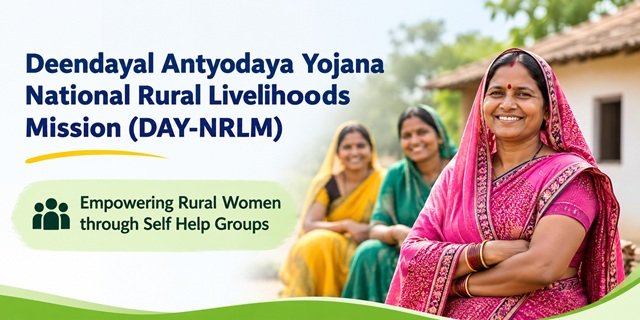
The Deendayal Antyodaya Yojana – National Rural Livelihoods Mission (DAY-NRLM), run by the Ministry of Rural Development, helps rural women form Self Help Groups, access bank loans and increase their income. Around 10 crore women have joined the Mission. Its target is to create 6 crore Lakhpati Didis by March 2029. There is no central application form. Women can join or form a Self Help Group to participate.
Deendayal Antyodaya Yojana – National Rural Livelihoods Mission (DAY-NRLM) Highlights | |
|---|---|
| Scheme Name | Deendayal Antyodaya Yojana – National Rural Livelihoods Mission (DAY-NRLM) |
| Launched | June 2011; renamed DAY-NRLM on 29 March 2016 |
| Ministry | Ministry of Rural Development, Government of India |
| Run By | State Rural Livelihoods Missions and Block Mission Management Units |
| Aim | Reduce rural poverty through self-employment and skilled jobs |
| Four Parts | Social mobilisation, financial inclusion, sustainable livelihoods and social inclusion |
| Who Benefits | Rural poor households, with at least one woman in an SHG |
| Where It Works | Rural areas across India, except Delhi and Chandigarh |
| Reach, as on 30 November 2025 | 10.05 crore women, 90.90 lakh SHGs, 5.35 lakh Village Organisations and 33,590 Cluster Level Federations |
| Bank Loans | About ₹11.89 lakh crore in loans received by SHGs |
| Loan Non-Repayment Rate | About 1.76%, as reported |
| Revolving Fund | ₹20,000 to ₹30,000 per eligible group, as reported |
| Community Investment Fund | Up to ₹2.5 lakh through the group’s federation, as reported |
| Bank Credit | Collateral-free loans of up to ₹20 lakh per eligible group, as reported |
| Interest Concession | 7% on eligible loans up to ₹3 lakh; 4% for timely repayment in selected districts, as reported |
| Lakhpati Didi | Household income of at least ₹1 lakh annually; target of 6 crore women by March 2029 |
| How to Join | Join or form an SHG, usually with 10 to 20 women; contact the Block Mission office |
| Official Pages | Aajeevika Portal |
Introduction of Deendayal Antyodaya Yojana – National Rural Livelihoods Mission (DAY-NRLM): A Brief Insight
In many villages, poor women need small loans to run their homes or start a small business. But they often have to borrow money from local moneylenders who charge very high interest. The Deendayal Antyodaya Yojana – National Rural Livelihoods Mission (DAY-NRLM) aims to provide them with a better option. It brings rural women together into Self Help Groups, where they save money, lend to one another and get access to bank loans at affordable interest rates.
The Ministry of Rural Development launched the Mission in June 2011 by restructuring the earlier Swarnajayanti Gram Swarozgar Yojana. The Government renamed it DAY-NRLM with effect from 29 March 2016, in line with the idea of Antyodaya, which means the upliftment of the poorest people.
The Ministry of Rural Development implements the Mission through its Rural Livelihoods Division and State Rural Livelihoods Missions. At the block level, the Block Mission Management Unit helps carry out the Mission’s activities and supports local Self Help Groups.
The main objective of DAY-NRLM is to reduce rural poverty by helping poor families earn a regular income. It supports self-employment, skill training and wage employment through strong community groups. The Mission focuses on four major areas: social mobilisation, financial inclusion, sustainable livelihoods, and social inclusion with convergence.
Another important aim is to bring at least one woman from every identified rural poor household into a Self Help Group. The Mission also connects these groups to Village Organisations and Cluster Level Federations. These larger groups help women work together, solve common problems and get better access to financial and livelihood support.
According to the Ministry, DAY-NRLM had reached 10.05 crore women through around 90.90 lakh Self Help Groups as of 30 November 2025. These groups had received bank loans worth approximately ₹11.89 lakh crore. The reported loan non-repayment rate was only about 1.76%.
Eligible Self Help Groups can receive a Revolving Fund of ₹20,000 to ₹30,000 and a Community Investment Fund of up to ₹2.5 lakh through their federation. The Mission also supports collateral-free bank loans of up to ₹20 lakh per eligible group and provides interest concessions on eligible loans of up to ₹3 lakh, as reported.
DAY-NRLM also aims to make more women Lakhpati Didis. A Lakhpati Didi is a woman whose household earns at least ₹1 lakh annually through livelihood activities. The Ministry has reported that more than 3 crore women have achieved this milestone. The Government aims to increase this number to 6 crore by March 2029.
Women from identified poor rural households can benefit from the Mission by joining a Self Help Group. The scheme operates in rural areas across States and Union Territories, except Delhi and Chandigarh. There is no separate central application form. A woman needs to join an existing group or form a new one and contact the Block Mission office for guidance.
If you need help, contact the Block Mission office in your area, the District Mission Management Unit or your State Rural Livelihoods Mission. You can find more information in the contact section below.
Rural youth who want to learn new skills and find jobs can explore the Deen Dayal Upadhyaya Grameen Kaushalya Yojana (DDU-GKY). Women who want to start their own businesses can also check the Stand-Up India Scheme.
People who want financial support to start a new business can explore the Prime Minister Employment Generation Programme (PMEGP). Those who need a small business loan can also check the Pradhan Mantri Mudra Yojana.
Rural women, Self Help Group members, young entrepreneurs and village families can explore more welfare and livelihood programmes on our Central Government Welfare Schemes page.
Benefits Provided to Eligible Beneficiaries
Many rural women work hard but struggle to save money or get loans at affordable interest rates. The Deendayal Antyodaya Yojana – National Rural Livelihoods Mission (DAY-NRLM) aims to solve these problems by bringing women together into Self Help Groups (SHGs).
The Mission helps these groups build savings, receive financial support, get bank loans and start income-generating activities. Women can use this support for farming, animal husbandry and small businesses. According to the Ministry of Rural Development, DAY-NRLM had reached 10.05 crore women through 90.90 lakh Self Help Groups as of 30 November 2025. The following sections explain the major benefits available under the Mission.
What Benefits Do Women and Their Groups Receive?
- Women can form or join Self Help Groups and receive regular guidance from Mission workers.
- Each eligible group may receive a Revolving Fund of ₹20,000 to ₹30,000 to start internal lending, as reported.
- Eligible groups may receive a Community Investment Fund of up to ₹2.5 lakh through their federation for livelihood activities.
- Self Help Groups can access collateral-free bank loans of up to ₹20 lakh, as reported.
- Eligible groups can receive interest support on loans of up to ₹3 lakh, with a reported effective interest rate of 7% and an additional concession for timely repayment in selected districts.
- Women receive training in bookkeeping, financial management, farming, animal care and small business activities.
- The Mission helps women connect their businesses and products with suitable markets.
- Women can receive support under the Lakhpati Didi Initiative to increase their household income to at least ₹1 lakh annually.
- Rural youth can access skill training and employment opportunities through related livelihood programmes.
Benefits Available Under DAY-NRLM at a Glance
| Support | Details | Amount or Scale |
|---|---|---|
| Self Help Groups and Federations | Women’s groups linked through Village Organisations and Cluster Level Federations | 10.05 crore women, 90.90 lakh groups, about 5.35 lakh Village Organisations and 33,590 Cluster Level Federations |
| Revolving Fund | Financial support to begin internal lending | ₹20,000 to ₹30,000 per group, as reported |
| Community Investment Fund | Financial assistance for livelihood activities through the federation | Up to ₹2.5 lakh per group, as reported |
| Bank Credit | Collateral-free loans through banks | Up to ₹20 lakh per group, as reported |
| Interest Subvention | Interest concession on eligible group loans | 7% on loans up to ₹3 lakh, with a further concession for timely repayment in selected districts, as reported |
| Bank Sakhi | Women working as banking agents in their villages | More than 1.49 lakh Bank Sakhis |
| Community Resource Persons | Trained women who guide other groups in farming, animal care and financial activities | More than 6 lakh |
| Women Farmers | Support for low-cost, natural and livestock-based farming | About 4.87 crore women farmers and 3.28 crore nutrition gardens |
| Village Enterprises | Support for starting and managing small non-farm businesses | About 4.02 lakh enterprises |
| Lakhpati Didi | Support to increase a woman’s household income to at least ₹1 lakh annually | 2 crore by November 2025, with a target of 6 crore by March 2029 |
How Much Can a Group Save on Bank Interest?
Let’s understand the interest benefit with a simple example. Suppose a Self Help Group takes a bank loan of ₹3 lakh at an annual interest rate of 10%. Without any interest support, the group would pay ₹30,000 as yearly interest.
- At 10% interest: The group pays ₹30,000 annually.
- At 7% interest: The group pays ₹21,000 annually after the reported interest support.
- At 4% interest: The group pays ₹12,000 annually if it qualifies for the additional prompt repayment concession.
At 7%, the group saves ₹9,000 in a year. If it qualifies for the 4% rate, its total saving becomes ₹18,000 compared with the original 10% rate. These are simple calculations based on the reported rates. The actual interest benefit depends on the applicable bank and Mission guidelines.
What Do the Mission’s Figures Show?
- Women associated with DAY-NRLM received bank loans worth approximately ₹11.89 lakh crore as of 30 November 2025.
- The Mission provided approximately ₹62,339.75 crore through the Revolving Fund and Community Investment Fund.
- The reported loan repayment default rate was around 1.76%, compared with 9.58% in 2014.
- A 2019 study by the International Initiative for Impact Evaluation, supported by the World Bank, found that women’s income increased by 19%, dependence on informal moneylenders decreased by 20% and savings increased by 28%.
How Does DAY-NRLM Help Rural Women?
- Provides access to affordable bank loans without requiring land or property as collateral for eligible SHG loans.
- Reduces dependence on private moneylenders who may charge high interest rates.
- Encourages regular savings and helps women build a financial record.
- Provides training to start farming activities, small businesses and other income-generating work.
- Helps women take part in village-level decisions through Self Help Groups and their federations.
- Creates earning opportunities for women as Bank Sakhis and Community Resource Persons.
Important Points to Remember
- Most financial assistance under DAY-NRLM reaches women through their Self Help Groups and federations, rather than as a direct payment to an individual woman.
- The Revolving Fund, Community Investment Fund and interest benefit amounts mentioned above are based on reported figures. Confirm the latest rules with your State Rural Livelihoods Mission.
- Women who need a loan to start or expand an individual business can also explore the Pradhan Mantri Mudra Yojana.
- Rural youth looking for skill training and employment opportunities can read about the Deen Dayal Upadhyaya Grameen Kaushalya Yojana (DDU-GKY).
- Do not pay any agent or middleman to receive SHG funds, bank loans or other benefits under the Mission.
Eligibility Conditions Required to be Fulfilled
The Deendayal Antyodaya Yojana – National Rural Livelihoods Mission (DAY-NRLM) supports poor rural households by helping women join Self Help Groups (SHGs). Its main aim is to bring at least one woman from every identified poor rural household into a group. These groups then receive support through savings, bank loans, financial assistance and skill training.
Women do not need a separate income certificate to join an SHG under the Mission. However, they must meet the basic conditions set by their State Rural Livelihoods Mission. The following points explain who can join a group and what conditions apply to different benefits.
Who Is Eligible for DAY-NRLM?
- A woman belonging to an identified poor rural household.
- A woman living in a rural area of a State or Union Territory where the Mission operates.
- A woman who joins an existing Self Help Group or helps form a new one.
- At least one woman from each identified poor rural household, as the Mission aims to cover these households through SHGs.
- Special groups for persons with disabilities, elderly people and transgender persons, as permitted under the Mission.
The Mission operates across all States and Union Territories except Delhi and Chandigarh.
Eligibility Conditions for a Self Help Group
- A group usually consists of 10 to 20 women from the same village or nearby area.
- Members should generally belong to a similar economic background.
- The group must follow the five basic rules known as Panchsutra: regular meetings, regular savings, internal lending, timely loan repayment and proper record-keeping.
- The group must maintain a bank account in its name.
- The group must complete the required registration or verification process under the State Rural Livelihoods Mission.
Eligibility for Revolving Fund and Community Investment Fund
- Revolving Fund: SHGs that regularly hold meetings, save money and provide loans to members may qualify for this fund. Reports mention assistance of ₹20,000 to ₹30,000 per group.
- Community Investment Fund: Eligible groups may receive financial support of up to ₹2.5 lakh through their federation.
- Group Records: The group must maintain proper meeting, savings and internal lending records.
Eligibility Conditions for a Bank Loan
- The SHG should generally have an active record of around six months.
- The group must maintain proper books of accounts and regular savings records.
- The group must prepare a Micro Credit Plan showing its financial requirements.
- The group must pass a resolution to take the loan.
- Eligible SHGs may receive collateral-free bank loans of up to ₹20 lakh, as reported under the Mission.
- Women’s SHGs may receive interest subvention on loans of up to ₹3 lakh. Reports mention an effective interest rate of 7%, with an additional 3% incentive for prompt repayment in the districts covered by the scheme.
Eligibility Conditions for the Lakhpati Didi Initiative
The Lakhpati Didi Initiative helps women in Self Help Groups increase their household income through farming and other livelihood activities. A woman must meet the following conditions to qualify as a Lakhpati Didi:
- She must be a member of a Self Help Group under DAY-NRLM.
- Her household must earn at least ₹1 lakh annually after meeting the costs of its livelihood activities.
- The household must maintain this income across different farming seasons or business cycles.
- The woman should practise at least two livelihood activities with the support of the Mission, as reported.
- The reported income target is an average of at least ₹10,000 per month.
According to the Ministry of Rural Development, more than 3 crore women have become Lakhpati Didis. The Government aims to increase this number to 6 crore by March 2029.
Related Schemes for Rural Youth
- Deen Dayal Upadhyaya Grameen Kaushalya Yojana (DDU-GKY): This programme provides skill training to poor rural youth aged 15 to 35 years. The upper age limit is 45 years for women, persons with disabilities and certain special groups.
- Rural Self Employment Training Institutes (RSETIs): These institutes provide self-employment training to rural youth aged 18 to 50 years.
Both programmes have separate eligibility conditions. Rural families can explore them if a young family member wants to learn a skill, find a job or start a business.
Difference Between DAY-NRLM and DAY-NULM
Both schemes support livelihoods, but they cover different areas. DAY-NRLM focuses on rural households, while DAY-NULM was designed for people living in urban areas.
| Particulars | DAY-NRLM | DAY-NULM |
|---|---|---|
| Area Covered | Rural areas | Urban areas |
| Implementing Ministry | Ministry of Rural Development | Ministry of Housing and Urban Affairs |
| Status | Ongoing, with a target of 6 crore Lakhpati Didis | The mission period ended on 30 September 2024, as reported |
| Main Beneficiaries | Rural poor households, mainly through women’s Self Help Groups | Urban poor households through urban SHGs and livelihood support |
Who May Not Be Eligible?
- People living in urban areas, as DAY-NRLM focuses on rural households.
- Households that do not fall under the poor household category identified by the Mission, unless the State permits their inclusion.
- Women who are not members of an eligible Self Help Group for benefits that require SHG membership.
These points explain the general eligibility rules. Your State Rural Livelihoods Mission may have additional conditions, so contact the Block Mission office if you are unsure about your eligibility.
Things to Check Before Joining a Self Help Group
- Confirm that you live in a rural area covered by DAY-NRLM.
- Find the Block Mission office in your area.
- Ask whether an existing SHG operates in your village.
- Check whether you can join an existing group or form a new one.
- Ask about the State-specific rules for group formation and registration.
- Do not pay anyone to join an SHG or receive financial assistance.
Documents Required to be Attached
The Deendayal Antyodaya Yojana – National Rural Livelihoods Mission (DAY-NRLM) is a flagship rural livelihood scheme of the Ministry of Rural Development, Government of India. The scheme started in June 2011 and received its present name in March 2016. State Rural Livelihoods Missions implement it across the country.
Nearly 10 crore rural women are now part of Self Help Groups (SHGs) under this Mission. Women do not need to fill out one central application form to join DAY-NRLM. They can join an existing Self Help Group or form a new group in their village.
The documents required depend on the type of support a woman or her group wants to receive. These may include personal documents, group records, bank documents and income records.
Documents Required for Each Member
- Aadhaar Card
- Mobile Number
- Passport-size Photograph
- Bank Passbook
- Residence Proof
- Ration Card or BPL Card, if available
Documents and Records Required for a Self Help Group
- SHG Name and Formation Date
- Member List with Names, Ages and Addresses
- Meeting Register
- Savings Register
- Internal Loan Register
- Cash Book
- Group Account Books
- SHG Bank Passbook
- Group Resolution
- Photographs and Aadhaar Cards of Authorised Signatories
Documents Required for Revolving Fund and Community Investment Fund
- Meeting Records
- Savings Records
- Internal Lending Records
- Micro Credit Plan
- Village Organisation Records
- Cluster Level Federation Records, if applicable
Documents Required for a Bank Loan to the Group
- SHG Bank Account Statement
- Group Loan Resolution
- Micro Credit Plan
- Member Aadhaar Cards
- Photographs of Members and Office Bearers
- Previous Loan and Repayment Records, if applicable
Documents Required for the Lakhpati Didi Initiative
A Lakhpati Didi is a woman associated with a Self Help Group whose household earns at least ₹1 lakh annually. The income may come from farming and non-farming activities. The household should maintain this income across different farming seasons or business cycles.
- Annual Household Income Records
- Farming and Non-farming Income Details
- Expense Records
- Bank Statements
- Sales Receipts
- Details of Livelihood Activities
- Income Verification Records
Documents Required to Start a Small Business
- Business Plan
- Udyam Registration Certificate, if applicable
- Machinery or Equipment Quotation
- Purchase Bills for Stock, Machinery or Livestock
What You Do Not Need
- Membership Fee to Join a Self Help Group
- Separate Central Application Form
- Agent or Middleman
- Land Documents for Joining an SHG
- Collateral for Eligible SHG Loans
How Beneficiaries Can Apply to Avail the Benefit of this Scheme
Imagine that a few women in your village decide to save a small amount of money every week. They put their savings together in one place. When one of them needs money, she can borrow from this common fund and return it later. This is how a Self Help Group (SHG) works. The Deendayal Antyodaya Yojana – National Rural Livelihoods Mission (DAY-NRLM) helps these groups by providing guidance, financial support and links to banks. It also helps women start small businesses and earn a regular income.
You do not need to visit a government office and fill out one central application form to join this scheme. Instead, you need to become a member of an existing Self Help Group or form a new group with other women in your village. Once your group starts working regularly, it can approach the Mission for different types of support. Follow the steps below to understand the process.
Before You Start
Step 1: Remember that DAY-NRLM does not have one central application form. You do not need to apply through a single government counter or website.
Step 2: Understand that most support under this Mission goes through a group of women. So, you first need to join an existing Self Help Group or form a new one.
Step 3: The Mission does not charge you a fee for joining an SHG. Do not pay anyone who promises to get you enrolled or arrange a fund.
Step 4: Keep your Aadhaar card, mobile number and bank passbook ready. You may need these details when you join a group or complete its records.
Step 5: Read the eligibility and benefits sections of this guide to understand who can join the Mission and what support the group may receive.
Find a Group in Your Village and Join It
Step 1: Ask the women in your village whether a Self Help Group already meets in your area.
Step 2: You can also ask your village head, Gram Panchayat member or ward member. They may know which groups are active in the village.
Step 3: Contact a community worker of the Mission. This worker may be a Community Resource Person (CRP) who helps SHGs with their meetings and activities. Ask whether any group has space for a new member.
Step 4: Visit a meeting of the group. Observe how its members save money, maintain records and help one another.
Step 5: If you want to join, tell the group members. They may ask for your name, address, Aadhaar details and other basic information.
Step 6: Discuss how much money you can save every week or month. Choose an amount that you can pay regularly without difficulty.
Step 7: Ask the group to enter your name and other details in its member register. Once the group accepts you, start attending its regular meetings and saving money.
Form a New Group
Step 1: Talk to 10 to 20 women in your village who want to save money and support one another. Try to form a group with women from similar economic backgrounds.
Step 2: Choose a name for your group. You can select the name of a flower, a goddess or your village.
Step 3: Decide a fixed day, time and place for meetings. You can meet every week or every fortnight, but all members should know the schedule.
Step 4: Decide how much every member will save during each meeting. Keep the amount affordable so that every woman can contribute regularly.
Step 5: Select two or three members to manage the group’s work, maintain its records and handle bank-related activities. These members may act as the group’s office bearers or authorised signatories.
Step 6: Agree to follow five basic rules, commonly known as the Panchsutra. These include regular meetings, regular savings, lending money within the group, timely repayment and proper maintenance of records.
Step 7: Hold your first meeting. Collect the savings from members and record the meeting date, attendance and amount saved by each woman.
Step 8: Continue holding meetings and saving money regularly. The Mission may check the group’s activities and records before providing financial support.
Meet the Block Mission Office and Get Your Group on the List
Step 1: Visit your block office and ask for the Block Mission Management Unit (BMMU). This office looks after DAY-NRLM activities at the block level.
Step 2: Take your group’s name, member list, formation date and other available records with you.
Step 3: Tell the officials, “We have formed a Self Help Group and want to join the National Rural Livelihoods Mission. Please guide us through the process.”
Step 4: Provide the details requested by the office. Ask how the group will be recorded under the Mission and what steps you need to complete next.
Step 5: Ask for the name and contact number of the community worker who will guide your group and help it with regular activities.
Step 6: Ask which documents your State Rural Livelihoods Mission requires. Document requirements and registration procedures may differ from one State to another.
Open a Bank Account for the Group
Step 1: Choose a nearby bank with the help of your community worker. Your group may approach a public sector bank, regional rural bank or another eligible bank.
Step 2: Take the group’s authorised members to the bank. Carry their Aadhaar cards, photographs and the documents related to the group.
Step 3: Ask the bank to open a savings account in the name of your Self Help Group. The bank will explain its account-opening requirements.
Step 4: Deposit the money collected from members into the group’s bank account. Keep the deposit slips and update the group’s records after every deposit.
Step 5: Check the bank account regularly. Make sure that the balance shown in the passbook matches the amount written in the group’s records.
Keep the Group’s Books
Step 1: Maintain a meeting register. Write the date of every meeting, the names of members who attended and the decisions taken.
Step 2: Maintain a savings register. Record how much money each member deposits during every meeting.
Step 3: Maintain a loan register. Write down the name of the member who borrows money, the amount borrowed and the repayment details.
Step 4: Maintain a cash book. Record all the money received by the group and every amount it spends or lends.
Step 5: Ask a member who can read and write or the community worker to check these records regularly. Make sure that all entries are correct and up to date.
Get the Revolving Fund and the Community Investment Fund
Step 1: Show the Block Mission office that your group holds regular meetings, collects savings and follows the basic rules of an SHG.
Step 2: Ask the officials about the Revolving Fund (RF). Government reports mention financial support of ₹20,000 to ₹30,000 per eligible group. The group can use this money to strengthen its savings and internal lending activities.
Step 3: Ask whether your group can become part of a Village Organisation (VO). A Village Organisation is a federation formed by bringing several Self Help Groups together at the village level.
Step 4: Ask the Village Organisation and the Mission officials how your group can receive support from the Community Investment Fund (CIF). Government reports mention assistance of up to ₹2.5 lakh through the federation for livelihood activities.
Step 5: Prepare a Micro Credit Plan (MCP) with the help of the community worker. This plan explains how the group and its members want to use the money for income-generating activities.
Step 6: Use the approved funds for the activities permitted under the Mission. Record every payment, loan and expense so that the group can explain how it used the money.
Get a Bank Loan for the Group
Step 1: Make sure that your group has been meeting regularly, saving money and maintaining proper records for some time. The bank and Mission officials may check these details before considering a loan.
Step 2: Discuss the loan requirement with all group members. Decide why the group needs the money and how much each member may require.
Step 3: Pass a decision to take the loan during a group meeting. Write this decision, known as a resolution, in the meeting register and record the members’ approval.
Step 4: Visit the bank with the group’s authorised members and community worker. Carry the group passbook, meeting records, loan resolution and Micro Credit Plan.
Step 5: Ask the bank staff for the SHG loan application form. Fill it in with their help and submit the documents required by the bank.
Step 6: Government reports mention that eligible SHGs can receive collateral-free bank loans of up to ₹20 lakh. If anyone asks your group to provide land or property as security, check the applicable loan rules with the bank and Block Mission office before proceeding.
Step 7: Once the bank approves the loan, use the money for the activities agreed upon by the members. Repay every instalment on time and keep the repayment receipts. A good repayment record can help the group build a stronger credit history.
Get the Interest Concession
Step 1: Ask your bank and Block Mission office whether your group’s loan qualifies for interest subvention. Government reports mention interest support for eligible SHG loans of up to ₹3 lakh.
Step 2: Ask the bank what interest rate will apply to your loan. The reported effective rate for eligible loans is 7%, but the applicable rules should be checked before taking the loan.
Step 3: Ask whether your district qualifies for the additional benefit linked to prompt repayment. Reports mention that the effective rate may come down to 4% in selected districts when the group repays on time.
Step 4: Pay every instalment by its due date. Keep the bank receipts and check whether the applicable interest benefit has been credited or adjusted as per the rules.
Become a Lakhpati Didi
Step 1: Contact your community worker and discuss how you can increase your household’s yearly income to at least ₹1 lakh. The Lakhpati Didi initiative supports women who want to improve their family’s income through regular livelihood activities.
Step 2: Choose two or more income-generating activities that suit your skills and local conditions. These may include farming, dairy work, animal rearing, running a shop or stitching clothes.
Step 3: Prepare a simple plan with the community worker. Decide how much money each activity needs and how it can help your family earn more.
Step 4: Keep a record of your income and expenses. For example, write down how much you earn by selling milk and how much you spend on animal feed.
Step 5: Try to maintain your income throughout the year, instead of earning the required amount only once. Ask the community worker about the process for recording and verifying your household income.
Become a Bank Sakhi or a Community Resource Person
Step 1: If you can read, write and do basic calculations, contact the Block Mission office and express your interest in becoming a Bank Sakhi or a Community Resource Person.
Step 2: Ask the officials about the eligibility conditions, training and selection process for these roles.
Step 3: Complete the required training. Depending on your role, you may help women with banking services, farming activities, animal care or other livelihood work.
Step 4: Ask about the payment or earning opportunities attached to the role. The amount and payment arrangement may differ according to the State and the work assigned.
Look Up the Mission Online
Step 1: Visit the official Aajeevika portal to read about DAY-NRLM, its activities and the State Rural Livelihoods Missions.
Step 2: Open the DAY-NRLM dashboard to check available information about Self Help Groups and Mission activities in different States, districts and blocks.
Step 3: Visit the scheme page on MyScheme to read the available details about eligibility and benefits.
Step 4: If you find an online member registration option, first confirm its availability and purpose with your State Rural Livelihoods Mission or Block Mission office. You can also ask a Common Service Centre (CSC) for help in using government portals.
Step 5: Use the official website addresses given above. Do not enter your personal or bank details on an unknown website that claims to offer DAY-NRLM registration.
If No Group or Mission Worker Is Near You
Step 1: Visit your Block Development Officer (BDO) or the District Rural Development Agency (DRDA). Ask which office manages DAY-NRLM activities in your area.
Step 2: Ask for the contact details of your State Rural Livelihoods Mission. This State-level organisation is responsible for carrying out the Mission’s activities in your State.
Step 3: Explain that your village does not have an active Self Help Group or Mission worker. Request guidance on forming a new group and getting support from the Mission.
Step 4: Meanwhile, talk to other interested women and start preparing to form a group, as explained in Method 2.
How to Avoid Cheats
Step 1: Never pay anyone who promises to arrange SHG membership, a government fund or a bank loan. Confirm all information with the Block Mission office.
Step 2: Never share your Aadhaar details, bank account information, ATM PIN or OTP with an unknown person who contacts you about the scheme.
Step 3: Do not sign a blank paper or any loan document that you do not understand. Ask a trusted person or bank official to explain it first.
Step 4: Do not allow only one person to control the group’s bank passbook and financial records. Keep the authorised members involved in important banking decisions.
Important Links Available of the Scheme
Contact Details in Case of Help Needed
- National Office: Rural Livelihoods Division, Department of Rural Development, Ministry of Rural Development, Government of India, 7th Floor, NDCC-II Building, Jai Singh Road, New Delhi 110001
- Your State: The State Rural Livelihoods Mission of your State, which runs the Mission and has its own office and officers
- Your District: The District Mission Management Unit, or the District Rural Development Agency, at your district headquarters
- Your Block: The Block Mission Management Unit at your block office, which is the first place to ask about a group, a fund or a loan
Frequently Asked Questions (FAQs)
Ans. DAY-NRLM is a major rural development scheme run by the Ministry of Rural Development, Government of India. It helps poor rural women form Self Help Groups, access bank loans, start income-generating activities and improve their family’s financial condition.
Ans. The Government of India launched the Mission in June 2011 by restructuring the earlier Swarnajayanti Gram Swarozgar Yojana. It received its present name, DAY-NRLM, on 29 March 2016.
Ans. The Ministry of Rural Development runs the Mission through its Rural Livelihoods Division and State Rural Livelihoods Missions. The Central and State Governments share the cost of implementing the scheme. You can read more in the Year Ender 2025 of the Ministry of Rural Development.
Ans. The main objective is to reduce rural poverty by helping poor families earn a regular income. The Mission supports women through Self Help Groups, connects these groups with banks, promotes farming and small businesses, and provides opportunities for skill training and employment.
Ans. According to the Ministry of Rural Development, around 10.05 crore women had joined approximately 90.90 lakh Self Help Groups as of 30 November 2025.
Ans. Women from identified poor rural households can join the Mission through a Self Help Group. Generally, one woman from each identified household can become a member. The Mission operates in rural areas across States and Union Territories, except Delhi and Chandigarh. A Self Help Group usually has 10 to 20 members, subject to applicable rules.
Ans. No. There is no single central application form for joining the Mission. You need to join an existing Self Help Group or form a new one and contact your Block Mission office for guidance. Keep your Aadhaar card, mobile number and bank passbook ready.
Ans. Ask the women in your village, the village head or a Mission community worker about an existing group. If you want to form a new group, bring together 10 to 20 interested women, choose a group name, fix a meeting day and decide how much each member will save. Maintain proper records of meetings, savings and loans.
Ans. Government reports mention a Revolving Fund of ₹20,000 to ₹30,000 per eligible group. A group may also receive a Community Investment Fund of up to ₹2.5 lakh through its federation for livelihood activities. The actual assistance depends on the applicable Mission guidelines and eligibility conditions.
Ans. Yes. Eligible Self Help Groups can access collateral-free bank loans of up to ₹20 lakh, as reported under the Mission. The bank will check the group’s records, repayment history and other applicable conditions before approving the loan.
Ans. Eligible Self Help Groups can receive interest support on loans of up to ₹3 lakh. Reports mention an effective interest rate of 7%, which may come down to 4% for timely repayment in selected districts. Ask your bank or Block Mission office to confirm the applicable rate for your group.
Ans. A Lakhpati Didi is a woman who is a member of a Self Help Group and whose household earns at least ₹1 lakh annually after meeting its expenses. She may earn this income through farming, dairy, animal rearing, small businesses or other livelihood activities. The Ministry has reported that more than 3 crore women have achieved this milestone, with a target of reaching 6 crore Lakhpati Didis by March 2029. Read the government release dated 27 March 2026 for more details.
Ans. No. Both schemes have different purposes. DAY-NRLM focuses on improving the livelihoods of poor rural households and comes under the Ministry of Rural Development. DAY-NULM focused on improving the livelihoods of the urban poor and came under the Ministry of Housing and Urban Affairs. Its mission period ended on 30 September 2024, as reported.
Ans. The Deen Dayal Upadhyaya Grameen Kaushalya Yojana (DDU-GKY) provides skill training and employment opportunities to eligible rural youth, generally between 15 and 35 years of age. It is a related rural livelihood programme with its own eligibility conditions.
Ans. You can contact your Block Mission office, District Mission Management Unit or State Rural Livelihoods Mission for help. You can also visit the official Aajeevika portal for information. The Mission does not charge a fee for joining an SHG. Never pay an agent who promises to arrange membership, funds or loans.
Tabassum is a government schemes researcher and writer with 5 years of experience tracking Central and State welfare scheme programmes across India. She has covered 500+ schemes spanning agriculture, women welfare, education, and housing, helping lakhs of beneficiaries understand their entitlements in simple language.