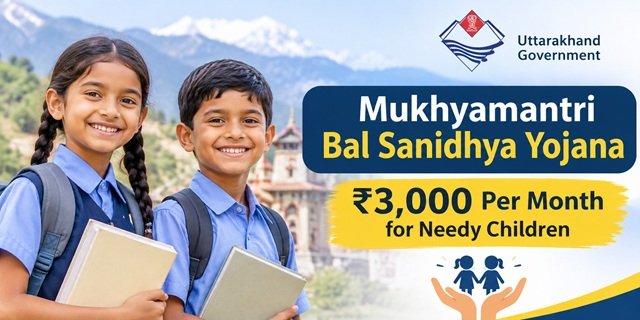
The Mukhyamantri Bal Sanidhya Yojana is a proposed scheme of the Government of Uttarakhand to provide ₹3,000 per month to more than 6,000 needy children. It aims to support children who have lost one or both parents, have parents with disabilities or in jail, or belong to families facing extreme hardship. The proposed age limit is 18 years. The application process has not yet started.
Uttarakhand Mukhyamantri Bal Sanidhya Yojana Highlights | |
|---|---|
| Scheme Name | Mukhyamantri Bal Sanidhya Yojana |
| Scheme Type | Uttarakhand State Government Child Welfare Scheme |
| Department | Women Empowerment and Child Development Department, Government of Uttarakhand |
| Objective | To provide financial assistance for the education, care and daily needs of vulnerable children |
| Monthly Financial Assistance | ₹3,000 per eligible child |
| Target Beneficiaries | More than 6,000 needy children |
| Proposed Age Limit | Up to 18 years |
| Eligible Categories | Children who have lost one or both parents, children whose parents have disabilities or are in jail, and children from families facing extreme hardship |
| Residence Requirement | Permanent and original resident of Uttarakhand |
| Reason for Launch | To extend financial support to needy children who remain outside the limited coverage of the Central Sponsorship Scheme |
| Payment Method | Not officially announced |
| Income Limit | Not officially announced |
| Application Status | Not started; official application form and portal details are awaited |
| Documents Required | Birth certificate, Aadhaar card, Uttarakhand residence proof, relevant family-related certificates and bank account details (tentative) |
| Contact Office | Women Empowerment and Child Development Directorate, Dehradun, or the concerned District Probation Office |
| Official Website | WECD Uttarakhand |
Introduction of Uttarakhand Mukhyamantri Bal Sanidhya Yojana: A Brief Insight
When a child loses one or both parents, managing daily expenses, education and healthcare becomes difficult for the family. In many such situations, grandparents, relatives or a surviving parent take responsibility for the child’s upbringing despite facing financial difficulties. To support these vulnerable children, the Government of Uttarakhand has proposed the Mukhyamantri Bal Sanidhya Yojana, under which eligible children will receive monthly financial assistance.
Under this proposed scheme, the Dhami Government plans to provide ₹3,000 per month to more than 6,000 needy children across Uttarakhand. The Women Empowerment and Child Development Department, under Minister Rekha Arya, has prepared the scheme proposal.
The Women Empowerment and Child Development Department, Uttarakhand, will be responsible for implementing the scheme. The department’s Director, Banshi Lal Rana, has also explained the need for introducing this financial assistance programme. Beneficiaries can check the department’s official website for upcoming notifications, guidelines and application details.
The main objective of the Mukhyamantri Bal Sanidhya Yojana is to provide financial support to children who have lost their parents or whose families cannot properly take care of them due to difficult circumstances. The monthly assistance will help families manage children’s education, healthcare, food, clothing and other essential needs.
Another important objective is to support children who remain outside the coverage of the Central Sponsorship Scheme because of its limited beneficiary allocation. Although the central scheme provides ₹4,000 per month, the number of beneficiaries covered in each state is restricted. Reports indicate that Uttarakhand’s allocation was reduced to 1,631 children from approximately 2,600, despite the State seeking 4,000 places. The proposed Bal Sanidhya Yojana aims to extend financial assistance to additional needy children.
According to the reported scheme details, five categories of children will receive consideration. These include children who have lost both parents, children who have lost one parent, children whose parents have disabilities, children whose parents are in jail, and children belonging to families facing extreme hardship.
The proposed eligibility conditions require the child to be a permanent and original resident of Uttarakhand and below 18 years of age. However, the Government has not yet clarified certain conditions, including the family income limit, the maximum number of children eligible from one family and the beneficiary selection process.
The Uttarakhand Government has not yet opened the application process for this scheme. Families can prepare the child’s birth certificate, Aadhaar card, Uttarakhand residence proof, relevant family-related documents, such as death certificates, and bank account details in advance. They can also contact their District Probation Office for information about upcoming application instructions.
For assistance, parents and guardians can approach their district’s District Probation Office or the concerned district office of the Women Empowerment and Child Development Department. The contact details provided below will help applicants reach the concerned department.
Children who lost a parent or guardian during the COVID-19 period can also explore the Mukhyamantri Vatsalya Yojana, which provides ₹3,000 per month to eligible beneficiaries up to 21 years of age, subject to its conditions. Families of children suffering from thalassemia can learn about the Thalassemia Bal Sewa Yojana.
Mothers and young children can also benefit from the Mukhyamantri Mahalaxmi Kit Yojana, which focuses on maternal and infant health and nutrition.
Children, widowed parents, grandparents, guardians and families facing financial difficulties can explore more welfare and social security programmes through our Uttarakhand Government Welfare Schemes page.
Benefits Provided to Eligible Beneficiaries
The Mukhyamantri Bal Sanidhya Yojana aims to provide financial assistance to vulnerable children in Uttarakhand who have lost one or both parents, have parents with disabilities, or belong to families facing extreme hardship. Under the proposed scheme, the Uttarakhand Government plans to provide ₹3,000 per month to each eligible child. This financial support will help beneficiaries meet their educational expenses, daily needs and other essential costs of upbringing.
Key Benefits of Mukhyamantri Bal Sanidhya Yojana
- Monthly Financial Assistance of ₹3,000 for each eligible child.
- Wider Beneficiary Coverage with a target of supporting more than 6,000 needy children across Uttarakhand.
- Age-Based Assistance for eligible children up to 18 years of age.
- Support for Vulnerable Children who have lost one or both parents, have parents with disabilities or in jail, or belong to families facing extreme hardship.
- Educational Support to help children continue their studies and meet school-related expenses.
- Support for Daily Needs to meet expenses related to food, clothing, healthcare and general upbringing.
- Additional State Support for needy children who remain outside the coverage of the Central Sponsorship Scheme due to its limited beneficiary allocation.
Financial Assistance Under the Scheme
| Particulars | Proposed Details |
|---|---|
| Monthly Financial Assistance | ₹3,000 per eligible child |
| Annual Financial Assistance | ₹36,000 per eligible child |
| Target Beneficiaries | More than 6,000 children |
| Proposed Age Limit | Up to 18 years |
| Beneficiary Categories | Orphan children, children of parents with disabilities or imprisonment, and children from families facing extreme hardship |
| Implementing Department | Women Empowerment and Child Development Department, Government of Uttarakhand |
| Payment Method | Not officially specified |
| Income Limit | Not officially specified |
Estimated Financial Assistance: An Example
Under the proposed assistance amount, an eligible child may receive ₹36,000 in one year. For example, if a child starts receiving assistance at the age of 10 and continues to receive it for eight years, the total financial support would amount to ₹2.88 lakh.
Similarly, providing ₹3,000 per month to 6,000 children would require an estimated budget of ₹1.8 crore per month or ₹21.6 crore per year. These figures are mathematical estimates based on the reported assistance amount and target beneficiaries, not an officially announced scheme budget.
Comparison With Other Child Welfare Schemes
| Particulars | Mukhyamantri Bal Sanidhya Yojana | Mukhyamantri Vatsalya Yojana | Central Sponsorship Scheme |
|---|---|---|---|
| Monthly Assistance | ₹3,000 | ₹3,000 | ₹4,000 |
| Target Beneficiaries | Children facing parental loss, disability-related family hardship, parental imprisonment or extreme hardship | Children who lost a parent or guardian during the specified COVID-19 period | Children in vulnerable circumstances who meet the scheme conditions |
| Age Limit | Up to 18 years (proposed) | Up to 21 years, subject to scheme conditions | As per applicable guidelines |
| Target Coverage in Uttarakhand | More than 6,000 children | As per existing scheme coverage | State-specific beneficiary allocation |
| Implementing Authority | Uttarakhand Government | Uttarakhand Government | Central and State Governments |
All three schemes have different beneficiary categories and eligibility conditions. Families should check the applicable guidelines and contact the District Probation Office to understand whether a child receiving assistance under another scheme can also qualify for the Mukhyamantri Bal Sanidhya Yojana. You can also read our detailed guide on the Mukhyamantri Vatsalya Yojana.
Important Points to Remember
- The proposed monthly assistance is ₹3,000 per eligible child.
- The scheme aims to cover more than 6,000 needy children in Uttarakhand.
- The proposed age limit is up to 18 years.
- The final beneficiary selection criteria, payment procedure and income conditions will depend on the official scheme guidelines.
- Applicants should keep the relevant identity, residence and family-related documents ready.
Eligibility Conditions Required to be Fulfilled
The Mukhyamantri Bal Sanidhya Yojana aims to support children in Uttarakhand who have lost one or both parents, have parents with disabilities, or belong to families facing extreme financial hardship. The scheme is intended for children who need financial assistance to meet their basic needs and continue their upbringing. The following eligibility conditions are based on the proposed scheme details.
Eligibility Criteria for Mukhyamantri Bal Sanidhya Yojana
- The applicant must be a permanent resident of Uttarakhand.
- The child must be below 18 years of age.
- Children who have lost both parents are eligible under the proposed beneficiary categories.
- Children who have lost one parent may receive assistance.
- Children whose parents have a disability are included in the proposed beneficiary categories.
- Children whose parents are serving a jail sentence may also receive assistance.
- Children belonging to families facing extreme financial hardship may qualify for the scheme.
Financial Assistance Available Under the Scheme
- Monthly financial assistance of ₹3,000 per eligible child.
- The scheme aims to cover more than 6,000 needy children across Uttarakhand.
- It intends to extend financial support to children who cannot receive assistance under the Central Sponsorship Scheme because of its limited beneficiary coverage.
Difference Between Mukhyamantri Bal Sanidhya Yojana and Mukhyamantri Vatsalya Yojana
- The Mukhyamantri Vatsalya Yojana primarily supports children who lost their parents or guardians during the COVID-19 period between 1 March 2020 and 31 March 2022.
- Under the Mukhyamantri Vatsalya Yojana, eligible children receive ₹3,000 per month until they turn 21 years old, subject to the applicable conditions.
- The Mukhyamantri Bal Sanidhya Yojana aims to cover a wider group of vulnerable children, including those whose parents are disabled, imprisoned or unable to provide proper care.
- Both schemes provide monthly financial assistance, but their beneficiary categories and eligibility conditions differ.
Difference Between Mukhyamantri Bal Sanidhya Yojana and Central Sponsorship Scheme
- The Central Sponsorship Scheme provides eligible children with financial assistance of ₹4,000 per month.
- The scheme operates with a fixed beneficiary allocation for each state.
- Uttarakhand plans to introduce the Mukhyamantri Bal Sanidhya Yojana to extend financial support to additional needy children who remain outside the coverage of the central scheme.
Note: The final eligibility conditions, income requirements, selection criteria, age-related provisions and rules regarding benefits under other government schemes will depend on the official guidelines issued by the Uttarakhand Government.
Documents Required to be Attached
Applicants should keep the following documents ready while preparing to apply for the Mukhyamantri Bal Sanidhya Yojana. These documents cover the child’s identity, Uttarakhand residence, family circumstances, guardian details and bank account information.
Documents Related to the Child
- Birth Certificate
- Aadhaar Card
- Recent Passport-Size Photograph
- School Certificate (if applicable)
Uttarakhand Residence Proof
- Permanent Resident Certificate
- Original Residence Certificate
- Ration Card
- Family Register Copy
Documents Related to the Child’s Family Situation
- Death Certificate of Both Parents (if applicable)
- Death Certificate of the Deceased Parent (if applicable)
- Disability Certificate of Parent (if applicable)
- Jail Confinement Certificate (if applicable)
- Income Certificate (if applicable)
- BPL Card (if applicable)
- Certificate from Gram Pradhan or Ward Member (if applicable)
Documents Related to Parent or Guardian
- Aadhaar Card of Parent or Guardian
- Recent Passport-Size Photograph of Parent or Guardian
- Family Register Copy or Relationship Certificate
- Active Mobile Number
Bank Account Details
- Bank Passbook Copy
- Cancelled Cheque
- Bank Account Number
- IFSC Code
- Aadhaar-Linked Bank Account Details
How Beneficiaries Can Apply to Avail the Benefit of this Scheme
The Mukhyamantri Bal Sanidhya Yojana is a proposed scheme of the Government of Uttarakhand that aims to provide ₹3,000 per month to eligible children facing difficult family circumstances. The Women Empowerment and Child Development Department will implement the scheme. However, the Government has not yet opened the application process or released the official application form and detailed guidelines. Therefore, families cannot submit applications at present. They can prepare the required documents, check their eligibility and contact the concerned district office to get information about the upcoming application process. Applicants can also visit the official Women Empowerment and Child Development Department website for the latest announcements.
Before You Start
Step 1: Understand that the Government has not opened the application process yet. Therefore, you cannot apply online or offline at present.
Step 2: Do not pay any application fee or service charge to anyone. The Government has not announced any application fee.
Step 3: Avoid websites, agents and social media messages that claim to provide an active application link for this scheme.
Step 4: Check the eligibility conditions and document requirements explained in this guide so that you can prepare before applications begin.
Keep All Required Documents Ready
The first thing you should do is collect the documents related to the child, parents and family circumstances. Keep all the papers in one folder so that you can easily submit them when the application process begins.
Step 1: Collect the child’s birth certificate or another valid document that proves the child’s age.
Step 2: Keep the Aadhaar card of the child and the parent or guardian who looks after the child.
Step 3: Arrange a permanent resident certificate or original residence certificate to establish that the child belongs to Uttarakhand.
Step 4: Collect the documents that prove the child’s family circumstances, such as death certificates, disability certificates or other relevant records.
Step 5: Keep the bank passbook of the parent or guardian, showing the account holder’s name, account number and IFSC code.
Step 6: Make photocopies of all the documents and keep the original papers safely. Follow the final document checklist once the Government releases the official guidelines.
Contact Your District Probation Office
The District Probation Office deals with various child welfare and protection-related matters. You can contact this office to ask whether it has received any instructions about the Mukhyamantri Bal Sanidhya Yojana.
Step 1: Visit the District Probation Office (DPO) in your district or contact the district-level Women Empowerment and Child Development Department office.
Step 2: Explain your child’s family circumstances and ask whether the department has issued any instructions regarding the new scheme.
Step 3: Ask the concerned officer about the expected application process, eligibility conditions and documents required.
Step 4: If the child already receives financial assistance under another government scheme, ask whether the child can also qualify for this scheme.
Step 5: Note down the office’s contact details so that you can follow up when the Government announces the application process.
Check the Official Department Website for Updates
The Uttarakhand Government will publish official information through the concerned department. You should regularly check its website instead of depending on unofficial websites or social media posts.
Step 1: Visit the official website of the Women Empowerment and Child Development Department, Uttarakhand.
Step 2: Check the latest announcements and notifications available on the homepage.
Step 3: Visit the State Government Schemes section to check whether the Mukhyamantri Bal Sanidhya Yojana has been added to the list.
Step 4: Look for the official Government Order (GO), scheme guidelines, application form and instructions regarding the submission of applications.
Step 5: Once the Government releases the application details, follow the official instructions regarding the application mode, submission location and last date.
Follow These Steps When the Application Process Begins
The Government has not yet announced whether beneficiaries will apply online or submit physical forms through district offices. The following steps explain the general application process that families should follow once the department releases the official instructions.
Step 1: First, check the official notification to understand who can apply, which documents are required and where applicants must submit their forms.
Step 2: The surviving parent, legal guardian or other authorised person should obtain the application form through the method specified by the Government.
Step 3: Fill in the child’s personal details, family information, residential address and other required particulars correctly.
Step 4: Attach the required documents, including the child’s identity proof, residence proof and documents supporting the family’s circumstances.
Step 5: Submit the completed application through the official online portal or the designated government office, as instructed by the department.
Step 6: Collect the application receipt or acknowledgement number, if provided, and keep it safe for future reference.
Step 7: The concerned department will verify the application and supporting documents according to the official scheme guidelines.
Step 8: After completing the verification and selection process, the department will inform eligible beneficiaries about the approval and payment procedure.
If Both Parents Have Died
If a child has lost both parents, the person currently looking after the child should arrange the following documents.
Step 1: Obtain the death certificates of both parents.
Step 2: If you do not have these certificates, contact the concerned municipal body or Gram Panchayat to understand the procedure for obtaining them.
Step 3: Keep a document showing who currently takes care of the child, such as a family register copy or another relevant guardianship document.
Step 4: Arrange the Aadhaar card, photograph and bank details of the guardian.
If One Parent Has Died
If the child has lost either the father or the mother, the surviving parent should keep the following documents ready.
Step 1: Obtain the death certificate of the deceased parent.
Step 2: Keep the Aadhaar card and bank account details of the surviving parent.
Step 3: Arrange the family’s income certificate or other relevant financial documents, if available.
Step 4: Contact the District Probation Office to confirm whether the child qualifies under this category and whether any additional conditions apply.
If the Parents Have a Disability
If the child’s parents have a disability, keep the relevant medical and disability-related documents ready.
Step 1: Obtain the valid disability certificate of the parent issued by the authorised medical authority.
Step 2: If the parent does not have a disability certificate, contact the Chief Medical Officer (CMO) office of your district to learn about the certification process.
Step 3: Keep the Aadhaar cards of the child and parent or guardian.
Step 4: Arrange the family’s income certificate and other supporting documents, if required under the final guidelines.
If a Parent Is in Jail
If either parent is serving a jail sentence, the person looking after the child should arrange documents that establish this situation.
Step 1: Obtain an official certificate or letter from the concerned jail authority or court confirming the parent’s imprisonment.
Step 2: Keep the Aadhaar card and photograph of the parent or guardian who currently takes care of the child.
Step 3: Arrange the child’s identity and residence documents along with the family’s financial records, if available.
Step 4: Contact the District Probation Office to understand the documents and verification requirements for this category.
If the Family Is Facing Extreme Hardship
Families facing severe financial difficulties should keep documents that explain their financial condition and the problems affecting the child’s upbringing.
Step 1: Obtain an income certificate from the concerned Tehsil office, if applicable.
Step 2: Keep the family’s BPL card or ration card, if available.
Step 3: Collect relevant supporting records, such as medical documents, employment-related records or other papers that establish the family’s difficult circumstances.
Step 4: If required, obtain a supporting letter from the Gram Pradhan or Ward Member.
Step 5: Contact the District Probation Office to understand which documents the department will accept for this category.
If the Child Already Receives Benefits Under Another Scheme
Some children may already receive financial assistance under existing child welfare schemes. Their parents or guardians should check the rules before applying for additional assistance.
Step 1: Keep the sanction letter, beneficiary certificate or payment records of the existing scheme.
Step 2: If the child receives assistance under the Mukhyamantri Vatsalya Yojana, check the applicable conditions of that scheme.
Step 3: Contact the District Probation Office and ask whether the child can receive benefits under both schemes.
Step 4: Do not discontinue any existing financial assistance unless the concerned department officially instructs you to do so.
If the Application Is Not Approved
If the department does not approve an application, the parent or guardian should first understand the reason behind the decision.
Step 1: Check the application status through the method provided by the department, if a status-check facility is made available.
Step 2: Contact the concerned office and ask why the application was rejected or kept pending.
Step 3: If the application was rejected because of missing or incorrect documents, ask whether you can correct the details or submit the missing papers.
Step 4: If you disagree with the decision, ask the department about the official grievance or appeal procedure.
Step 5: You can also explore other available child welfare programmes through our Uttarakhand Government Schemes guide.
How to Avoid Fraud While Applying
Whenever a new government scheme is announced, some people may try to mislead applicants by promising guaranteed benefits. Follow these precautions to protect yourself and your child’s information.
Step 1: Do not pay agents or middlemen who promise to secure a place for your child under the scheme.
Step 2: Never share your Aadhaar details, bank information, password or OTP with unknown persons.
Step 3: Use only the official websites and application channels announced by the Uttarakhand Government.
Step 4: Verify any application form or notification with the concerned department before submitting personal documents.
If You Need Help
If you have questions about eligibility, documents or the application procedure, contact the Women Empowerment and Child Development Department or the concerned district office.
Step 1: Visit your district’s District Probation Office or the district-level Women Empowerment and Child Development Department office.
Step 2: Visit the department’s official Contact Us page to find its contact information.
Step 3: You can also check the department’s official website for District Probation Officer (DPO) and Child Development Project Officer (CDPO) contact details.
Step 4: Explain your child’s circumstances to the concerned officer and ask for guidance about the scheme.
Important: The application process for the Mukhyamantri Bal Sanidhya Yojana has not yet opened. Therefore, families cannot submit applications at present. Keep the relevant documents ready and regularly check the official department website for the Government Order, application form and final guidelines. Apply only through the procedure announced by the Uttarakhand Government and do not pay anyone who promises guaranteed selection.
Important Links Available of the Scheme
- Official Website of Women Empowerment and Child Development Department, Uttarakhand
- Uttarakhand State Government Schemes
- Government Orders and Scheme Guidelines
- Latest News, Notifications and Scheme Updates
- WECD Uttarakhand Contact Details
Contact Details in Case of Help Needed
- Department Office: Directorate of Women Empowerment and Child Development, Government of Uttarakhand, Suddhowala, near Nanda Ki Chowki, Dehradun
- Your District: The District Probation Office of your district, or the district office of the Women Empowerment and Child Development Department, which usually handle schemes for children
- Your Area: The office of the Child Development Project Officer of your area, which runs the Anganwadi centres and knows the families of the area
Frequently Asked Questions (FAQs)
Ans. The Mukhyamantri Bal Sanidhya Yojana is a proposed child welfare scheme of the Uttarakhand Government. It aims to provide ₹3,000 per month to needy children who have lost one or both parents, have parents with disabilities or in jail, or belong to families facing extreme hardship.
Ans. The Women Empowerment and Child Development Department, Government of Uttarakhand, is responsible for preparing the scheme. Visit the official department website for scheme-related announcements and updates.
Ans. The proposed financial assistance is ₹3,000 per month for each eligible child, amounting to ₹36,000 per year.
Ans. The scheme aims to provide financial assistance to more than 6,000 needy children across Uttarakhand. The final beneficiary coverage will be confirmed through the official guidelines.
Ans. The scheme aims to support vulnerable children who cannot receive assistance under the Central Sponsorship Scheme because of its limited beneficiary allocation. It will help eligible children meet their educational expenses, daily needs and other essential costs.
Ans. The proposed beneficiary categories include children who have lost both parents, children who have lost one parent, children whose parents have disabilities or are in jail, and children from families facing extreme hardship. The reported age limit is up to 18 years, and the child must be a permanent resident of Uttarakhand. The final eligibility conditions will depend on the official guidelines.
Ans. No. The Uttarakhand Government has not yet opened the application process or released the official application form. Applicants should wait for the department’s notification and keep the necessary documents ready.
Ans. Applicants can keep the child’s birth certificate, Aadhaar card, Uttarakhand residence proof, parent’s or guardian’s Aadhaar card, relevant family-related certificates and bank account details ready. The final document list will be confirmed by the Government through the scheme guidelines.
Ans. The Uttarakhand Government has not yet announced an official income limit. Applicants should wait for the scheme guidelines to know whether a specific family income condition will apply.
Ans. The Mukhyamantri Vatsalya Yojana primarily supports children who lost a parent or guardian during the COVID-19 period between 1 March 2020 and 31 March 2022. It provides ₹3,000 per month, subject to its eligibility conditions, up to the age of 21 years. In comparison, the proposed Mukhyamantri Bal Sanidhya Yojana aims to cover a wider group of vulnerable children.
Ans. The Government has not yet clarified whether children receiving assistance under the Mukhyamantri Vatsalya Yojana or the Central Sponsorship Scheme can also receive benefits under this scheme. Contact the District Probation Office for guidance once the official rules are released.
Ans. The Government has not yet announced whether school attendance will be compulsory. The proposed scheme aims to support children’s education, care and daily needs. The final guidelines will clarify this condition.
Ans. Visit the official website of the Women Empowerment and Child Development Department, Uttarakhand. You can also check its Government Orders section for official notifications and scheme guidelines.
Ans. The Government has not announced any application fee. Do not pay agents or middlemen who promise to arrange registration or guarantee financial assistance.
Ans. Applicants can contact their District Probation Office or the Women Empowerment and Child Development Department. Visit the department’s Contact Us page to find the available contact details.

Tabassum is a government schemes researcher and writer with 5 years of experience tracking Central and State welfare scheme programmes across India. She has covered 500+ schemes spanning agriculture, women welfare, education, and housing, helping lakhs of beneficiaries understand their entitlements in simple language.