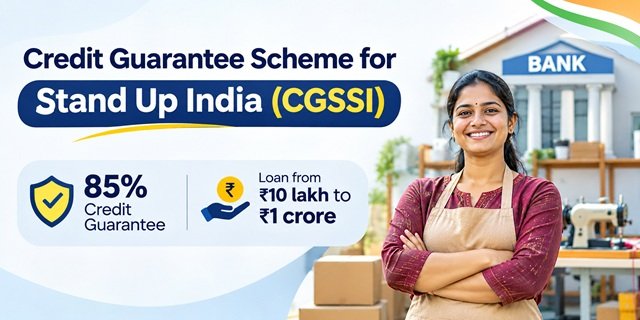
The Credit Guarantee Scheme for Stand-Up India (CGSSI) provides government-backed credit guarantee cover for bank loans given to women, Scheduled Caste and Scheduled Tribe entrepreneurs. It covers 85% of the eligible loan amount for loans above ₹10 lakh and up to ₹1 crore. The National Credit Guarantee Trustee Company Limited (NCGTC) manages the scheme. You apply for the loan through a bank, while the bank applies for the guarantee.
Credit Guarantee Scheme for Stand-Up India (CGSSI) Highlights | |
|---|---|
| Scheme Name | Credit Guarantee Scheme for Stand-Up India (CGSSI), operated through the Credit Guarantee Fund for Stand-Up India (CGFSI) |
| Scheme Type | Government-backed credit guarantee scheme, not a loan or subsidy |
| Managed By | National Credit Guarantee Trustee Company Limited (NCGTC), under the Department of Financial Services, Ministry of Finance |
| Linked Scheme | Stand-Up India Scheme, launched in April 2016 |
| Main Objective | To help banks provide collateral-free loans to eligible women, Scheduled Caste and Scheduled Tribe entrepreneurs starting new businesses |
| Cabinet Decision | 11 November 2026, approval for continuation of the Stand-Up India Scheme for five years |
| Scheme Validity | Until 31 March 2031 |
| Credit Guarantee Corpus | ₹4,111 crore |
| Additional Beneficiary Target | At least 2.5 lakh more entrepreneurs over five years |
| Beneficiaries Supported | More than 2.75 lakh women, SC and ST entrepreneurs since April 2016 |
| Credit Guarantee Cover | 85% of the loan amount |
| Standard Guarantee Fee | 0.50%, paid by the bank; reports indicate that no additional risk premium applies |
| Earlier Guarantee Cover | 80% of the amount in default, up to ₹40 lakh, for loans from ₹10 lakh to ₹50 lakh. For larger loans, ₹40 lakh plus 50% of the amount in default above ₹50 lakh, subject to a maximum of ₹65 lakh |
| Eligible Loan Amount | Above ₹10 lakh and up to ₹1 crore, as a composite loan covering a term loan and working capital, or as a term loan |
| Project Cost Coverage | Loan financing of up to 85% of the project cost |
| Eligible Borrowers | Women and Scheduled Caste or Scheduled Tribe entrepreneurs aged 18 years or above |
| Business Requirement | New or greenfield enterprise |
| Eligible Business Sectors | Manufacturing, services, trading and activities allied to agriculture |
| Ownership Requirement | At least 51% shareholding and control must remain with an eligible promoter in a partnership, company or LLP |
| Eligible Lenders | Scheduled Commercial Banks having an agreement with NCGTC |
| How to Apply | Through a bank branch, the Stand-Up Mitra portal of SIDBI or the district Lead District Manager |
| Direct Application to NCGTC | Not allowed. The bank submits the guarantee details through NCGTC’s SURGE platform |
| Guarantee Claim Rules | Reported lock-in period of about 18 months and claim timeline of about two years after the account turns bad |
| NCGTC Office Address | 1410, 14th Floor, Parinee Crescenzo, Bandra Kurla Complex, Mumbai – 400051 |
| Helpdesk Contact | ncgtc.cgfsi@ncgtc.in, 022-69035624; Board Number: 022-69035600 |
| Official Websites | NCGTC Official Website and Press Information Bureau |
Introduction of Credit Guarantee Scheme for Stand-Up India (CGSSI): A Brief Insight
A good business idea is not always enough to get a bank loan. Banks often ask for property or a guarantor as security, which can be difficult for women, Scheduled Caste and Scheduled Tribe entrepreneurs who are starting their first business. The Credit Guarantee Scheme for Stand-Up India (CGSSI) helps address this problem by providing a government-backed guarantee to banks, allowing them to lend without collateral.
The scheme operates through the Credit Guarantee Fund for Stand-Up India (CGFSI). It supports loans that banks provide under the Stand-Up India Scheme, which the Government of India launched in April 2016 to help women, Scheduled Caste and Scheduled Tribe entrepreneurs establish new businesses.
The National Credit Guarantee Trustee Company Limited (NCGTC) manages the scheme. It is a Government of India company that functions under the Department of Financial Services, Ministry of Finance.
The main objective is to reduce the risk banks face while lending to first-time entrepreneurs. With credit guarantee support, banks can consider eligible business proposals without insisting on collateral. The scheme also aims to encourage entrepreneurship and create employment opportunities among women, Scheduled Caste and Scheduled Tribe communities.
On 11 November 2026, the Union Cabinet extended the Stand-Up India Scheme for another five years, until 31 March 2031. It approved a Credit Guarantee Corpus of ₹4,111 crore and set a target of supporting at least 2.5 lakh additional entrepreneurs. Since 2016, the scheme has helped more than 2.75 lakh entrepreneurs obtain loans.
Under the revised arrangement, the credit guarantee covers 85% of the loan amount, with a standard guarantee fee of 0.50%. Eligible borrowers can obtain loans above ₹10 lakh and up to ₹1 crore. The loan can cover up to 85% of the project cost and may be provided as a composite loan combining a term loan and working capital, or as a term loan.
Women entrepreneurs and Scheduled Caste or Scheduled Tribe entrepreneurs aged 18 years or above can apply to start a new business. Eligible activities include manufacturing, services, trading and activities allied to agriculture. If the business operates as a partnership or company, eligible promoters must hold at least 51% of its shareholding and control.
You do not need to apply directly to NCGTC for the guarantee. You must apply for a Stand-Up India loan through a Scheduled Commercial Bank, the Stand-Up Mitra portal or with guidance from your district’s Lead District Manager. The bank then approaches NCGTC to obtain the guarantee cover.
If you need assistance, you can contact your bank manager, the Lead District Manager or the NCGTC helpdesk in Mumbai. You can find its address, email address and phone numbers in the contact section below.
Entrepreneurs who want to understand the loan facility can read our guide to the Stand-Up India Scheme. Founders of recognised startups can explore the Credit Guarantee Scheme for Startups, while those looking for small business loans can learn about the PM Mudra Yojana.
Young entrepreneurs looking for financial assistance through subsidies can explore the Prime Minister’s Employment Generation Programme. Startups seeking initial funding can also check the Startup India Seed Fund Scheme.
Women, Scheduled Caste and Scheduled Tribe entrepreneurs, small business owners, startup founders and other individuals looking for business loans, credit support and enterprise assistance can explore the available programmes on our List of Central Government Schemes page.
Latest Update on Credit Guarantee Scheme for Stand-Up India (CGSSI)
- Official Cabinet Announcement: The Press Information Bureau and the Prime Minister’s website published the Cabinet decision on 11 November 2026. The announcement mentions the credit guarantee cover and standard fee but does not explain how the 85% cover will apply when a bank makes a claim.
- New Operating Rules Awaited: The revised operating guidelines for the extended scheme have not yet been made available. Therefore, details such as the interest rate, repayment period and margin money requirements under the new phase remain unclear. Contact your bank to confirm the terms currently applicable.
- Loans Provided Under the Scheme: Reports state that banks had sanctioned approximately ₹62,791 crore to 2.75 lakh entrepreneurs under the Stand-Up India Scheme before its extension.
- Credit Guarantee Support for Micro Units Extended: On the same day, the Cabinet also extended the Credit Guarantee Fund for Micro Units for five years, until March 2031, with a reported corpus of ₹5,000 crore. This fund supports eligible loans under the Pradhan Mantri Mudra Yojana.
- Other Credit Guarantee Schemes Managed by NCGTC: The National Credit Guarantee Trustee Company Limited lists 20 credit guarantee schemes on its official website. Its Emergency Credit Line Guarantee Scheme 5.0 also commenced on 8 May 2026.
- What to Watch Next: Keep an eye on the revised operating guidelines, the list of participating banks and the first loans covered under the revised 85% guarantee structure.
- Prepare Before Applying: Keep your project report and required documents ready. Also, ask your bank whether it will obtain CGSSI cover for your proposed loan.
Benefits Provided to Eligible Beneficiaries
For many entrepreneurs, arranging property or a guarantor is a major obstacle when applying for a business loan. The Credit Guarantee Scheme for Stand-Up India (CGSSI) addresses this problem by providing guarantee cover to banks that finance eligible women and Scheduled Caste and Scheduled Tribe entrepreneurs. This support reduces the bank’s lending risk and makes it easier for eligible borrowers to access business finance.
The benefits below are based on the Press Information Bureau release dated 11 November 2026 and the scheme details provided.
Benefits for Borrowers
- Collateral-free loan facility: You can obtain a loan without offering collateral or arranging a third-party guarantee, subject to the bank’s lending conditions and guarantee coverage
- Loan up to ₹1 crore: Eligible entrepreneurs can access loans above ₹10 lakh and up to ₹1 crore to establish a new business
- Term loan and working capital: A composite loan can cover machinery, equipment and day-to-day business expenses through a single loan facility
- Finance for up to 85% of project cost: The loan can cover up to 85% of the project cost, while the borrower arranges the remaining contribution
- 85% credit guarantee coverage: The scheme provides guarantee cover for 85% of the loan amount, with a standard guarantee fee of 0.50%
How Banks Benefit from the Scheme
- The Government-backed guarantee reduces the bank’s risk if a borrower fails to repay the loan
- Banks can finance first-time entrepreneurs without depending entirely on property or other collateral as security
- Banks can submit eligible loan details in batches through the National Credit Guarantee Trustee Company Limited’s online platform, making the guarantee process easier to manage
Changes in Credit Guarantee Coverage
| Point | Earlier Coverage | Coverage Approved in November 2026 |
|---|---|---|
| Loan of ₹10 lakh to ₹50 lakh | 80% of the amount in default, up to ₹40 lakh | 85% of the loan amount |
| Loan above ₹50 lakh and up to ₹1 crore | ₹40 lakh, plus 50% of the amount in default above ₹50 lakh, subject to a maximum of ₹65 lakh | 85% of the loan amount |
| Guarantee Fee | Risk-based fee under the earlier scheme rules | Standard fee of 0.50%, with no additional risk premium, as reported |
| Scheme Validity | Earlier approved period | Extended until 31 March 2031 |
For example, 85% of a ₹1 crore loan equals ₹85 lakh. This is the stated guarantee coverage percentage, not a loan waiver or a direct payment to the borrower. Ask your bank or NCGTC how the coverage applies if the bank makes a guarantee claim.
Government Funding and Scheme Coverage
- ₹4,111 crore guarantee corpus: The Cabinet approved this amount to support the credit guarantee mechanism
- Extension until 31 March 2031: The scheme will continue for five more years under the extended period
- Support for 2.5 lakh more entrepreneurs: The Government aims to support at least 2.5 lakh additional women, SC and ST entrepreneurs
- More than 2.75 lakh entrepreneurs supported: The scheme has helped over 2.75 lakh entrepreneurs access loans since April 2016
What Happens When a Borrower Defaults?
- The guarantee becomes effective after the bank pays the applicable guarantee fee and remains valid for the loan period, subject to scheme conditions
- If the loan account becomes a non-performing asset (NPA), the bank may claim the guarantee after taking the required recovery action, such as proceedings before a civil court, Lok Adalat or Debt Recovery Tribunal
- The bank must submit its claim within about 2 years of the account becoming an NPA. The guarantee also carries a lock-in period of about 18 months, as reported in NCGTC’s scheme details
- The bank continues its recovery efforts. If it later recovers any amount covered by the guarantee, it must return the applicable share to the guarantee fund
- The guarantee does not transfer the borrower’s repayment responsibility to NCGTC. The bank retains its right to recover the outstanding loan from the borrower
How the Scheme Supports Your Business
- Access formal bank finance instead of depending on high-interest informal borrowing
- Start a business without arranging property as collateral, subject to the bank’s loan conditions
- Build a credit history through regular loan repayments, which may support future borrowing
- Create employment opportunities and generate income through your business in a village or town
Important Points to Remember
- The guarantee protects the bank, not the borrower. The bank still checks your business plan, repayment capacity and project viability before approving the loan
- You must repay the loan according to the agreed schedule. The guarantee does not cancel your debt or prevent the bank from taking recovery action
- The Cabinet release does not specify the interest rate, repayment period or margin money requirements for the extended phase. Confirm these details with your bank before applying
- Reports state that the Stand-Up India loan interest rate has been linked to the bank’s lowest applicable rate for the borrower’s category, subject to the prescribed limit above the bank’s base rate. Compare the terms offered by different banks
- Do not pay an agent for guarantee coverage. The credit guarantee is an arrangement between the lending bank and NCGTC
Eligibility Conditions Required to be Fulfilled
The Credit Guarantee Scheme for Stand-Up India (CGSSI) provides guarantee cover for eligible loans sanctioned under the Stand-Up India Scheme. To qualify, both the borrower and the loan must meet the prescribed conditions. The Cabinet extended the scheme until 31 March 2031 on 11 November 2026, as announced in the Press Information Bureau release.
Who Can Borrow
- A woman entrepreneur, irrespective of her social category
- A Scheduled Caste (SC) or Scheduled Tribe (ST) entrepreneur, whether male or female
- The promoter must be at least 18 years old
- The promoter must not be in default to any bank or financial institution
- Men who do not belong to the Scheduled Caste or Scheduled Tribe category are not eligible
- For a partnership, company or LLP, at least 51% of the shareholding and control must belong to an eligible woman, SC or ST entrepreneur
Loan Conditions for Guarantee Cover
- The loan amount must be above ₹10 lakh and up to ₹1 crore, as stated in the Cabinet release
- The loan can be a composite loan, combining a term loan and working capital, or a standalone term loan
- The loan can finance up to 85% of the project cost, while the borrower must arrange the remaining contribution
- The credit guarantee covers 85% of the loan amount, and the standard guarantee fee is 0.50%
- The loan must be sanctioned by a Scheduled Commercial Bank covered under the scheme
Eligible Business Activities
- The enterprise must be a new or greenfield business, not an existing business seeking expansion or modernisation
- Eligible sectors include manufacturing, services and trading
- Businesses engaged in agriculture-allied activities, such as dairy, poultry, fisheries, beekeeping and food processing, can also qualify
- The scheme covers the non-farm sector and does not cover ordinary crop cultivation or land development activities
Who Cannot Apply for the Guarantee
- Entrepreneurs seeking finance for an existing business, expansion or modernisation
- Applicants seeking a loan of ₹10 lakh or less or more than ₹1 crore
- Borrowers who are already in default to a bank or financial institution
- Applicants seeking finance for crop cultivation or activities such as digging wells and canals
- Men belonging to the general category, as the scheme covers women and SC/ST entrepreneurs
- Businesses where an eligible woman, SC or ST entrepreneur does not hold at least 51% of the shareholding and control
Conditions for Banks to Provide Guarantee Cover
- Only a Scheduled Commercial Bank that has signed an agreement with the National Credit Guarantee Trustee Company Limited (NCGTC) can claim guarantee cover
- The bank must assess the loan according to the Reserve Bank of India guidelines and the scheme’s conditions
- The bank decides whether to submit the loan for guarantee cover. NCGTC can accept or reject the proposal, so confirm with your bank whether it will obtain the guarantee for your loan
Check These Points Before Applying
- Make sure your business is new, belongs to an eligible sector and requires a loan between ₹10 lakh and ₹1 crore
- Confirm that an eligible woman, SC or ST promoter holds at least 51% of the shareholding and control
- Prepare a proper project report with the business plan, estimated costs and expected income
- Ask the bank whether it has an agreement with NCGTC and will obtain guarantee cover for your loan without collateral
- Do not pay any agent who promises to arrange loan approval or guarantee cover
Documents Required to be Attached
The Credit Guarantee Scheme for Stand-Up India (CGSSI), operated through the Credit Guarantee Fund for Stand-Up India (CGFSI), is a Government of India scheme. The National Credit Guarantee Trustee Company Limited (NCGTC), under the Department of Financial Services, Ministry of Finance, manages the scheme.
One important point makes this scheme different: the credit guarantee protects the bank, not the borrower. You do not submit any application directly to NCGTC. Instead, you submit your documents to the bank when applying for a Stand-Up India loan. The bank then approaches NCGTC to obtain the guarantee cover for your loan.
This section covers three types of documents: the papers you submit to the bank, the documents the bank files to obtain the guarantee, and the records it needs to claim the guarantee if the loan becomes a non-performing asset.
Your Identity and Category Papers
- Aadhaar Card and PAN Card of the promoter, for identity verification and credit checks
- Category certificate, such as a caste certificate for applicants belonging to the Scheduled Caste or Scheduled Tribe category
- Proof of age, to confirm that the promoter is at least 18 years old
- Recent photographs of the promoter and address proof, if required by the bank
Papers About Your Business and Its Owners
- For a proprietorship, Udyam registration, if available, and proof of the business address
- For a partnership, company or LLP, the partnership deed or certificate of incorporation, along with documents showing the ownership structure
- For such businesses, proof that at least 51% of the shareholding and control belong to a woman, a Scheduled Caste person or a Scheduled Tribe person
- A declaration confirming that the business is new, as the Stand-Up India loan supports only new or greenfield enterprises
Your Project and Money Papers
- A project report explaining the business activity, required machinery, working capital, expected sales and employment opportunities
- Quotations for machinery and equipment, along with proof of the business premises, such as a rent agreement or property document
- Proof of your ability to contribute your own share of the project cost. The borrower must contribute at least 10%, while another scheme may provide the remaining margin money
- Bank statements and, if available, income tax returns to help the bank assess your financial history
- A declaration confirming that you are not a bank defaulter, along with consent for the bank to check your credit report
What the Bank Files With NCGTC for the Guarantee
You do not submit these documents yourself. The bank handles this process, but knowing what happens can help you follow up with the bank and understand how it obtains the guarantee cover.
- An agreement between the bank and NCGTC, which the bank must sign before claiming any guarantee
- A list of sanctioned loans submitted quarterly to NCGTC through its online platform, SURGE, within the prescribed timeline
- A management certificate confirming that the loans included in the list meet the requirements of the Stand-Up India Scheme
- The guarantee fee paid by the bank to NCGTC. The Government has fixed the standard fee at 0.50%. Ask your bank in writing whether it passes any part of this fee on to you
Papers the Bank Needs to Claim the Guarantee
If your loan account becomes a non-performing asset (NPA), the bank may claim the guarantee. These documents are the bank’s responsibility, but they also show why you should repay your loan on time and maintain proper financial records.
- The loan account ledger, showing the sanctioned amount, disbursements, date of default and outstanding dues on that date
- Proof that the bank has started legal recovery proceedings, such as proceedings before a Lok Adalat, civil court or Debt Recovery Tribunal, a notice under the SARFAESI Act, or an application before the National Company Law Tribunal
- The bank must submit its claim within 2 years of the account becoming an NPA. The guarantee also has a lock-in period of 18 months, as reported in NCGTC’s scheme details
How Beneficiaries Can Apply to Avail the Benefit of this Scheme
You do not need to apply directly to the National Credit Guarantee Trustee Company Limited (NCGTC) for the Credit Guarantee Scheme for Stand-Up India (CGSSI). First, you apply for a loan under the Stand-Up India Scheme. After that, the bank approaches NCGTC to get the credit guarantee for your loan.
Think of it this way: you give your application to the bank, and the bank takes care of the guarantee process with NCGTC. Your main job is to prepare a good business plan and submit the required documents. You can approach a bank in three ways. Follow the steps below to understand each method. To learn more about the loan scheme, read our guide to the Stand-Up India Scheme.
Before You Start
Step 1: Check whether you are a woman entrepreneur or belong to the Scheduled Caste or Scheduled Tribe category. You must also be at least 18 years old.
Step 2: Make sure your business is new and belongs to manufacturing, services, trading or an activity allied to agriculture.
Step 3: Decide how much money you need. The loan must be above ₹10 lakh and up to ₹1 crore. Also, arrange your own contribution towards the project cost.
Step 4: Collect your documents, including your Aadhaar card, PAN card, caste certificate, if applicable, and business-related papers. Check the documents section of this guide for the details.
Step 5: Prepare a clear project report. Explain what you plan to make or sell, which machines you need, how much money you expect to earn and how many people you plan to employ.
Method 1: Apply Directly at a Bank Branch
Step 1: Visit a nearby Scheduled Commercial Bank branch, such as a public sector bank or a private sector bank covered under the scheme.
Step 2: Meet the bank manager or loan officer and explain that you want a Stand-Up India loan to start a new business.
Step 3: Ask for the loan application form and fill it in with the correct personal and business details.
Step 4: Submit your documents and project report to the bank. Collect an acknowledgement or receipt for your application.
Step 5: Ask the bank in writing whether it will obtain credit guarantee cover for your loan so that you do not have to provide collateral.
Step 6: Answer the bank’s questions and explain your business plan. The bank will examine your project before deciding whether to approve the loan.
Method 2: Apply Through the Stand-Up Mitra Portal
Step 1: Visit the Stand-Up Mitra portal of SIDBI using your mobile phone or computer.
Step 2: Register on the portal and select your applicant category, such as woman, Scheduled Caste or Scheduled Tribe.
Step 3: Enter your personal details and information about your proposed business in the application form.
Step 4: Select the bank and branch where you want to submit your loan application, and complete the submission process.
Step 5: Save your application number. You may need it to track your application later.
Step 6: Visit the selected bank branch after a few days with your documents and project report. The bank will still need to examine your application and business plan.
Method 3: Take Help from the Lead District Manager
Step 1: Find the Lead District Manager (LDM) of your district. The LDM is a senior bank officer who coordinates banking activities across the district. You can ask at a bank branch or district office for the contact details.
Step 2: Explain that you want to apply for a Stand-Up India loan and ask which bank branch can handle your application.
Step 3: Note down the bank branch and the officer’s details. Visit the branch with your documents and project report.
Step 4: Submit your application by following the steps explained under Method 1.
What Happens at the Bank
Step 1: The bank checks your documents, business plan and credit history to see whether you meet the loan conditions.
Step 2: If the bank finds your project suitable, it may sanction a composite loan combining a term loan and working capital, or a standalone term loan.
Step 3: If the bank obtains credit guarantee cover for your loan, it may provide finance without collateral or a third-party guarantee, subject to the scheme rules.
Step 4: Read all loan terms carefully before signing. Ask the bank for a copy of every document you sign.
What the Bank Does With NCGTC for the Guarantee
You do not need to complete this process yourself. The bank handles the guarantee application, but understanding these steps will help you follow up on your loan.
Step 1: The bank must have a valid agreement with NCGTC before it can obtain guarantee cover.
Step 2: The bank collects details of the eligible Stand-Up India loans it has sanctioned during a quarter.
Step 3: The bank submits these loan details in a batch through NCGTC’s online platform, SURGE, within the prescribed timeline. It also provides the required management certificate.
Step 4: The bank pays the applicable guarantee fee. The guarantee becomes effective according to the scheme rules after the required fee payment.
After You Get the Loan
Step 1: Use the loan amount only for the business purpose mentioned in your approved project report.
Step 2: Pay your loan instalments on time. Remember that the credit guarantee does not cancel your repayment responsibility.
Step 3: Keep your purchase bills, bank statements, sales records and other business documents safe.
Step 4: If you face difficulty repaying the loan, contact your bank manager early. Do not wait until your account becomes overdue or turns into a non-performing asset.
If the Bank Rejects Your Application
Step 1: Ask the bank to explain the rejection in writing. Find out whether the problem relates to your project, documents, credit history or bank requirements.
Step 2: Correct the problem, such as improving your project report or submitting missing documents, before applying again.
Step 3: You can approach another eligible bank branch or ask the Lead District Manager to guide you.
Step 4: If your business is a recognised startup, you can also read our guide to the Credit Guarantee Scheme for Start-ups to understand its separate credit guarantee facility.
If You Need Help
Step 1: Contact your bank manager or the Lead District Manager of your district for help with the loan application.
Step 2: If you need clarification about the guarantee, contact the National Credit Guarantee Trustee Company Limited (NCGTC) through its official contact page.
Important: You cannot apply directly to NCGTC for the credit guarantee. Your bank processes the guarantee request after considering your loan application. The guarantee is an arrangement between the bank and NCGTC, so do not pay any agent who promises to arrange a loan or guarantee for you.
Stand-Up India Loan, CGSSI and the Credit Guarantee Scheme for Startups: What Is the Difference?
Entrepreneurs often confuse the Stand-Up India Scheme, CGSSI and the Credit Guarantee Scheme for Startups because all three support business loans. However, they serve different purposes. The Stand-Up India Scheme provides the loan, while CGSSI and the Credit Guarantee Scheme for Startups provide guarantee cover to banks. The table below explains their key differences, including who can benefit and who submits the application.
| Point | Stand-Up India Scheme | Credit Guarantee Scheme for Stand-Up India (CGSSI) | Credit Guarantee Scheme for Startups (CGSS) |
|---|---|---|---|
| What It Is | A bank loan scheme for eligible entrepreneurs | A credit guarantee that covers eligible loans provided under the Stand-Up India Scheme | A credit guarantee scheme that covers eligible loans given to recognised startups |
| Who It Is For | Women and Scheduled Caste or Scheduled Tribe entrepreneurs starting a new business | Banks providing eligible Stand-Up India loans to entrepreneurs | Startups recognised by the Department for Promotion of Industry and Internal Trade (DPIIT) |
| Who Applies | The entrepreneur applies through a bank, the Stand-Up Mitra portal or the Lead District Manager | The lending bank applies to the National Credit Guarantee Trustee Company Limited (NCGTC) | The eligible lending institution applies to NCGTC |
| Loan Amount | Above ₹10 lakh and up to ₹1 crore | Covers eligible Stand-Up India loans above ₹10 lakh and up to ₹1 crore | Up to ₹20 crore per borrower |
| What You Get | A bank loan to establish a new business | Credit guarantee support that helps the bank provide the loan without collateral | Credit guarantee support that helps eligible startups obtain loans without collateral |
| Who Manages It | Department of Financial Services, Ministry of Finance, through participating banks and SIDBI | National Credit Guarantee Trustee Company Limited (NCGTC) | National Credit Guarantee Trustee Company Limited (NCGTC) |
Which Scheme Should You Consider?
- If you are a woman or a Scheduled Caste or Scheduled Tribe entrepreneur planning to start a new business, apply for a Stand-Up India loan and ask your bank about CGSSI guarantee cover.
- If your business is a DPIIT-recognised startup and you need a larger loan, explore the Credit Guarantee Scheme for Startups.
- If you need a smaller business loan of up to ₹10 lakh, the PM Mudra Yojana may be worth considering.
- If your business appears eligible under more than one scheme, compare the loan conditions, interest rates and other applicable terms with your bank before choosing.
Important Links Available of the Scheme
- Stand-Up India Scheme Continuation and Credit Guarantee Details, Press Information Bureau
- Cabinet Decision on the Continuation of the Stand-Up India Scheme, PM India
- National Credit Guarantee Trustee Company Limited (NCGTC), Official Website
- Credit Guarantee Scheme for Stand-Up India (CGSSI), FAQs and Claim Process
- NCGTC Contact Details and CGSSI Helpdesk
- Stand-Up Mitra Portal, Apply for a Stand-Up India Loan
Contact Details in Case of Help Needed
- Office: National Credit Guarantee Trustee Company Limited (NCGTC), Department of Financial Services, Ministry of Finance, 1410, 14th Floor, Parinee Crescenzo, Plot No. C-38 and C-39, G-Block, Bandra Kurla Complex, Bandra East, Mumbai, Maharashtra – 400051
- CGSSI Helpdesk Email: ncgtc.cgfsi@ncgtc.in
- CGSSI Helpdesk Phone: 022-69035624 and 022-69035607
- Board Number: 022-69035600
- General Email: info@ncgtc.in
- Grievance Email: grievance@ncgtc.in
- Your Bank: The manager of the branch where you apply, who decides on your loan and who files the guarantee with NCGTC
- Lead District Manager: The senior bank officer of your district, who can tell you which bank can take your Stand-Up India application
Frequently Asked Questions (FAQs)
Ans. It is a Government of India scheme that provides credit guarantee cover for eligible bank loans given to women, Scheduled Caste and Scheduled Tribe entrepreneurs under the Stand-Up India Scheme. This guarantee reduces the bank’s risk and helps eligible borrowers get loans without collateral.
Ans. The National Credit Guarantee Trustee Company Limited (NCGTC), a Government of India company under the Department of Financial Services, Ministry of Finance, manages the scheme. Visit its official website for more information.
Ans. The Union Cabinet approved the continuation of the Stand-Up India Scheme for five more years, until 31 March 2031, on 11 November 2026, as stated in the Press Information Bureau release.
Ans. The Cabinet approved credit guarantee cover of up to 85% of the eligible loan amount. Under the earlier structure, the guarantee cover was 80% for loans up to ₹50 lakh, with a different coverage formula for larger loans.
Ans. The standard guarantee fee is 0.50%, which the bank pays to NCGTC. Reports indicate that no additional risk premium applies. Ask your bank whether it will pass any part of this fee on to you.
Ans. The Cabinet approved a Credit Guarantee Corpus of ₹4,111 crore. The fund aims to support at least 2.5 lakh additional women, Scheduled Caste and Scheduled Tribe entrepreneurs over the next five years.
Ans. No. The guarantee protects the bank, not the borrower. You must apply for a Stand-Up India loan through a bank or the Stand-Up Mitra portal. The bank then approaches NCGTC for the guarantee.
Ans. Women entrepreneurs and Scheduled Caste or Scheduled Tribe entrepreneurs aged 18 years or above can apply for a loan to start a new, or greenfield, enterprise. For a partnership or company, at least 51% of the shareholding and control must remain with an eligible woman or SC/ST promoter.
Ans. Eligible borrowers can apply for a loan above ₹10 lakh and up to ₹1 crore. The bank may provide it as a composite loan covering a term loan and working capital, or as a term loan. The loan can finance up to 85% of the project cost.
Ans. New enterprises in manufacturing, services, trading and activities allied to agriculture can qualify. Ordinary crop cultivation is not covered under the scheme.
Ans. You can visit a Scheduled Commercial Bank branch, submit an application through the Stand-Up Mitra portal of SIDBI, or seek guidance from your district’s Lead District Manager. The application section above explains these methods.
Ans. The bank can provide the loan without collateral or a third-party guarantee when it obtains credit guarantee cover under the scheme. Ask the bank to confirm the guarantee coverage in writing before accepting the loan.
Ans. The credit guarantee does not waive your loan repayment obligation. If your account becomes a non-performing asset, the bank may claim the guarantee after taking the required recovery steps. The bank can still recover the outstanding amount from you. Contact your bank early if you face repayment difficulties.
Ans. The Cabinet release does not specify the revised interest rate or margin money requirements. Reports indicate that the loan may carry the bank’s lowest applicable rate for the relevant category, subject to a limit above its base rate, and that the borrower may need to contribute at least 10% of the project cost. Confirm the applicable terms with your bank before applying.
Ans. Contact your bank manager or the Lead District Manager first. You can also reach the NCGTC helpdesk at ncgtc.cgfsi@ncgtc.in or 022-69035624. Do not pay any agent who promises to arrange a loan or credit guarantee.

Tabassum is a government schemes researcher and writer with 5 years of experience tracking Central and State welfare scheme programmes across India. She has covered 500+ schemes spanning agriculture, women welfare, education, and housing, helping lakhs of beneficiaries understand their entitlements in simple language.