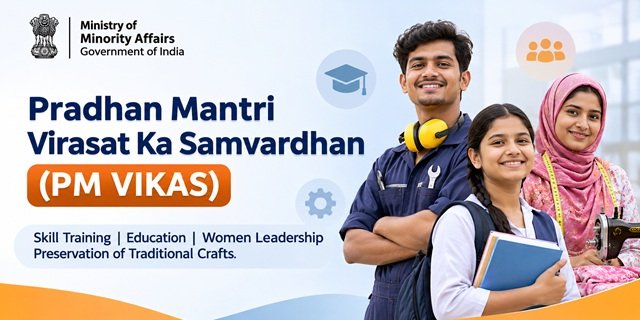
The Pradhan Mantri Virasat Ka Samvardhan (PM VIKAS), run by the Ministry of Minority Affairs, provides skill training to minority youth and artisans, helps women develop leadership and business skills, and supports school dropouts in completing their education. The Ministry covers the full training cost under the eligible components and provides stipends of ₹2,000 to ₹3,000 per month for non-residential skilling. Eligible candidates aged 14 to 45 years can apply through the Skill India Digital Hub.
Pradhan Mantri Virasat Ka Samvardhan (PM VIKAS) Highlights | |
|---|---|
| Scheme Name | Pradhan Mantri Virasat Ka Samvardhan (PM VIKAS) |
| Implementing Ministry | Ministry of Minority Affairs, Government of India |
| Earlier Schemes Merged | Seekho Aur Kamao, USTTAD, Hamari Dharohar, Nai Roshni and Nai Manzil |
| Main Objective | To improve skills and employment opportunities, preserve traditional crafts, promote women’s leadership and entrepreneurship, and help school dropouts continue their education |
| Major Components | Skilling and training, women leadership and entrepreneurship, education through open schooling, and community infrastructure |
| Eligible Communities | Muslim, Christian, Buddhist, Sikh, Jain and Parsi communities |
| Age Limit | 14 to 45 years for skilling and education; 18 to 45 years for women leadership and entrepreneurship |
| Required Documents | Aadhaar card, Aadhaar-linked bank account, proof of age, educational documents and minority community declaration or certificate, as applicable |
| Training Cost | Fully covered by the Ministry for skilling, women leadership and education components |
| Modern Skilling Stipend | ₹2,000 per month for non-residential training and ₹1,000 per month for residential training |
| Traditional Training Stipend | ₹3,000 per month for non-residential training and ₹1,500 per month for residential training |
| Women Leadership Stipend | ₹200 per day |
| Education Stipend | ₹1,000 per month for 6 months |
| Skilling Course Duration | 3 to 12 months, with a maximum of 30 candidates in each batch |
| Women Leadership Training | 60 hours of leadership training, followed by 120 hours of entrepreneurship training and 240 hours of advanced training for selected Biz Sakhis |
| Seats Reserved for Women | At least 33% in skilling, at least 50% in education, and the entire women leadership component |
| Seats Reserved for Persons with Disabilities | 3% in every component |
| Seats for Other Communities | Up to 25% in traditional training and 15% in other components for eligible candidates from the Economically Weaker Section of non-minority communities |
| Placement Target | At least 75% of modern skilling candidates, with at least 50% of placements in the organised sector |
| Minimum Attendance | 70% to appear for the assessment |
| Training Target | Approximately 1.51 lakh candidates across 27 States and Union Territories, including 5,780 candidates in Uttarakhand |
| Application Process | Register as a learner on the Skill India Digital Hub, find a PM VIKAS course and apply for a suitable training batch |
| Contact Numbers | 011-24364312, 011-24360857 |
| Email Address | PMVIKAS-mma@gov.in |
| Official Portals | PM VIKAS Portal and Skill India Digital Hub |
Introduction of Pradhan Mantri Virasat Ka Samvardhan (PM VIKAS): A Brief Insight
A skilled weaver who cannot find buyers, a girl who leaves school after Class 8, and a graduate struggling to find a job face different challenges but often share one problem. They lack the right skills, opportunities and financial support to move forward. The Pradhan Mantri Virasat Ka Samvardhan (PM VIKAS) aims to bridge this gap by providing skill training, education support and opportunities for self-employment.
The Government of India approved the scheme guidelines in January 2025. It brings five earlier schemes of the Ministry of Minority Affairs under one programme: Seekho Aur Kamao, USTTAD, Hamari Dharohar, Nai Roshni and Nai Manzil.
The Ministry of Minority Affairs implements PM VIKAS as a Central Sector Scheme. Selected training agencies carry out its activities and provide training to eligible beneficiaries across the country.
The scheme focuses on improving skills and employment opportunities among minority communities while preserving their traditional arts and crafts. It also supports women who want to become community leaders or start businesses, helps school dropouts continue their education, and connects beneficiaries with credit and market opportunities.
PM VIKAS covers four major components: skilling and training, women leadership and entrepreneurship, education through the National Institute of Open Schooling, and community infrastructure development through the Pradhan Mantri Jan Vikas Karyakram.
The Ministry covers the full training cost under the first three components. Eligible candidates also receive financial support during training. For non-residential courses, the monthly stipend is ₹2,000 for modern skilling and ₹3,000 for traditional training.
Women participating in the leadership component receive ₹200 per day, while eligible school dropouts in the education component receive ₹1,000 per month for six months. The scheme also sets a placement target of at least 75% for candidates trained under modern skilling.
Applicants must belong to one of the six notified minority communities: Muslim, Christian, Buddhist, Sikh, Jain or Parsi. The general age limit is 14 to 45 years, while women applying for the leadership and entrepreneurship component must be 18 to 45 years old. Applicants also need an Aadhaar card and an Aadhaar-linked bank account.
PM VIKAS reserves at least 33% of the skilling seats for women and 3% of the seats across all components for persons with disabilities. The scheme also provides a limited share of seats to eligible candidates from the Economically Weaker Section of other communities.
Eligible candidates can register as learners on the Skill India Digital Hub, search for available PM VIKAS courses and apply for a suitable training batch. The training agency verifies their documents and confirms admission. Candidates must maintain at least 70% attendance to appear for the assessment.
For assistance, applicants can email the PM VIKAS Division at PMVIKAS-mma@gov.in or call 011-24364312. By February 2026, the Ministry had assigned training targets for approximately 1.51 lakh candidates across 27 States and Union Territories.
Artisans and young people interested in learning traditional trades can also explore the PM Vishwakarma Yojana. Those looking for other skill development opportunities can read about the PM Kaushal Vikas Yojana. People planning to start a small business can also explore the PM Mudra Yojana.
Youth, women, artisans and students looking for more opportunities in skill development, education and employment can explore other Central Government programmes on our Central Government List of Welfare and Popular Schemes page.
Latest Update on Pradhan Mantri Virasat Ka Samvardhan (PM VIKAS)
- Budget Allocation: The Ministry allocated ₹255.43 crore for 2024-25 but did not spend any amount during that year, as the scheme had only recently started. For 2025-26, the initial allocation was ₹267.29 crore, which was later revised to ₹200 crore. By February 2026, the Ministry had spent ₹92.28 crore.
- Start of Training: In February 2026, the Ministry reported that candidate training had started only during 2025-26. It also stated that it would identify and address implementation challenges as the scheme progressed.
- Training Targets in December 2025: The Ministry had assigned targets for approximately 1.40 lakh candidates by December 2025. This included 22,000 candidates under the education component, 3,380 under women leadership, and around 1.15 lakh under skilling.
- Courses with the Highest Targets: Some of the largest job-role targets included Broadband Network Technician with 6,050 seats, Traditional Hand Embroiderer with 6,000, Airline Cabin Crew with 6,000, Technical Artist for AR and VR with 4,980, and General Duty Assistant with 4,950.
- Training in New-Age Skills: The available job roles also cover emerging fields such as artificial intelligence, drone technology, solar installation, electric vehicle repair, the Internet of Things (IoT) and 5G installation.
- Candidate Enrolment: Reports published in July 2026 stated that approximately 80,918 minority candidates had enrolled across the skilling, entrepreneurship and education components.
- Scheme Period: The Ministry aligned the scheme with the Finance Commission cycle ending in 2025-26. Candidates and training agencies should contact the Ministry or the concerned training centre for information about training opportunities beyond this period.
- Prepare Before Applying: Link your Aadhaar with your bank account and create your learner profile on the Skill India Digital Hub. Completing these steps early can help you apply when a suitable training batch becomes available.
Benefits Provided to Eligible Beneficiaries
Many young people want to learn new skills but cannot afford training fees or take time away from earning for several months. The Pradhan Mantri Virasat Ka Samvardhan (PM VIKAS) scheme, launched by the Ministry of Minority Affairs, addresses these challenges by covering training costs and providing financial support during the learning period. It funds the skilling, women leadership and education components entirely, allowing eligible candidates to develop their skills without paying for the training.
Training at No Cost to the Candidate
- The Ministry of Minority Affairs covers 100% of the training cost for the skilling, women leadership and education components through the implementing agency.
- Candidates receive training in job roles aligned with the National Skills Qualifications Framework and a certificate after successfully completing the assessment.
- Training takes place at an accredited Skill India Digital Hub centre, with a maximum of 30 candidates in each batch.
- The scheme also covers the cost of assessment and certification.
Monthly Stipend for Skilling
- Non-traditional (modern) skilling: ₹2,000 per month for non-residential training and ₹1,000 per month for residential training.
- Traditional training for artisans: ₹3,000 per month for non-residential training and ₹1,500 per month for residential training.
- The stipend is available during the training period, up to a maximum of 12 months, and is transferred to the candidate’s Aadhaar-linked bank account.
What the Stipend Adds Up To
- A 6-month non-residential modern skilling course provides ₹12,000, while a 12-month course provides ₹24,000.
- A 6-month non-residential traditional training course provides ₹18,000, while a 12-month course provides ₹36,000.
- For residential training, a 6-month traditional course provides ₹9,000, while a modern skilling course provides ₹6,000.
- These amounts are examples. The actual stipend depends on the course duration and the candidate’s attendance.
Support After You Get a Job
- Candidates under the non-traditional skilling component receive ₹2,000 in post-placement support for each month over a period of 2 months.
- The implementing agency tracks candidates for at least 3 months after training. A candidate counts as placed after remaining in the job for three months.
- Each agency must place at least 75% of the candidates it trains through employment, self-employment or apprenticeships. At least 50% of these placements must be in the organised sector.
Women Leadership and Entrepreneurship
- A 60-hour programme covers leadership and basic entrepreneurship. Its subjects include personality development, financial inclusion, legal rights, digital literacy and communication with banks and government offices.
- Half of the women who complete the first programme can receive an additional 120 hours of entrepreneurship training.
- Among those who complete the entrepreneurship training, 10% can receive a further 240 hours of training to become Biz Sakhis. They help other women in their communities by providing guidance at their doorsteps.
- Participants receive a stipend of ₹200 per day. For a 60-hour programme with eight training hours per day, the total comes to approximately ₹1,500.
- Interested women receive career counselling. The scheme also aims to help at least 30% of the women who complete entrepreneurship training to start their own enterprises.
Education for School Dropouts
- School dropouts receive coaching to complete Class 8, Class 10 or Class 12 through the National Institute of Open Schooling (NIOS) and obtain the corresponding certificate.
- Eligible candidates receive a stipend of ₹1,000 per month for 6 months, amounting to ₹6,000.
- The Ministry covers ₹16,000 towards coaching and ₹4,000 towards assessment for each candidate. Therefore, candidates do not have to pay these costs.
- At least 50% of the available seats in this component are reserved for women.
Credit and Market Support
- Artisans and entrepreneurs receive assistance in accessing loans from the National Minorities Development and Finance Corporation, banks and other lenders for working capital or business expansion.
- The scheme supports the formation of Self Help Groups and Artisan Producer Organizations to improve access to credit and markets.
- Artisans and food experts can participate in fairs and Parvs to display and sell their products and connect with potential buyers.
- Product catalogues and e-commerce support help artisans reach customers in domestic and international markets.
- Beneficiaries also receive information about other available support programmes, including the Pradhan Mantri Mudra Yojana.
Support for the Heritage and the Community
- The scheme promotes the preservation of traditional arts and crafts that are at risk of disappearing. It also supports the documentation and promotion of calligraphy, manuscripts and oral traditions.
- Artisans can attend specialised workshops on product design, packaging, quality control and online selling.
- The scheme also supports community infrastructure in minority-concentration areas through the Pradhan Mantri Jan Vikas Karyakram.
Good to Know
- The 75% placement figure is an implementing agency target. It does not guarantee a job to every candidate.
- The stipend is transferred to the candidate’s Aadhaar-linked bank account. The training agency records attendance through a biometric system.
- Candidates must maintain at least 70% attendance to appear for the assessment.
- Check the available courses, training centres and batches in your State through the official portal, as each implementing agency has its own assigned target.
Eligibility Conditions Required to be Fulfilled
The Pradhan Mantri Virasat Ka Samvardhan (PM VIKAS) scheme mainly supports youth, women and artisans from the six notified minority communities. The Ministry of Minority Affairs has set eligibility conditions for each component, covering age, education, community and other requirements. Applicants should identify the component that matches their needs and check whether they meet its conditions before applying.
Who Can Apply
- A candidate who holds Indian nationality
- A candidate belonging to one of the six notified minority communities: Muslim, Christian, Buddhist, Sikh, Jain or Parsi
- A candidate with an Aadhaar card and an Aadhaar-linked bank account at the time of registration
- A candidate who meets the minimum educational qualification and work experience required for the selected job role under the National Skills Qualifications Framework
Age Limits by Component
- Traditional training, non-traditional skilling and the education component: Applicants must be 14 to 45 years old. The scheme gives preference to candidates from the Economically Weaker Section.
- Women leadership and entrepreneurship component: Applicants must be 18 to 45 years old.
Who Can Take Which Component
- Traditional training: Minority artisans and craft persons, including those involved in traditional art forms that are declining or at risk of disappearing
- Non-traditional skilling: Minority youth interested in learning modern job skills in sectors such as manufacturing, services, healthcare and information technology
- Women leadership and entrepreneurship: Women belonging to the notified minority communities
- Education: School dropouts who want to complete Class 8, Class 10 or Class 12 through open schooling
Seats for Women
- At least 33% of the seats in traditional training and non-traditional skilling are reserved for women.
- At least 50% of the seats in the education component are reserved for women.
- The women leadership and entrepreneurship component is exclusively for women.
Seats for Persons with Disabilities
- 3% of the seats in each component are reserved for persons with disabilities.
- The scheme also directs implementing agencies to reach disadvantaged groups, including persons with disabilities and transgender persons.
Candidates from Other Communities
- Candidates from non-minority families who belong to the Economically Weaker Section can occupy up to 25% of the seats in traditional training and up to 15% in the other components.
- Candidates from communities recognised as minorities only by a State or Union Territory can also participate. However, they can occupy no more than 5% of the seats, and the State Government must provide written confirmation.
- If a reserved seat remains vacant, the implementing agency treats it as an unreserved seat.
Conditions During the Training
- Candidates must attend at least 70% of the course to appear for the assessment.
- A skilling course must run for at least 3 months and no more than 12 months. Each batch can have a maximum of 30 candidates.
- The women leadership course includes 60 hours of training, followed by 120 hours of entrepreneurship training and another 240 hours for participants who become Biz Sakhis.
- The education and women leadership components do not provide residential training.
Who Is Not Eligible
- A candidate who does not belong to a notified minority community, except those eligible under the Economically Weaker Section seats for other communities
- A candidate below 14 years or above 45 years of age. For the women leadership component, women below 18 years are not eligible.
- A man applying for the women leadership and entrepreneurship component, as this component is exclusively for women
- A candidate who does not meet the educational qualification or experience required for the selected job role
- A candidate whose attendance falls below 70%, as they cannot appear for the course assessment
Check Before You Apply
- Confirm that your age falls within the limit for your chosen component.
- Make sure your Aadhaar card and bank account are linked, or ask the training agency for assistance.
- Check the educational qualification and work experience required for your selected course.
- Find out which implementing agency and training batch are available in your State, as each agency works according to its assigned targets.
Documents Required to be Attached
The Pradhan Mantri Virasat Ka Samvardhan (PM VIKAS) scheme, run by the Ministry of Minority Affairs, provides skill training to minority youth and women, supports school dropouts in continuing their education and helps women develop entrepreneurial skills. A Project Implementing Agency (PIA) handles enrolment and verifies the documents required for each training component. These documents establish the applicant’s identity, minority community, age and educational background. The Ministry’s scheme guidelines specify certain requirements, while additional documents may depend on the selected course. Applicants should confirm the final document list with the training centre or through the official portal before enrolment.
Identity Papers
- Aadhaar Card of the applicant, as required during registration
- Mobile number linked to Aadhaar for completing e-KYC through the Skill India Digital Hub
- Recent passport-size photograph of the applicant
Bank Details
- Aadhaar-linked bank account to receive the stipend
- First page of the bank passbook showing the account number and IFSC code
- If the applicant does not have an Aadhaar card or an Aadhaar-linked bank account, the PIA helps arrange these before the training begins.
Proof of Minority Community
- Declaration or certificate confirming that the applicant belongs to one of the six notified minority communities: Muslim, Christian, Buddhist, Sikh, Jain or Parsi
- For applicants belonging to a community recognised as a minority only by the State Government, an assertion from the State Government, as these applicants can occupy up to 5% of the available seats
Proof of Age
- Proof of date of birth, such as a Class 10 marksheet or birth certificate
- The applicant must be 14 to 45 years old for skill training, traditional training and the education component.
- The applicant must be 18 to 45 years old for the women leadership and entrepreneurship component.
Proof of Education and Experience
- Mark sheets and certificates of the highest class passed, to establish the minimum educational qualification required for the selected job role
- Documents showing the required work experience, wherever applicable to the selected job role
- Proof of the applicant’s craft or trade, such as a letter from a guild, society or master artisan, for traditional training
Papers for the Education Component
- School records or a transfer certificate showing that the applicant left school before completing the required education
- Details of the last class passed, so the PIA can enrol the applicant in Class 8, Class 10 or Class 12 through open schooling
- Documents required for registration with the National Institute of Open Schooling (NIOS), as advised by the PIA
Papers for Women Leadership and Entrepreneurship
- Proof that the applicant is a woman, as recorded on her Aadhaar card
- Details of the village or locality where she lives, as the training focuses on developing community leaders
- A brief note describing her business idea, if she wishes to pursue the entrepreneurship module
Papers for the Reserved Seats
- Disability certificate or UDID card for applicants with disabilities, who can apply under the 3% seat reservation
- Economically Weaker Section (EWS) certificate for applicants from non-minority families, for the reserved seats of up to 25% in traditional training and 15% in the other components
Papers to Keep During the Training
- Enrolment confirmation or invitation letter issued by the training centre
- Attendance record, as applicants must attend at least 70% of the course to appear for the assessment
- Assessment result and certificate issued after completing the course
- Offer letter along with salary slips or a bank statement if the applicant secures a job, as the PIA tracks placement for at least three months
How Beneficiaries Can Apply to Avail the Benefit of this Scheme
You can apply for the Pradhan Mantri Virasat Ka Samvardhan (PM VIKAS) scheme online through the Skill India Digital Hub. First, create your learner account and complete your profile. Then, search for a PM VIKAS course and choose a suitable training centre near you. After you submit your application, the training agency checks your details and documents before confirming your admission. The Ministry of Minority Affairs calls this training agency a Project Implementing Agency (PIA). Follow the steps below to understand the complete application process.
Before You Start
Step 1: Check whether you belong to one of the six notified minority communities: Muslim, Christian, Buddhist, Sikh, Jain or Parsi.
Step 2: Check your age before choosing a course. You must be between 14 and 45 years for skilling and the education component. For women leadership training, the age limit is 18 to 45 years.
Step 3: Decide which type of training you want to join. You can choose a modern skill, learn a traditional craft, complete your school education through open schooling, or join leadership and entrepreneurship training for women.
Step 4: Keep your Aadhaar card, Aadhaar-linked mobile number and bank passbook ready. Your bank account must also be linked with Aadhaar.
Step 5: Keep your educational marksheets and proof of age ready. You may also need other documents according to the course you choose.
Step 6: Read the PM VIKAS beneficiary eligibility conditions before applying.
Step 7: If you want to understand the complete rules, read the PM VIKAS guidelines issued by the Ministry of Minority Affairs.
Apply Online on the Skill India Digital Hub
Step 1: Visit the official Skill India Digital Hub website using your mobile phone or computer.
Step 2: Register yourself as a learner if you are using the portal for the first time. If you already have an account, log in with your existing details.
Step 3: Complete your e-KYC using your Aadhaar number. Enter the OTP sent to your registered mobile number to verify your identity.
Step 4: Fill in your personal information, educational details and contact information carefully. Check all the entries before moving ahead.
Step 5: Open your dashboard after logging in and search for the PM VIKAS scheme.
Step 6: Apply the available filters to find suitable courses and training batches. You can use the scheme, training mode and sector options to narrow down your search.
Step 7: Select a course and training centre that suits your location and requirements. Read the course details, subjects and training duration before making your choice.
Step 8: Select the batch you want to join and submit your interest. This action sends your application for that batch. You may apply for more than one batch to improve your chances of getting a seat.
Step 9: Review your application details carefully. If everything is correct, submit the application.
Step 10: Save your application details and take a screenshot for future reference. You may need these details to check your application status.
After You Apply
Step 1: After submission, the training centre checks your age, educational qualifications and supporting documents to confirm whether you meet the course requirements.
Step 2: Log in to your dashboard and open the Applications section to check the latest status of your application.
Step 3: If the training centre approves your application, accept its invitation through the portal. This step confirms that you want to join the selected batch.
Step 4: Visit the training centre on the date mentioned in the invitation. Carry your original documents so the centre can verify them.
Step 5: If you do not have an Aadhaar card or your bank account is not linked with Aadhaar, ask the training centre for help. The agency must help complete these requirements before your training begins.
Join Through a Training Agency
Step 1: Contact a training agency working in your area. These agencies help identify interested candidates, explain the available courses and guide them through enrolment.
Step 2: Ask the agency which PM VIKAS courses and training batches it currently offers.
Step 3: If you meet the requirements, the agency can help enrol you through the scheme portal. It also records candidate and batch details on the portal.
Step 4: Discuss the available job roles with the agency. Choose a course that matches your education, interests and career plans.
Attend the Training
Step 1: Attend your classes regularly. You must maintain at least 70% attendance to appear for the final assessment.
Step 2: Mark your attendance through the biometric system used by your training centre.
Step 3: Attend the classes and complete the practical work properly. Skilling courses generally run for 3 to 12 months, while the women leadership programme follows its prescribed training hours.
Step 4: Check your bank account regularly during the training period to see whether the applicable stipend has been credited.
Assessment, Certificate and Job
Step 1: Appear for the assessment after completing your training and meeting the attendance requirement.
Step 2: Collect your training certificate after successfully passing the assessment.
Step 3: Ask the training centre to help you find a suitable job, apprenticeship or self-employment opportunity after completing the course.
Step 4: If you get a job, keep your offer letter and salary slips safely. You should also retain your employment records and remain in the job for at least three months, as this period counts towards placement tracking.
Step 5: If you want to start your own business, ask the training centre about available loan facilities through the National Minorities Development and Finance Corporation or a bank.
For Agencies That Want to Run the Training
Step 1: Check whether your organisation falls under an eligible category. These include a minority community institution, an industry body with industry links, or a Central or State Government institution.
Step 2: Make sure your organisation has been registered for at least three years and is listed on the NGO Darpan portal.
Step 3: Prepare a Detailed Project Report (DPR) according to the format prescribed by the Ministry of Minority Affairs.
Step 4: Submit your proposal through the prescribed process. A State-level institution must send it through the State Government with its recommendation. A Central Government institution can follow the direct submission process. Use the official PM VIKAS Portal for the required procedure.
Step 5: Wait for the Ministry’s committees to examine your proposal. If it receives approval, the Ministry issues the required allocation and sanction letter.
If You Need Help
Step 1: Contact your training centre or Project Implementing Agency (PIA) first. It can help you with enrolment, documents, course selection and training-related questions.
Step 2: Read the Ministry of Minority Affairs’ information on PM VIKAS to understand the scheme and its implementation.
Step 3: If you need further assistance, contact the Ministry of Minority Affairs at its office in New Delhi.
Important: Do not pay anyone to register you or promise you a stipend. The Ministry covers the prescribed training cost under the scheme. Before applying, check the official portal for the courses, training centres and batches currently available in your area.
State-Wise Target under PM VIKAS: How Many Candidates in Your State
The Ministry of Minority Affairs has assigned candidate training targets to different States and Union Territories under the PM VIKAS scheme. Training agencies must work towards these targets by providing training to eligible candidates in their respective regions. The table below shows the state-wise targets, arranged from highest to lowest.
| State or Union Territory | Target of Candidates |
|---|---|
| Uttar Pradesh | 18,080 |
| Punjab | 16,800 |
| Jammu and Kashmir | 14,960 |
| Assam | 12,020 |
| Madhya Pradesh | 10,245 |
| Delhi | 9,140 |
| Maharashtra | 8,995 |
| Jharkhand | 8,120 |
| Meghalaya | 7,045 |
| West Bengal | 6,610 |
| Uttarakhand | 5,780 |
| Karnataka | 4,885 |
| Bihar | 4,725 |
| Rajasthan | 3,330 |
| Telangana | 3,300 |
| Haryana | 3,250 |
| Andhra Pradesh | 3,150 |
| Tamil Nadu | 2,000 |
| Arunachal Pradesh | 1,860 |
| Kerala | 1,840 |
| Nagaland | 1,550 |
| Odisha | 1,400 |
| Tripura | 1,350 |
| Goa | 270 |
| Chhattisgarh | 260 |
| Mizoram | 210 |
| Sikkim | 210 |
| Total | 1,51,385 |
Uttar Pradesh has the highest training target, with 18,080 candidates, while Sikkim and Mizoram have the lowest, with 210 candidates each. If your State has a smaller target, check the official PM VIKAS portal regularly for new training batches. You may also need to contact a nearby training agency if no centre is available in your locality.
Important Links Available of the Scheme
- PM VIKAS Official Portal: Apply for Training and Check Scheme Updates
- Skill India Digital Hub: Register as a Learner and Find PM VIKAS Courses
- PM VIKAS Eligibility Criteria for Beneficiaries
- PM VIKAS Contact Details: Ministry of Minority Affairs
- PM VIKAS Scheme Guidelines: Training Components, Stipend and Funding
- PM VIKAS: Budget and State-Wise Beneficiary Allocation
- PM VIKAS: Objectives, Placement and Job Role Targets
- PM VIKAS: Skill Development, Entrepreneurship and Education for Minorities
- Ministry of Minority Affairs: Official Website and Government Schemes
Contact Details in Case of Help Needed
- Office: Joint Secretary, PM VIKAS Division, Ministry of Minority Affairs, 11th Floor, Pt. Deendayal Antyodaya Bhawan, CGO Complex, Lodhi Road, New Delhi – 110003
- Phone of the Joint Secretary: 011-24364312
- Phone of the Deputy Secretary: 011-24360857
- Phone of the Under Secretary, PM VIKAS: 011-24364310
- Email: PMVIKAS-mma@gov.in
- Toll-Free Helpline of the Ministry: 1800-11-2001
- Training Centre Level: The agency that runs your batch, which counsels candidates and enrols them on the scheme portal
Frequently Asked Questions (FAQs)
Ans. PM VIKAS is a Central Sector Scheme run by the Ministry of Minority Affairs. It provides skill training, education support to school dropouts, and leadership and entrepreneurship training for women from the six notified minority communities.
Ans. The scheme brings together five earlier programmes: Seekho Aur Kamao, USTTAD, Hamari Dharohar, Nai Roshni and Nai Manzil. The Ministry approved the scheme guidelines in January 2025.
Ans. The Ministry of Minority Affairs implements the scheme through selected training agencies, also known as Project Implementing Agencies (PIAs). Visit the official PM VIKAS portal for details.
Ans. The scheme covers four major areas: modern and traditional skill training, women leadership and entrepreneurship, education for school dropouts through the National Institute of Open Schooling, and community infrastructure support through the Pradhan Mantri Jan Vikas Karyakram.
Ans. Indian citizens belonging to the Muslim, Christian, Buddhist, Sikh, Jain or Parsi community can apply if they meet the age, Aadhaar, bank account and educational requirements of their chosen component or job role.
Ans. Applicants must be 14 to 45 years old for skilling and education. For the women leadership and entrepreneurship component, the age limit is 18 to 45 years.
Ans. For non-residential training, modern skilling candidates receive ₹2,000 per month, while traditional training candidates receive ₹3,000 per month. For residential training, the respective amounts are ₹1,000 and ₹1,500 per month. Women in the leadership programme receive ₹200 per day, while eligible candidates in the education component receive ₹1,000 per month for six months.
Ans. Yes. The Ministry covers the full cost of the skilling, women leadership and education components, including assessment and certification. Eligible candidates do not have to pay training fees.
Ans. No. The scheme sets a placement target for implementing agencies. Each agency must place at least 75% of the candidates trained under modern skilling through jobs, self-employment or apprenticeships. At least 50% of these placements must be in the organised sector. This target does not guarantee a job to every candidate.
Ans. Yes. At least 33% of the seats in skilling and 50% of the seats in the education component are reserved for women. The women leadership component is exclusively for women. In addition, 3% of the seats in every component are reserved for persons with disabilities.
Ans. Yes, candidates from non-minority families belonging to the Economically Weaker Section can occupy up to 25% of the seats in traditional training and 15% of the seats in the other components, subject to the scheme rules.
Ans. Visit the Skill India Digital Hub, register as a learner and complete your Aadhaar-based e-KYC. Then search for a PM VIKAS course, select a suitable training batch and submit your application. The training agency will verify your details and inform you about admission.
Ans. It starts with a 60-hour leadership and basic entrepreneurship programme. Half of the women who complete it can receive 120 hours of further entrepreneurship training. Around 10% of those who complete this training can receive another 240 hours of training to become Biz Sakhis and guide other women in their communities.
Ans. Candidates must attend at least 70% of the training sessions to appear for the assessment. The training centre records attendance through its biometric system.
Ans. Contact your training agency or Project Implementing Agency first for assistance with enrolment and training. You can also email the PM VIKAS Division at PMVIKAS-mma@gov.in, call 011-24364312, or use the PM VIKAS contact page to seek help or report a grievance.

Tabassum is a government schemes researcher and writer with 5 years of experience tracking Central and State welfare scheme programmes across India. She has covered 500+ schemes spanning agriculture, women welfare, education, and housing, helping lakhs of beneficiaries understand their entitlements in simple language.