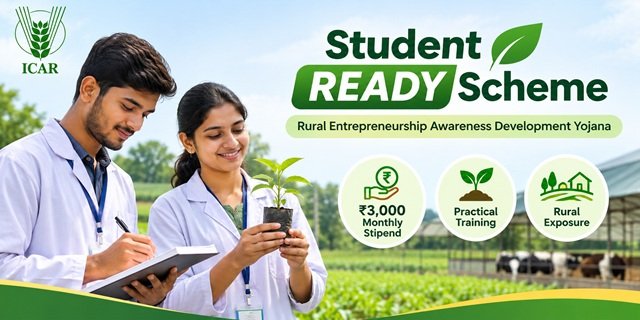
The Student READY Scheme (Rural Entrepreneurship Awareness Development Yojana), implemented by the Indian Council of Agricultural Research (ICAR), provides practical training and stipend support to final-year undergraduate students of agriculture and allied subjects. Eligible students receive a monthly stipend of ₹3,000 for up to six months. They join the programme through their college, while the university processes the stipend requirement with ICAR. The Prime Minister launched the scheme on 25 July 2015.
ICAR Student READY Scheme Highlights | |
|---|---|
| Scheme Name | Student READY Scheme (Rural Entrepreneurship Awareness Development Yojana) |
| Launch Date | 25 July 2015, by the Prime Minister |
| Implementation in Universities | Academic session 2016-17 |
| Ministry | Ministry of Agriculture and Farmers Welfare, Government of India |
| Implementing Organisation | Agricultural Education Division, Indian Council of Agricultural Research (ICAR), under the Department of Agricultural Research and Education |
| Implementing Institutions | Agricultural universities and their colleges |
| Scheme Type | Practical training programme with stipend support as part of the undergraduate degree |
| Eligible Students | Final-year undergraduate students of agriculture and allied subjects |
| Eligible Universities | State Agricultural Universities, Deemed Universities, Central Agricultural Universities and Central Universities with an agriculture faculty |
| Accreditation Requirement | Course accredited by ICAR’s National Agricultural Education Accreditation Board (NAEAB) |
| Subjects Covered | Agriculture, Agricultural Engineering, Biotechnology, Dairy Technology, Fisheries, Food Technology, Forestry, Home Science, Horticulture, Sericulture and Veterinary Science |
| Programme Duration | One full year during the final year, including 180 days of Experiential Learning |
| Training Components | Experiential Learning, Hands-on Training or Skill Development, RAWE, Internship or In-Plant Training, and Student Project. Students must complete any three components. |
| Monthly Stipend | ₹3,000 per student, comprising ₹2,500 from ICAR and ₹500 from the State Government |
| Maximum Stipend Period | Six months, amounting to a maximum of ₹18,000 per student |
| Additional Programme Support | ₹500 per student per month provided by ICAR to the university |
| Stipend Payment Method | Direct Benefit Transfer (DBT) into the student’s Aadhaar-linked bank account through the university |
| Academic Credits | 20 credits for Experiential Learning and Skill Development, 10 for RAWE, and 10 for industry attachment or Student Project |
| Experiential Learning Profit Sharing | 50% to students, 10% to faculty, 20% to the university, 10% to associate staff and 10% towards new facilities |
| Key Documents | University ID or enrolment number, Aadhaar Card, bank account details, selected training component and training dates |
| How to Join | Through the participating college, without a separate application to ICAR |
| Contact for Assistance | Student READY Programme Coordinator of the college or Agricultural Education Division of ICAR, New Delhi |
| Official Scheme Page | ICAR Student READY Scheme Official Page |
Introduction of ICAR Student READY Scheme: A Brief Insight
A student may complete four years of agricultural studies without ever managing a farm unit, working with farming families in a village or experiencing the operations of an agricultural industry. As a result, many graduates look for jobs instead of exploring opportunities to start their own businesses. The Student READY Scheme (Rural Entrepreneurship Awareness Development Yojana) aims to bridge this gap between classroom education and practical experience.
The Prime Minister launched the scheme on 25 July 2015, based on the recommendations of the Fifth Deans’ Committee of ICAR. Agricultural universities started implementing it from the academic session 2016-17. The programme has become an essential part of undergraduate education in agriculture and allied subjects.
The Agricultural Education Division of the Indian Council of Agricultural Research (ICAR), under the Department of Agricultural Research and Education, Ministry of Agriculture and Farmers Welfare, implements the scheme. Agricultural universities and their affiliated colleges conduct the training and manage student participation.
The main objective is to prepare agriculture graduates to become job creators rather than depend only on employment opportunities. The scheme develops their practical skills, confidence and understanding of rural farming conditions. It also helps them explore entrepreneurship and employment opportunities in agriculture and allied industries.
Under the scheme, each eligible student receives a monthly stipend of ₹3,000 for up to six months. ICAR contributes ₹2,500, while the State Government provides ₹500. The university transfers the amount to the student’s Aadhaar-linked bank account through Direct Benefit Transfer (DBT). Along with financial support, students complete one year of practical learning through five components: Experiential Learning, Hands-on Training or Skill Development, Rural Agricultural Work Experience (RAWE), Internship or In-Plant Training, and Student Project.
Experiential Learning allows students to operate a real production unit for 180 days, with 50% of the unit’s profit allocated to the participating students. Through RAWE, students work with farming families in villages and understand their day-to-day agricultural challenges. In-plant training gives them an opportunity to spend up to 10 weeks in an industry and observe its actual working environment. The programme also carries academic credits that count towards the student’s degree.
The scheme covers final-year undergraduate students of agriculture and allied subjects studying at State Agricultural Universities, Deemed Universities, Central Agricultural Universities and Central Universities with an agriculture faculty, provided their courses have accreditation from ICAR’s National Agricultural Education Accreditation Board (NAEAB). Students must maintain good conduct and regular attendance. They must also follow the programme rules, including restrictions on other scholarships, employment and participation in strikes.
Students do not need to apply directly to ICAR. They join the programme through their college, select any three of the five prescribed components, and submit their Aadhaar and bank details for stipend processing. The university forwards the stipend requirement to ICAR. Students who need assistance can approach their college’s Student READY Programme Coordinator or contact the Agricultural Education Division of ICAR in New Delhi.
Students planning to pursue higher education can also explore the PM Vidyalaxmi Scheme, which provides financial support through education loans. Those interested in gaining work experience in a company can read about the PM Internship Scheme.
Students, farmers, young entrepreneurs and others looking for education, skill development and employment opportunities can explore more welfare programmes on our Central Government Welfare Schemes List page.
Latest Update on Student READY Scheme
- 25 July 2015: The Prime Minister launched the Student READY Scheme to prepare agriculture graduates for entrepreneurship, self-employment and employment opportunities in the agricultural sector.
- Academic Session 2016-17: Agricultural universities began implementing the programme during the final year of undergraduate courses, following the subject-wise syllabus recommended by the Fifth Deans’ Committee of ICAR.
- Experiential Learning Units: ICAR provided financial assistance to establish at least two Experiential Learning units in each State Agricultural University. These facilities allow students to operate production units and gain practical business experience.
- 14 March 2023: The Ministry of Agriculture and Farmers Welfare informed the Lok Sabha that eligible students receive a monthly stipend of ₹3,000, comprising ₹2,500 from ICAR and ₹500 from the State Government, for up to six months. ICAR also provides an additional ₹500 per student per month to the university towards programme expenses.
- Stipend Information: The ICAR Education Portal lists stipend support of ₹3,000 per month for up to six months for eligible students undertaking the prescribed rural and practical training.
- What Students Should Do: Contact your college’s Student READY Programme Coordinator to confirm the training schedule and available components. Also, ensure that your Aadhaar-linked bank account is ready before the stipend processing begins.
Benefits Provided to Eligible Beneficiaries
A degree in agriculture becomes more valuable when students gain practical experience alongside classroom learning. The Student READY Scheme (Rural Entrepreneurship Awareness Development Yojana) provides final-year students with hands-on training in villages, agricultural industries and production units. It also offers a monthly stipend during the approved training period.
- A monthly stipend of ₹3,000 per student, comprising ₹2,500 from ICAR and ₹500 from the State Government.
- Stipend support for a maximum of six months, amounting to a total of ₹18,000 per student.
- Monthly stipend payments through Direct Benefit Transfer (DBT) into the student’s own Aadhaar-linked bank account, routed through the university.
- An additional ₹500 per student per month from ICAR to the university towards faculty costs, contingency expenses, fuel and medicines required for the programme.
- One full year of practical training during the final year, allowing students to gain experience beyond classroom studies.
- Experiential Learning for 180 days, where students operate a production unit and learn the practical aspects of running an enterprise through an earn-while-learning approach.
- Distribution of profits from the Experiential Learning unit: 50% to final-year students, 10% to faculty, 20% to the university, 10% to associate staff and 10% towards new facilities.
- Rural Agricultural Work Experience (RAWE), where students work with farming families, understand village-level agricultural problems and apply extension methods to address them.
- In-plant training for up to 10 weeks in an industry, giving students direct exposure to industrial operations and workplace practices.
- Hands-on and skill development training in farm systems, agricultural equipment and related technologies through practical exercises.
- A Student Project for students interested in higher studies, supported by an academic advisor who guides their research and report preparation.
- Academic credits towards the degree: 20 credits for Experiential Learning and Skill Development, 10 credits for RAWE, and 10 credits for industry attachment or the Student Project.
- Practical knowledge of business planning, production, sales, accounting and marketing to help graduates explore self-employment and agricultural entrepreneurship.
- Exposure to local farming practices and rural conditions, along with skills that can improve employment opportunities in agriculture-based industries.
- Assessment by a college-level evaluation committee under the guidance of a Programme Coordinator. Students receive a merit or participation certificate for the Student Project, as applicable.
- For Veterinary Science students, a six-month internship with applicable leave provisions, including maternity leave of up to three months for women interns.
Eligibility Conditions Required to be Fulfilled
The Student READY Scheme (Rural Entrepreneurship Awareness Development Yojana) is designed for final-year undergraduate students pursuing agriculture and allied degree programmes at eligible agricultural universities and institutions. ICAR has prescribed specific conditions for participation and stipend support. The college verifies these requirements before forwarding the student’s details to ICAR.
Who Is Eligible
- An undergraduate student enrolled in a degree programme in agriculture or an allied subject
- A student studying at a State Agricultural University, Deemed University, Central Agricultural University or Central University having an agriculture faculty under the National Agricultural Research and Education System
- A student enrolled in a course accredited by ICAR’s National Agricultural Education Accreditation Board (NAEAB)
- A student studying in the final (fourth) year of the undergraduate programme, when the one-year Student READY programme is conducted
- An Indian citizen or a person residing in India, irrespective of sex, race or religion
- A student whose merit and good conduct are certified by the Head of the College, University or Institution
Subjects Covered
- Agriculture
- Agricultural Engineering
- Biotechnology
- Dairy Technology
- Fisheries
- Food Technology
- Forestry
- Home Science (now Community Science)
- Horticulture
- Sericulture
- Veterinary Science, which includes a six-month internship at hospitals and farms
Conditions of the Programme
- The student must complete any three of the five programme components: Experiential Learning, Skill Development or Hands-on Training, RAWE, Internship or In-Plant Training, and Student Project.
- Students pursuing Dairy Technology, Food Technology and Agricultural Engineering must undertake in-plant training instead of RAWE.
- The student must devote full time to the approved training programme.
- The student must not remain absent during the programme without prior permission from the competent authority.
- The student must not participate in any agitation or strike during the training period.
- The student must not take up any employment, including part-time work, or receive other financial assistance for the same activities during the programme.
- The student must discontinue any other fellowship or scholarship before receiving the Student READY stipend. However, merit-cum-means scholarships and freeships are exempt from this condition.
Stipend Conditions
- The stipend is available for a maximum period of six months. It starts from the month in which the student joins RAWE, in-plant training, internship or industrial attachment.
- The stipend stops if the student leaves the degree programme before completing it.
- The student cannot receive the stipend after changing the subject or university without a valid reason and prior approval from the competent authority.
- The college may cancel the stipend due to poor academic progress, irregular attendance or leaving the training without permission from the Head of the Institution. Once cancelled, the stipend will not be restored.
- The student will not receive a stipend for the period of a strike or while placed under conduct probation.
- The university must contribute the State share of ₹500 per student. ICAR may stop its grant to the university if it fails to provide this contribution.
Documents Required to be Attached
The Student READY Scheme (Rural Entrepreneurship Awareness Development Yojana), implemented by the Indian Council of Agricultural Research (ICAR), operates through participating colleges and universities. Students do not need to send documents directly to ICAR. Instead, the college collects the required details and documents for training, stipend processing and academic records. The college informs students about the final document list at the beginning of their final year.
Documents of the Student
- Student’s name and degree programme, as recorded in the university records
- Unique student ID or university enrolment number
- Final-year roll number
- Year and date of admission to the university
- College identity card
- Proof of admission to the fourth year of the undergraduate programme
- Proof of date of birth
- Proof of Indian nationality or domicile in India
- Recent passport-size photograph
- Student’s mobile number and email ID
Documents Required for Stipend Processing
- Student’s Aadhaar Card
- Aadhaar-linked bank account details, including account number and IFSC code
- Copy of the bank passbook or a cancelled cheque
- Details of the selected programme component, such as RAWE, in-plant training, internship or industrial attachment
- Training period, including the starting and ending dates for stipend calculation
- Good conduct and merit certificate signed by the Head of the College or University
- Declaration confirming that the student does not receive another fellowship or scholarship, or hold a job for the same work
- Undertaking to follow ICAR guidelines, including attendance and discipline requirements
Documents Required for Training
- Student READY Scheme registration form for the selected programme component
- College allotment letter mentioning the assigned village, unit, plant or hospital
- Training attendance record
- Daily work diary containing field observations and plant-related activities, wherever applicable
- Business plan for students enrolled in the Experiential Learning component
- Production and sales records maintained by the Experiential Learning unit
- In-plant training report submitted to the university
- Student Project report, including its abstract and registration form, wherever applicable
- Final training report and presentation for evaluation
- Certificate issued by the Programme Coordinator and evaluation committee
Documents Maintained by the College and University
- List of final-year students prepared in the format prescribed by ICAR
- University’s annual stipend requirement submitted to ICAR for the relevant financial year
- Proof of availability of the State Government’s share of ₹500 per student
- Utilisation Certificate for the previous financial year
- Compiled bank statement showing stipend disbursements, submitted to ICAR every year
- Proof of course accreditation by the National Agricultural Education Accreditation Board (NAEAB)
How Beneficiaries Can Apply to Avail the Benefit of this Scheme
You do not need to apply directly to ICAR for the Student READY Scheme (Rural Entrepreneurship Awareness Development Yojana). Your college enrols eligible students in the programme during their final year, while the university sends the stipend requirement to ICAR. Follow the steps below to join the training, complete the required activities and receive your stipend without any difficulty.
Before You Start
Step 1: First, check whether you are studying in the final year of an undergraduate degree in agriculture or an allied subject.
Step 2: Make sure that ICAR’s National Agricultural Education Accreditation Board (NAEAB) has accredited your course.
Step 3: Visit the Student READY page of the ICAR Education Portal to understand the programme and its basic details.
Step 4: Read the ICAR Student READY Booklet to understand the training components and the syllabus prescribed for your subject.
Step 5: You can also visit the Student READY page on myScheme to check the eligibility conditions and stipend details.
Join the Programme in Your College
Step 1: Visit your college and meet the Student READY Programme Coordinator. This is the person who guides students throughout the programme.
Step 2: Ask which training components your college offers, such as Experiential Learning, RAWE, in-plant training, internship or Student Project.
Step 3: Select your training components carefully. You must complete any three of the five prescribed components to fulfil the programme requirements.
Step 4: Fill out the registration form provided by your college and submit the documents requested by the college authorities.
Step 5: Provide your Aadhaar Card and bank account details so that the college can process your stipend through Direct Benefit Transfer (DBT).
Step 6: Check whether your bank account is linked to your Aadhaar. If it is not linked, get it updated before the stipend payment process begins.
Step 7: Inform your college if you receive another scholarship or fellowship. You must discontinue any other scholarship or fellowship before receiving the Student READY stipend, except for a merit-cum-means scholarship or a freeship.
Step 8: Attend the programme orientation organised by your college. During this session, the coordinator explains the training schedule, attendance rules and other responsibilities.
Do Your Training
Step 1: Report to the village, production unit, industrial plant or hospital assigned by your college, depending on the training component you have selected.
Step 2: Give your full time and attention to the training. You cannot take up another job, even a part-time job, during the programme.
Step 3: Attend your training regularly. Do not remain absent without taking prior permission from the competent authority, as unauthorised absence can affect your stipend.
Step 4: Maintain a daily work diary and record your observations, activities and learning experiences as required by your college.
Step 5: If you are undertaking RAWE, work with farming families, understand their agricultural problems and learn how to help them through practical solutions.
Step 6: If you are part of Experiential Learning, prepare a business plan, operate your production unit and maintain proper records of production, sales and accounts.
Step 7: Maintain good conduct throughout the programme. Do not participate in strikes or agitations, as such activities can affect your stipend and training record.
Get Your Stipend
Step 1: Your stipend starts from the month in which you join RAWE, in-plant training, internship or industrial attachment, as applicable.
Step 2: Your university prepares and sends the stipend requirement to ICAR. ICAR releases the required funds to the university in advance for disbursement.
Step 3: Check your Aadhaar-linked bank account for the monthly stipend of ₹3,000. This amount includes ₹2,500 from ICAR and ₹500 from the State Government.
Step 4: Remember that the stipend is available for a maximum of six months. ICAR does not transfer the stipend directly to your account; the university handles the payment.
Step 5: If you do not receive the stipend, contact your college office without delay. Ask them to check your stipend records, Aadhaar linkage and bank account details.
Finish and Get Evaluated
Step 1: After completing your training, prepare the final report describing the work you performed and the experience you gained.
Step 2: Present your work before the evaluation committee formed by your college.
Step 3: Answer the questions asked by the committee. It may also consider the observations and feedback of the scientist, supervisor or industry officer who guided you during the training.
Step 4: Complete the evaluation process and collect your academic credits and certificate, as applicable. The programme forms part of your degree requirements.
If You Face a Problem
Step 1: If you face any difficulty with registration, training, attendance or stipend payment, first contact your Student READY Programme Coordinator.
Step 2: If the coordinator cannot resolve your issue, approach the Head of your College or University and explain the problem.
Step 3: If your college or university cannot help, write to the Agricultural Education Division of ICAR for further guidance.
Important: Never pay anyone to get admission to the programme or receive the stipend. Also, do not leave your course or change your subject or university without obtaining the required permission from the competent authority, as this may affect your stipend eligibility.
Student READY Scheme: Training Requirements for Each Subject
Students from different agricultural disciplines follow different training schedules under the Student READY Scheme. A Dairy Technology student may undergo extensive industrial training, while an Agriculture student may focus on rural fieldwork and experiential learning. The table below explains the subject-wise training components, duration and academic credits prescribed in the ICAR syllabus.
| Subject | Semester VII and Earlier | Semester VIII |
|---|---|---|
| Agriculture | RAWE and Agro-Industrial Attachment for 20 weeks, carrying 20 credits | Experiential Learning or Hands-on Training for 24 weeks, carrying 20 credits |
| Agricultural Engineering | Five-week skill training during the summer break after Semester IV and again after Semester VI, followed by 10 weeks of industrial attachment and 12 weeks of Experiential Learning in Semester VII | Project planning and report writing for 12 weeks, carrying 10 credits |
| Biotechnology | One in-house skill development module in areas such as plant, animal, microbial or bioinformatics, for 20 weeks and 20 credits | Project work for 12 weeks and entrepreneurship training for 12 weeks, carrying 10 credits each |
| Dairy Technology | Rural Dairy Work Experience for five weeks during the summer break after Semester II and again after Semester IV, followed by 24 weeks of in-plant training in Semester VII, carrying 20 credits | Experiential Learning module for 10 weeks, along with a project report, carrying 10 credits |
| Fisheries | In-plant attachment for 12 weeks, Rural Fisheries Work Experience for eight weeks and a study tour for four weeks | Experiential Learning module carrying 20 credits, covering skill development and project work |
| Food Technology | Experiential Learning in a pilot plant, along with project work and a seminar | Educational tour for two to three weeks, followed by one semester of in-plant training, carrying 20 credits |
| Forestry | Experiential Learning modules of five weeks each in Semesters V and VI, followed by 24 weeks of Forestry Work Experience in Semester VII, carrying 20 credits | Project work and dissertation for 10 weeks, carrying 10 credits |
| Home Science (Community Science and Food Nutrition and Dietetics) | Experiential Learning for 24 weeks for Community Science, or in-plant training for 20 weeks for Food Nutrition and Dietetics, carrying 20 credits | In-plant training, internship or RAWE for 20 weeks for Community Science, or Hands-on Training for 24 weeks for Food Nutrition and Dietetics, carrying 20 credits |
| Horticulture | Rural Horticulture Work Experience and industry placement for 24 weeks, carrying 20 credits, with two modules selected by the student | Experiential Learning package for 20 weeks |
| Sericulture | Experiential Learning or Hands-on Training module for 20 weeks, carrying 20 credits | Rural Work Experience in sericulture for 24 weeks, carrying 20 credits |
| Veterinary Science | Six-month internship in veterinary hospitals and farms, following the pattern prescribed by the Veterinary Council of India | |
The training schedule may vary according to the facilities, available units and academic arrangements of the college. Students should contact their Student READY Programme Coordinator to confirm the final subject-wise training plan, selected modules and schedule.
Important Links Available of the Scheme
- Student READY Scheme: Official Programme Details, ICAR Agricultural Education Division
- Student READY Guidelines, Training Components and Discipline-Wise Syllabus: ICAR Official Booklet (PDF)
- Student READY Scheme: Eligibility and Stipend Details on myScheme, Government of India
- Lok Sabha Reply on Student READY Stipend for Agricultural Graduates (PDF)
- Student READY Stipend Demand Proforma for Universities: ICAR Official PDF
- Student READY Scheme Accomplishments: ICAR Agricultural Education Division (PDF)
- Indian Council of Agricultural Research (ICAR): Official Government Website
Contact Details in Case of Help Needed
- Office: Agricultural Education Division, Indian Council of Agricultural Research (ICAR), Krishi Anusandhan Bhawan-II, New Delhi – 110012
- College Level: The Student READY Programme Coordinator of your college, who runs the training and checks your work
- University Level: The Dean or the office of Student Welfare of your agricultural university, which sends the demand for the stipend to ICAR
- Accounts Help: The accounts section of your college, for questions on the bank account and the DBT of the stipend
Frequently Asked Questions (FAQs)
Ans. The Student READY Scheme (Rural Entrepreneurship Awareness Development Yojana) is an ICAR programme that provides practical training and stipend support to final-year undergraduate students of agriculture and allied subjects. It helps them develop skills for entrepreneurship, self-employment and employment in the agricultural sector.
Ans. READY stands for Rural Entrepreneurship Awareness Development Yojana.
Ans. The Prime Minister launched the programme on 25 July 2015. Agricultural universities started implementing it from the academic session 2016-17.
Ans. The Agricultural Education Division of the Indian Council of Agricultural Research (ICAR), under the Department of Agricultural Research and Education, Ministry of Agriculture and Farmers Welfare, implements the programme in coordination with agricultural universities.
Ans. Final-year undergraduate students of agriculture and allied subjects studying at eligible State Agricultural Universities, Deemed Universities, Central Agricultural Universities or Central Universities with an agriculture faculty can participate, provided their course has ICAR accreditation through NAEAB.
Ans. The programme covers Agriculture, Agricultural Engineering, Biotechnology, Dairy Technology, Fisheries, Food Technology, Forestry, Home Science (Community Science), Horticulture, Sericulture and Veterinary Science.
Ans. The five components are Experiential Learning, Skill Development or Hands-on Training, Rural Agricultural Work Experience (RAWE), Internship or In-Plant Training or Industrial Attachment, and Student Project.
Ans. A student must complete any three of the five components during the one-year programme, depending on the subject and the training arrangement of the university.
Ans. Each eligible student receives ₹3,000 per month for a maximum of six months. The total stipend can reach ₹18,000, subject to the prescribed conditions.
Ans. ICAR contributes ₹2,500 per student per month, while the State Government provides the remaining ₹500. ICAR also provides an additional ₹500 per student per month to the university towards programme-related expenses.
Ans. The university processes the stipend through Direct Benefit Transfer (DBT) into the student’s Aadhaar-linked bank account. ICAR releases the funds to the university and does not pay students directly.
Ans. Students do not need to apply directly to ICAR or register through a separate national application portal. They must contact their college’s Student READY Programme Coordinator, complete the college registration process and submit the required documents.
Ans. Experiential Learning is a 180-day practical component in which students operate a real production unit and learn business planning, production, sales and management through an earn-while-learning approach. The prescribed profit-sharing arrangement allocates 50% to students, 10% to faculty, 20% to the university, 10% to associate staff and 10% to new facilities.
Ans. Students cannot receive another fellowship or scholarship during the programme, except a merit-cum-means scholarship or a freeship. They must also devote their full time to training and cannot take up employment, including part-time work.
Ans. Students can read the official Student READY Booklet issued by ICAR and visit the ICAR Student READY Programme Page. For assistance, they should first contact their college Programme Coordinator, followed by the university authorities or the Agricultural Education Division of ICAR.

Tabassum is a government schemes researcher and writer with 5 years of experience tracking Central and State welfare scheme programmes across India. She has covered 500+ schemes spanning agriculture, women welfare, education, and housing, helping lakhs of beneficiaries understand their entitlements in simple language.