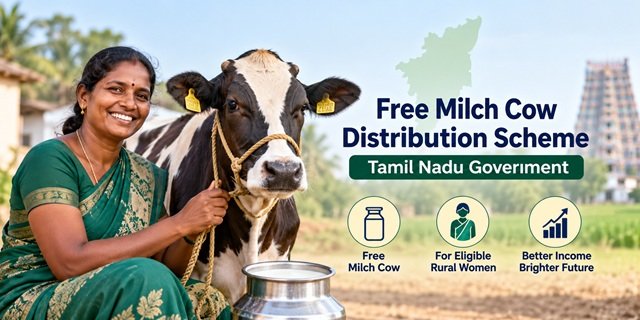
The Free Milch Cow Distribution Scheme of Tamil Nadu, implemented by the Animal Husbandry, Dairying, Fisheries and Fishermen Welfare Department, aims to provide one free, healthy crossbred milch cow capable of producing at least 8 litres of milk per day to each selected beneficiary. The Government plans to cover 10,000 eligible rural women every year and has sanctioned Rs. 57 crore for the financial year 2026-27. Eligible women below 60 years of age and belonging to families owning up to 1 acre of land can apply through the Village Panchayat and Gram Sabha selection process.
Tamil Nadu Free Milch Cow Distribution Scheme Highlights | |
|---|---|
| Scheme Name | Free Milch Cow Distribution Scheme (Scheme for Free Distribution of Milch Cows) |
| First Announced | 9 July 2011 |
| Revived Through | Revised Budget 2026-27, presented on 5 August 2026 |
| Implementing Department | Animal Husbandry, Dairying, Fisheries and Fishermen Welfare Department, Government of Tamil Nadu |
| Scheme Type | Rural Livelihood Support Through Free Milch Cow Distribution |
| Eligible Beneficiaries | Eligible Rural Women Residing in Tamil Nadu |
| Benefit Provided | One Free, Healthy Crossbred Milch Cow Producing at Least 8 Litres of Milk Per Day |
| Annual Beneficiary Target | 10,000 Women |
| Budget Allocation | Rs. 57 Crore for 2026-27 |
| Expected Calves | Three to Five Calves Over 5 Years, With Proper Care |
| Age Limit | Below 60 Years |
| Landholding Limit | Not More Than 1 Acre of Land Owned by the Family |
| Existing Cattle Ownership | The Applicant’s Family Must Not Own a Cow or Buffalo |
| SC/ST Beneficiary Quota | At Least 30% of Beneficiaries Must Belong to the Scheduled Caste and Scheduled Tribe Communities |
| Priority Beneficiaries | Women Heading Households, Widows, Destitute Women, Women With Disabilities and Transgender Persons |
| Beneficiary Selection | Verification by the Village Level Committee and Approval by the Gram Sabha |
| Additional Support | Insurance, Dairy Farming Training, Veterinary Health Card and Village Milk Cooperative Society, as Provided Under the Earlier Scheme |
| Cost to Beneficiary | Nil. The Milch Cow Is Provided Free of Cost |
| Application Process | Through the Village Panchayat and Gram Sabha When the Department Opens the Selection Process |
| Contact for Assistance | Veterinary Assistant Surgeon, Assistant Director of Animal Husbandry or Concerned Village Panchayat Office |
Introduction of Tamil Nadu Free Milch Cow Distribution Scheme: A Brief Insight
In many Tamil Nadu villages, a woman who owns a cow owns a daily income. A woman who cannot afford one depends on a day’s wage, or on none at all. The Free Milch Cow Distribution Scheme puts a productive cow in the hands of a rural woman, without asking her for a rupee.
The Government of Tamil Nadu first announced the scheme on 9 July 2011, to bring another White Revolution to the State. The Revised Budget for 2026-27, presented by Finance Minister Dr. N. Marie Wilson on 5 August 2026, revived it, and the Government sanctioned the money for the year in late October 2026.
The Animal Husbandry, Dairying, Fisheries and Fishermen Welfare Department runs the scheme. Its field staff, the Veterinary Assistant Surgeons and the Assistant Directors of Animal Husbandry, work with the District Collector, the Village Panchayat and the Gram Sabha.
Its aim is to raise the income of rural women, to increase milk output and to strengthen the dairy cooperatives of the State. The Government also wants to spread scientific dairy farming, to improve the nutrition of families and to give women an economic footing of their own.
Each year, 10,000 eligible women will get a healthy, high-yielding crossbred cow that gives at least 8 litres of milk a day, and the Government has sanctioned ₹57 crore for 2026-27. With proper care, a cow can give three to five calves over 5 years, and the earlier scheme also gave insurance, training, a veterinary health card and a village milk cooperative society.
The scheme is for rural women who live permanently in the Village Panchayat, are below 60 years of age, and whose families hold no more than 1 acre of land and own no cow or buffalo. Widows, destitute women, women who head their families, women with disabilities and transgender persons get priority, and at least 30% of the beneficiaries must be SC and ST women.
A woman waits for the notice of her Village Panchayat, goes to the Gram Sabha, fills in the form and gives it with her Aadhaar, ration card and land details to the Village Level Committee. The Gram Sabha approves the final list, and the department helps her to choose the cow. For help, she can ask the Veterinary Assistant Surgeon of her area or her Village Panchayat office.
Women who want to raise goats can read about the Vetri Magalir Goat Rearing Scheme, which gives five goats or sheep to the most vulnerable women. Farmers who want to protect their cattle against loss can look at the Centre’s Rashtriya Pashudhan Bima Yojana.
Rural women, farmers, families, and anyone looking for more livelihood and welfare schemes available under the Tamil Nadu Government can explore all available programmes on our Popular and Welfare Schemes List of Tamil Nadu Government page.
Latest Updates on Free Milch Cow Distribution Scheme
- Late October 2026: The Tamil Nadu Government sanctioned ₹57 crore for the Free Milch Cow Distribution Scheme in 2026-27. The allocation will support the distribution of free milch cows to 10,000 eligible rural women.
- Type of Cow: Each selected woman is expected to receive a healthy, high-yielding crossbred milch cow capable of producing at least 8 litres of milk per day. According to the scheme information, a cow may produce three to five calves over 5 years with proper care.
- 5 August 2026: The Tamil Nadu Government revived the scheme through its Revised Budget for 2026-27 and announced free milch cows for 10,000 eligible women every year.
- Other Livestock Schemes: The same Budget also announced the Vetri Magalir Goat Rearing Scheme, which provides five goats or sheep to eligible women from vulnerable groups, and the Kaalnadaigal Kaappom livestock insurance scheme with an allocation of ₹31 crore.
- Expansion of Dairy Farming: Tamil Nadu plans to add 22,500 more cows to its cooperative dairy network during 2026-27. Of these, 10,000 cows will be distributed free of cost, while the remaining animals will be supported through mini and medium dairy units.
- 9 July 2011: The Government first announced the Free Milch Cow Distribution Scheme to promote dairy farming and bring another White Revolution to Tamil Nadu.
- Beneficiary Selection: The Animal Husbandry Department will identify the participating Village Panchayats. The Village Level Committee will verify applications, and the Gram Sabha will approve the final list of beneficiaries.
- Keep Documents Ready: Interested women should keep their Aadhaar Card, Family Ration Card, landholding details and bank passbook ready. They should also regularly check their Village Panchayat notice board for application announcements and selection dates.
Benefits Provided to Eligible Beneficiaries
The Government of Tamil Nadu’s Free Milch Cow Distribution Scheme aims to help rural women build a regular source of income through dairy farming. Under the scheme, the Government plans to provide one milch cow free of cost to 10,000 eligible women every year, helping their families improve their livelihood and financial security.
- One free milch cow for each selected woman, without any purchase cost.
- A healthy, high-yielding crossbred cow capable of producing at least 8 litres of milk per day.
- Annual coverage of 10,000 women, with ₹57 crore sanctioned for the scheme in 2026-27.
- Government support of approximately ₹57,000 per beneficiary, based on the total allocation of ₹57 crore for 10,000 women.
- An opportunity to earn a regular income by selling milk, while also improving household nutrition.
- Potential to obtain three to five calves from a cow over 5 years with proper care, adding to the family’s assets.
- Insurance coverage for the allotted cow and assistance with transportation, as provided under the earlier scheme.
- Training in dairy farming, including animal feeding, milking, breeding and calf care.
- A veterinary health card and access to regular veterinary visits, vaccination and deworming services.
- Support from the village Milk Producers Cooperative Society, including milk procurement, breeding assistance and veterinary services.
- Guidance from the Animal Husbandry Department on scientific dairy farming practices and proper animal management.
- Greater financial independence and decision-making opportunities for rural women.
- Support for increasing milk production in Tamil Nadu and strengthening the State’s cooperative dairy sector.
Eligibility Conditions Required to be Fulfilled
The Free Milch Cow Distribution Scheme of the Tamil Nadu Government aims to support rural women who want to earn a regular income through dairy farming but cannot afford to purchase a cow. The Government will confirm the final eligibility conditions when it begins the beneficiary selection process. The following conditions are based on the scheme norms being followed for its revival.
Basic Eligibility
- The applicant must be a woman residing in a rural area of Tamil Nadu.
- She must be a permanent resident of the Village Panchayat selected for cow distribution.
- She must be below 60 years of age.
- The applicant’s family must own no more than 1 acre of land, whether registered in her name or in the name of another family member.
- No member of the applicant’s family should currently own a cow or buffalo.
- She must not have received a free milch cow under this scheme in the past.
- She must not be a Government, cooperative or local body employee, or a close relative of an employee working in these organisations.
- She must be willing to rear the allotted cow herself and supply its milk to the village Milk Producers Cooperative Society.
Priority Groups
- Women who head their households
- Widows and destitute women
- Deserted women
- Women with disabilities
- Transgender persons
- At least 30% of the beneficiaries in each Village Panchayat must belong to the Scheduled Caste (SC) and Scheduled Tribe (ST) communities.
Selection Conditions
- Each eligible household can receive one cow, with the woman of the household registered as the beneficiary.
- A Village Level Committee verifies the applications and prepares the beneficiary list.
- The Gram Sabha approves the final list, which the concerned Panchayat displays on its notice board.
- The Government distributes cows to 10,000 women every year, selecting Village Panchayats in phases.
- Each selected beneficiary must receive a healthy crossbred cow capable of producing at least 8 litres of milk per day.
Documents Required to be Attached
The Tamil Nadu Government’s Free Milch Cow Distribution Scheme aims to provide a free milch cow to 10,000 eligible rural women every year. However, the Animal Husbandry Department has not yet released the final list of documents required for application. Applicants should keep clear copies of the following documents ready and check with their Village Panchayat for the exact requirements.
Documents for Application
- Application form for the Free Milch Cow Distribution Scheme
- Aadhaar Card
- Family Ration Card or Smart Card
- Residence proof confirming that the applicant lives in the concerned Village Panchayat
- Age proof, such as a birth certificate, school certificate or any valid document confirming that the applicant is below 60 years
- Landholding documents showing ownership of up to 1 acre, such as Patta, Chitta or other land records
- Declaration confirming that the applicant’s family does not own a cow or buffalo
- Aadhaar-linked bank account details, along with a copy of the bank passbook
- Recent passport-size photograph
- Active mobile number
Documents for Priority Categories
- Community Certificate for Scheduled Caste (SC) and Scheduled Tribe (ST) women
- Widow Certificate
- Destitute Woman Certificate
- Deserted Woman Certificate
- Disability Certificate or UDID Card for women with disabilities
- Transgender Identity Card, wherever applicable
- Proof confirming that the applicant belongs to a woman-headed household
Documents After Selection
- Beneficiary identity slip or selection letter issued by the Village Panchayat
- Undertaking confirming that the beneficiary will not sell the cow during the period prescribed by the Government
- Insurance documents and ear tag details of the allotted cow
- Veterinary Health Card
- Membership form of the Milk Producers Cooperative Society
- Training attendance certificate
How Beneficiaries Can Apply to Avail the Benefit of this Scheme
The Tamil Nadu Government has sanctioned funds for the Free Milch Cow Distribution Scheme, under which 10,000 rural women will receive free milch cows every year. The Animal Husbandry Department will select the Village Panchayats and announce when women can submit their applications.
If you want to get a free cow, follow the steps below. They explain the entire process, from checking the scheme announcement to receiving your cow.
Stop 1: Know Where the Scheme Stands
Step 1: Remember that the Tamil Nadu Government announced the distribution of free milch cows to 10,000 rural women every year in its Revised Budget for 2026-27.
Step 2: The Government has sanctioned ₹57 crore for the scheme during the financial year 2026-27.
Step 3: The Animal Husbandry, Dairying, Fisheries and Fishermen Welfare Department is responsible for implementing the scheme.
Step 4: Visit the Animal Husbandry Department’s Official Website to understand how the department describes the scheme and its earlier implementation.
Stop 2: Get Ready
Step 1: First, check whether you meet the basic conditions. You must be a woman living in a rural area of Tamil Nadu and should be below 60 years of age.
Step 2: Make sure your family’s total landholding does not exceed 1 acre and that your family does not currently own a cow or buffalo.
Step 3: Keep your Aadhaar Card, Family Ration Card or Smart Card and bank passbook ready. You will need these documents when you apply.
Step 4: If you belong to the Scheduled Caste (SC) or Scheduled Tribe (ST) community, keep your Community Certificate ready.
Step 5: If you are a widow, destitute woman, woman with a disability or transgender person, also keep the relevant certificate or identity document ready to claim priority, wherever applicable.
Stop 3: Watch for the Notice
Step 1: Visit your Village Panchayat office regularly and check its notice board. The department or Panchayat will display information about cow distribution and application dates when the process begins.
Step 2: Meet the Veterinary Assistant Surgeon at your nearest veterinary dispensary and ask whether your Village Panchayat has been selected for the scheme this year.
Step 3: You can also contact the office of the Assistant Director of Animal Husbandry in your area to ask about the selection schedule and application dates.
Step 4: Keep an eye on Gram Sabha meeting announcements. Your Panchayat may inform villagers through public announcements, loudspeakers or notices displayed on the notice board.
Stop 4: Apply for the Cow
Step 1: Attend the Gram Sabha meeting organised in your Village Panchayat after the Government announces the selection process.
Step 2: Listen carefully to the officials. They will explain the scheme, eligibility conditions, required documents and the application process.
Step 3: Collect the application form from the Village Panchayat office or the authorised committee, as instructed by the officials.
Step 4: Fill in the form carefully. Enter your name, family details, landholding information and bank account details. Make sure that all information matches your documents.
Step 5: Sign the application form. If you cannot sign, put your thumb impression wherever required.
Step 6: Attach the required documents and submit the completed form to the Village Level Committee member or the Panchayat office, as instructed.
Step 7: Ask for an acknowledgement receipt. If the office does not issue a separate receipt, request an acknowledgement on a photocopy of your application form. Keep it safe for future reference.
Step 8: The earlier scheme allowed an additional week for submitting applications. Therefore, ask the Panchayat officials whether any extended application period is available under the present scheme.
Stop 5: Wait for the Selection
Step 1: After you submit your form, the Village Level Committee will examine the applications and check whether applicants meet the eligibility conditions.
Step 2: The concerned officials, including the Village Administrative Officer, may verify your landholding, residence and community details.
Step 3: The selection process gives priority to eligible widows, destitute women, women heading their households, women with disabilities and transgender persons, as per the applicable scheme guidelines.
Step 4: The Gram Sabha will consider and approve the final beneficiary list. Therefore, attend the meeting if the Panchayat asks you to be present.
Step 5: Check the Panchayat notice board to see whether your name appears in the approved beneficiary list. If selected, follow the instructions given by the department for receiving your cow.
Stop 6: Get Your Cow
Step 1: Attend the dairy farming training arranged by the department. You will learn how to feed the cow, collect milk, manage breeding and take care of calves.
Step 2: Follow the department’s instructions while selecting your cow. If the Veterinary Assistant Surgeon accompanies you, take their help to identify a healthy animal that produces at least 8 litres of milk per day.
Step 3: Check that the allotted cow receives its prescribed ear tag and insurance coverage. Keep the related details safely.
Step 4: Collect the cow’s Veterinary Health Card. This card contains important information about its health and veterinary care.
Step 5: Complete the membership process of your village Milk Producers Cooperative Society. The society will help you sell the milk produced by your cow.
Step 6: Take proper care of your cow. Provide suitable food and water, contact a veterinarian whenever it falls sick and follow the Government’s conditions regarding how long you must keep the animal.
Important: The cow is provided free of cost. Do not pay anyone who demands money for your selection, a place on the beneficiary list or the allotment of a cow. You can also read the Official Government Order on the Earlier Free Milch Cow Distribution Scheme to understand how the earlier distribution process worked. The application schedule for the present scheme should be confirmed through the Animal Husbandry Department or your Village Panchayat before applying.
Important Links Available of the Scheme
- Free Milch Cow Distribution Scheme Details, Animal Husbandry Department
- Free Milch Cow Distribution Scheme Government Order and Implementation Guidelines
- Tamil Nadu Animal Husbandry Policy Note 2018-19, Free Milch Cow and Goat Distribution Schemes
- Animal Husbandry Department, Dindigul, Tamil Nadu, Free Milch Cow Scheme Information
- Tamil Nadu Government Official Website, Government Schemes and Department Updates
Contact Details in Case of Help Needed
- Office: Directorate of Animal Husbandry and Veterinary Services, Animal Husbandry, Dairying, Fisheries and Fishermen Welfare Department, Government of Tamil Nadu, Chennai
- District Level: The office of the Regional Joint Director of Animal Husbandry of your district, whose phone number is on the district website
- Block Level: The Assistant Director of Animal Husbandry of your area, who looks after the selection and the distribution
- Village Level: The Veterinary Assistant Surgeon of your nearest veterinary dispensary, and the office of your Village Panchayat, which holds the Gram Sabha and the beneficiary list
- Collector’s Office: The District Collector of your district, who is in charge of choosing the beneficiaries
Frequently Asked Questions (FAQs)
Ans. It is a State Government scheme that provides a free milch cow to eligible rural women to help them earn a regular income through dairy farming.
Ans. The Animal Husbandry, Dairying, Fisheries and Fishermen Welfare Department of the Government of Tamil Nadu implements the scheme.
Ans. The Government first announced the scheme on 9 July 2011 with the objective of bringing another White Revolution to Tamil Nadu.
Ans. The Tamil Nadu Government announced the revival of the scheme in its Revised Budget for 2026-27, presented on 5 August 2026. It subsequently sanctioned funds for its implementation.
Ans. The Government plans to provide free milch cows to 10,000 eligible rural women every year.
Ans. The Tamil Nadu Government has sanctioned ₹57 crore for the scheme during the financial year 2026-27.
Ans. Each selected beneficiary is expected to receive a healthy, high-yielding crossbred milch cow capable of producing at least 8 litres of milk per day.
Ans. Women who permanently reside in the selected Village Panchayat, are below 60 years of age, belong to families owning no more than 1 acre of land and whose families do not own a cow or buffalo can apply, subject to other scheme conditions.
Ans. Yes. Eligible transgender persons residing in the selected Village Panchayat can be considered under the priority categories, subject to the final Government guidelines.
Ans. Priority categories include women heading their households, widows, destitute women, deserted women, women with disabilities and transgender persons.
Ans. Yes. At least 30% of the beneficiaries in a Village Panchayat must belong to the Scheduled Caste (SC) and Scheduled Tribe (ST) communities.
Ans. Each eligible household can receive only one free milch cow under the scheme.
Ans. Applicants should check their Village Panchayat notice board for the application announcement, collect the prescribed form, attach the required documents and submit it to the authorised committee or Panchayat office as instructed. The application schedule should be confirmed through local officials.
Ans. No. The cow is provided free of cost. Beneficiaries should not pay anyone for registration, selection or allotment of the animal.
Ans. Applicants can contact the Veterinary Assistant Surgeon at their nearest veterinary dispensary, the Assistant Director of Animal Husbandry in their area or their Village Panchayat office. They can also visit the Tamil Nadu Animal Husbandry Department Information Page for scheme-related details.

Tabassum is a government schemes researcher and writer with 5 years of experience tracking Central and State welfare scheme programmes across India. She has covered 500+ schemes spanning agriculture, women welfare, education, and housing, helping lakhs of beneficiaries understand their entitlements in simple language.