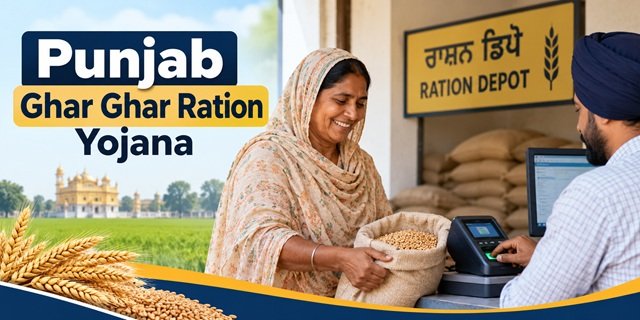
The Punjab Ghar Ghar Ration Yojana is a Punjab Government initiative implemented by the Department of Food, Civil Supplies and Consumer Affairs. Launched in February 2024, the scheme initially aimed to deliver free NFSA foodgrains, including wheat or packed atta, directly to eligible households. The packed atta delivery model stopped in July 2024, and eligible Antyodaya Anna Yojana (AAY) and Priority Household (PHH) ration card holders now collect their entitled foodgrains from ration depots. Under the applicable NFSA entitlement, eligible beneficiaries generally receive 5 kg of foodgrains per person per month, while eligible AAY households receive 35 kg per family per month.
Punjab Ghar Ghar Ration Yojana Highlights | |
|---|---|
| Scheme Name | Ghar Ghar Ration Yojana |
| Announced By | Chief Minister Bhagwant Mann on 28 March 2022 |
| Launch Date | February 2024 |
| Implementing Department | Department of Food, Civil Supplies and Consumer Affairs, Government of Punjab |
| Nodal Agency | Markfed, associated with the original Model Fair Price Shop delivery arrangement |
| Original Objective | To provide eligible NFSA foodgrains, including wheat or packed atta, through doorstep delivery |
| Eligible Beneficiaries | Eligible NFSA ration card holders under the Antyodaya Anna Yojana (AAY) and Priority Household (PHH) categories |
| Monthly Foodgrain Entitlement | 5 kg per eligible person; 35 kg per eligible AAY household |
| Foodgrain Price | Free of cost for eligible beneficiaries, as indicated by the zero rate on the AePDS Punjab portal |
| Application Process | No separate application is required for existing eligible NFSA ration card holders to receive their foodgrain entitlement |
| Current Distribution Method | Foodgrains are collected from ration depots following discontinuation of the packed atta delivery model in July 2024 |
| Verification Method | Aadhaar-based verification through an electronic Point of Sale (e-PoS) machine |
| Helpline Numbers | 1800-300-11007, 1800-300-61313 and 1967 |
| Official Portal | AePDS Punjab Portal |
Introduction of Punjab Ghar Ghar Ration Yojana: A Brief Insight
For many years, eligible families in Punjab had to visit ration depots and wait in long queues to collect their monthly foodgrains. This could mean losing a day’s wages for working families and create additional difficulties for elderly people and those who could not travel easily. The Punjab Ghar Ghar Ration Yojana was introduced to make ration distribution more convenient by bringing foodgrains to beneficiaries’ doorsteps.
Chief Minister Bhagwant Mann announced the scheme on 28 March 2022, and the Punjab Cabinet approved it on 2 May 2022. Following a legal challenge by ration depot holders, the government approved a revised mechanism on 29 July 2023. The scheme was launched in February 2024.
The Department of Food, Civil Supplies and Consumer Affairs, Government of Punjab, implements the scheme, with Markfed serving as the nodal agency responsible for operating Model Fair Price Shops. The initiative aimed to reduce queues, improve access to quality wheat or packed atta, and make ration distribution more transparent through Aadhaar-based verification and electronic Point of Sale (e-PoS) machines.
The foodgrains are provided under the National Food Security Act (NFSA), while the Punjab Government initially bore the cost of doorstep delivery. Eligible NFSA beneficiaries receive 5 kg of wheat per person per month, while eligible Antyodaya Anna Yojana (AAY) households receive 35 kg per family per month. The AePDS Punjab portal lists the foodgrain rate as zero for both AAY and Priority Household (PHH) beneficiaries.
When the scheme launched, families could choose wheat or packed atta for doorstep delivery. They could also collect their entitled ration from the designated depot. Punjab residents holding a valid NFSA ration card under the AAY or PHH category are covered, subject to the applicable eligibility conditions. Existing eligible cardholders do not need to submit a separate application solely to receive their ration entitlement, but their Aadhaar details must meet the applicable verification requirements.
The packed atta doorstep delivery model was discontinued in July 2024, after which beneficiaries received wheat through ration depots. The AePDS portal currently indicates that no Model Fair Price Shop is active under the earlier delivery model. Beneficiaries can use the portal to check their ration card details, monthly allocation and collection status. For assistance, they can call the helpline at 1800-300-11007.
Punjab residents can also explore other welfare initiatives that address housing, business ownership and support for daughters. Families seeking property-related support can read about the Mera Ghar Mere Naam Scheme and the Meri Dukaan Mere Naam Scheme. Parents of daughters can explore the Bebe Nanki Ladli Beti Kalyan Yojana.
Eligible families receiving foodgrains under the NFSA can also learn about the Centre’s Pradhan Mantri Garib Kalyan Anna Yojana, which provides additional context on food security support for eligible households.
Ration card holders and other residents looking for welfare programmes, financial assistance and food security initiatives can explore more schemes on our Punjab Government Welfare Schemes List page.
Benefits Provided to Eligible Beneficiaries
The Punjab Ghar Ghar Ration Yojana helps eligible families receive their monthly foodgrain entitlement free of cost under the National Food Security Act (NFSA). The government introduced doorstep delivery in 2024 but later discontinued the packed atta service. The following benefits and changes explain how eligible families receive their ration.
- 5 kg of foodgrains per person per month, provided free of cost to eligible NFSA beneficiaries
- 35 kg of foodgrains per family per month for eligible Antyodaya Anna Yojana (AAY) households, as prescribed under NFSA norms
- At the launch in February 2024, families could choose wheat or packed atta for free doorstep delivery through Model Fair Price Shops operated by Markfed
- The packed atta delivery service was discontinued in July 2024, and beneficiaries thereafter received wheat through ration depots
- Beneficiaries can collect their entitled foodgrains after Aadhaar-based verification through an electronic Point of Sale (e-PoS) machine at the ration depot. The machine generates a receipt for the quantity issued
- Beneficiaries do not have to pay any premium, scheme fee or delivery charge for their entitled foodgrains
Eligibility Conditions Required to be Fulfilled
The Punjab Ghar Ghar Ration Yojana covers families already eligible for foodgrain benefits under the National Food Security Act (NFSA). To receive ration under the scheme, a family must meet the applicable conditions and hold a valid NFSA ration card issued in Punjab.
- Must be a resident of Punjab
- Must hold a valid NFSA ration card under the Antyodaya Anna Yojana (AAY) or Priority Household (PHH) category
- Every eligible family member must have their Aadhaar details linked to the ration card records, as required under the applicable rules
- Each eligible member is entitled to 5 kg of foodgrains per month, subject to the applicable scheme provisions
- The eldest woman aged 18 years or above is generally recorded as the head of the household on the ration card, subject to the applicable rules
- Existing eligible NFSA ration card holders do not need a separate application solely to receive benefits under the scheme
- Families without a valid NFSA ration card must first apply for one and meet the applicable eligibility conditions
Documents Required to be Attached
The Punjab Ghar Ghar Ration Yojana covers eligible families that already hold a ration card under the National Food Security Act (NFSA). Families generally do not need a separate application form to receive their ration quota under the scheme. However, they should keep their ration card and Aadhaar details ready for verification and any required corrections.
- Punjab NFSA ration card under the Antyodaya Anna Yojana (AAY) or Priority Household (PHH) category
- Aadhaar Card of every family member listed on the ration card
- Mobile number linked to the Aadhaar Card or ration card, as applicable
- Punjab residence proof, such as a voter ID card or electricity bill, if required
- Recent passport-size photograph of the head of the family, if requested for a ration card update
- Bank passbook or account details, if requested by the concerned department
How Beneficiaries Can Apply to Avail the Benefit of this Scheme
Eligible families who already hold an NFSA ration card do not need to submit a separate application for the Punjab Ghar Ghar Ration Yojana. They can collect their monthly foodgrain entitlement from their designated ration depot. The official portal also allows beneficiaries to check their ration card details, monthly allocation and ration collection status. Follow the steps below to check your entitlement and collect your ration.
Part 1: Check Your Entitlement Online
Step 1: Open the AePDS Punjab portal, the official portal of the Food, Civil Supplies and Consumer Affairs Department.
Step 2: Click on Beneficiary Details. Enter the required ration card details to view your family’s ration card record.
Step 3: Open Allotment Details to check how much wheat the department has allocated to your family for the month.
Step 4: Visit RC Drawl Status to check whether someone has already collected the ration allocated to your card.
Part 2: Collect Your Ration
Step 1: Open FPS Details on the AePDS Punjab portal to find your ration depot and its details.
Step 2: Visit the depot during the monthly ration distribution period. Carry your ration card details and Aadhaar Card for verification.
Step 3: Follow the instructions of the depot operator and complete Aadhaar-based verification on the electronic Point of Sale (e-PoS) machine. You may need to place your thumb on the scanner to verify your identity.
Step 4: After successful verification, collect the foodgrains allocated to your family. Under the stated NFSA entitlement, eligible beneficiaries generally receive 5 kg of foodgrains per person per month.
Step 5: Collect the receipt generated by the e-PoS machine. Check the quantity mentioned on it and make sure it matches the foodgrains you received.
Part 3: No Ration Card Yet?
Step 1: Keep your Aadhaar Card, Punjab residence proof and family details ready. You may need additional documents depending on the application requirements.
Step 2: Visit the Punjab Ration Card Management System. Register or log in to access the available public services.
Step 3: Look for the new ration card application service. Enter the required details of your family members and upload the requested documents.
Step 4: Review the information you entered, submit the application and save the acknowledgement or application reference number for future use.
Step 5: If the portal displays a maintenance message or does not open, try again later. You can also contact your District Food and Supplies Office for guidance on applying for a ration card.
Important: Applying for a ration card does not automatically guarantee eligibility under the scheme. The department must verify your application and determine whether your family qualifies under the applicable NFSA rules.
Part 4: Taking Ration Away From Home
Step 1: If you are away from your home state, visit a ration depot that supports the One Nation One Ration Card (ONORC) system. Carry your Aadhaar details and ration card information.
Step 2: Ask the depot operator to check your eligibility for portability. Complete the required Aadhaar-based verification on the e-PoS machine.
Step 3: Collect the foodgrains available to you under the portability rules and take the transaction receipt. The quantity you can collect depends on your remaining entitlement and the applicable rules.
Part 5: If You Face a Problem
Step 1: If you face a problem with your ration card or foodgrain distribution, contact the department helpline at 1800-300-11007.
Step 2: You can also try the helpline numbers 1800-300-61313 or 1967 for assistance.
Step 3: Visit the AePDS FAQs to find answers to common questions about ration card details, foodgrain distribution and e-PoS transactions.
Important: The scheme’s doorstep delivery of packed atta stopped in July 2024, according to the information provided. Beneficiaries should collect their entitled wheat from the designated ration depot. Do not pay anyone who promises guaranteed ration delivery or claims they can add your name to the beneficiary list in exchange for money.
Important Links Available of the Scheme
- AePDS Punjab, Food, Civil Supplies and Consumer Affairs Department
- Beneficiary details on AePDS Punjab
- Wheat allotment details on AePDS Punjab
- Ration card drawl status on AePDS Punjab
- Ration depot (Fair Price Shop) details on AePDS Punjab
- AePDS Punjab FAQs (PDF)
- National Food Security Act portal, Punjab page
- Punjab Ration Card Management System
- Department of Food, Civil Supplies and Consumer Affairs, Punjab
Contact Details in Case of Help Needed
- Department: Department of Food, Civil Supplies and Consumer Affairs, Government of Punjab
- Office: Anaj Bhawan, Sector 39-C, Chandigarh – 160036
- Helpline: 1800-300-11007, 1800-300-61313, 1967
- One Nation One Ration Card Helpline: 14445
- Director’s Office Phone: 0172-2636090
- Secretary’s Office Phone: 0172-2742803
- Email: director.dfcs@punjab.gov.in, secy.fs@punjab.gov.in
- Local Help: District Food and Supplies office or your ration depot holder
Frequently Asked Questions (FAQs)
Ans. The Punjab Ghar Ghar Ration Yojana is a Punjab Government initiative launched in February 2024 to provide eligible National Food Security Act (NFSA) beneficiaries with their monthly foodgrain entitlement. The original model offered wheat or packed atta through doorstep delivery.
Ans. The Department of Food, Civil Supplies and Consumer Affairs, Government of Punjab, oversees the scheme, with Markfed serving as the nodal agency.
Ans. According to the information provided, the packed atta delivery model stopped in July 2024, and beneficiaries now collect wheat from ration depots. The AePDS portal also indicates that no Model Fair Price Shop is currently active for this delivery model.
Ans. Eligible NFSA beneficiaries generally receive 5 kg of foodgrains per person per month. Eligible Antyodaya Anna Yojana (AAY) households receive 35 kg per family per month, according to the applicable NFSA entitlement.
Ans. No. According to the information provided, the AePDS Punjab portal lists the foodgrain rate as zero for eligible AAY and Priority Household (PHH) ration cards.
Ans. Punjab residents who hold a valid NFSA ration card under the Antyodaya Anna Yojana (AAY) or Priority Household (PHH) category can receive benefits, subject to the applicable eligibility and verification requirements.
Ans. No. Existing eligible NFSA ration card holders do not need to submit a separate application solely to receive their foodgrain entitlement under the scheme.
Ans. Visit the AePDS Punjab portal. Open the Beneficiary Details, Allotment Details and RC Drawl Status pages to check your ration card information, allocated quantity and collection status.
Ans. Visit your ration depot during the distribution period with your ration card details and Aadhaar Card. Complete the required verification on the electronic Point of Sale (e-PoS) machine, collect your foodgrains and take the transaction receipt.
Ans. The information provided indicates that the portal showed distribution for July, August and September 2026 together. Since distribution dates can change, contact your ration depot or check the AePDS Punjab portal for the latest schedule.
Ans. You can visit the Punjab Ration Card Management System to check the available application services. You can also contact your District Food and Supplies Office for guidance. The department will verify your details and determine your eligibility.
Ans. Yes. Under the One Nation One Ration Card (ONORC) system, eligible NFSA beneficiaries can collect their available foodgrain entitlement from a participating ration depot in another State after completing the required verification.
Ans. The Smart Ration Card Scheme is an earlier Punjab initiative launched in September 2020. According to the information provided, it replaced the Atta-Dal Scheme and supplied wheat in sealed 30 kg bags twice a year. It is separate from the Punjab Ghar Ghar Ration Yojana.
Ans. No. According to the information provided, the Meri Rasoi Yojana is a separate scheme announced in February 2026. It aims to provide eligible NFSA families with a free food kit every quarter in addition to their wheat entitlement.
Ans. You can try calling 1800-300-11007, 1800-300-61313 or 1967 for assistance with ration-related issues.

Tabassum is a government schemes researcher and writer with 5 years of experience tracking Central and State welfare scheme programmes across India. She has covered 500+ schemes spanning agriculture, women welfare, education, and housing, helping lakhs of beneficiaries understand their entitlements in simple language.