The Pradhan Mantri Samajik Sahayata Yojana, implemented by the Department of Rural Development, is the renamed umbrella programme for social assistance. The Union Cabinet approved the new name on 14 October 2026 and allocated Rs. 53,428 crore for 2026-27 to 2030-31. The programme covers old-age, widow and disability pensions, along with family assistance, and is expected to benefit around 3.20 crore people across India.
Pradhan Mantri Samajik Sahayata Yojana Highlights | |
|---|---|
| Scheme Name | Pradhan Mantri Samajik Sahayata Yojana |
| Earlier Name | National Social Assistance Programme |
| Programme Launch Date | 15 August 1995 |
| Renamed On | 14 October 2026 |
| Approved By | Union Cabinet, chaired by Prime Minister Narendra Modi |
| Implementing Department | Department of Rural Development, Ministry of Rural Development |
| Total Programme Outlay | Rs. 53,428 crore for 2026-27 to 2030-31 |
| Expected Beneficiaries | Approximately 3.20 crore people across 36 States and Union Territories |
| Central Funding | Central assistance, with additional support possible from State and UT governments |
| Old-Age Pension | Pradhan Mantri Vridhavastha Pension Yojana: Rs. 200 or Rs. 500 per month |
| Widow Pension | Pradhan Mantri Vidhawa Pension Yojana: Rs. 300 or Rs. 500 per month |
| Disability Pension | Pradhan Mantri Divyangjan Pension Yojana: Rs. 375 or Rs. 625 per month |
| Family Assistance | Pradhan Mantri Parivar Labh Yojana: Rs. 20,000 as a one-time payment |
| Food Assistance | Annapurna Scheme: 10 kg of free food grains per month for eligible beneficiaries |
| Possible State Top-Up | Rs. 50 to Rs. 5,700 per month under State-specific rules |
| Payment Method | Direct Benefit Transfer (DBT) to the beneficiary’s bank or post office account, where applicable |
| Official Information Portal | Ministry of Rural Development’s social assistance portal |
Introduction of Pradhan Mantri Samajik Sahayata Yojana: A Brief Insight
Millions of Indians face financial difficulties in old age, after losing a spouse or while living with a disability. Many poor families also lose their main earning member without warning and struggle to meet their daily needs. The Pradhan Mantri Samajik Sahayata Yojana is the Central Government’s umbrella programme that brings different forms of social assistance together to support these vulnerable groups.
The programme is the renamed version of the National Social Assistance Programme (NSAP), which began on 15 August 1995. On 14 October 2026, the Union Cabinet, chaired by Prime Minister Narendra Modi, approved the new name, renamed its sub-schemes and continued the programme for five years, from 2026-27 to 2030-31, with an allocation of Rs. 53,428 crore.
The programme reflects the spirit of Article 41 of the Constitution of India, which directs the State to provide public assistance to people facing certain forms of need, including old age, disability and other circumstances covered by the provision.
The Department of Rural Development, Ministry of Rural Development, implements the programme through State and Union Territory governments. The Centre provides the prescribed central assistance, while States and UTs may add extra support under their own rules. The programme aims to provide basic social security to senior citizens, widows, persons with disabilities and families that lose their primary breadwinner.
The programme covers different needs through separate sub-schemes. Each has its own eligibility conditions and benefits. You can read the details of each scheme in our dedicated guides below:
- The Pradhan Mantri Vridhavastha Pension Yojana replaces the Indira Gandhi National Old Age Pension Scheme.
- The Pradhan Mantri Vidhawa Pension Yojana replaces the Indira Gandhi National Widow Pension Scheme.
- The Pradhan Mantri Divyangjan Pension Yojana replaces the Indira Gandhi National Disability Pension Scheme.
- The Pradhan Mantri Parivar Labh Yojana replaces the National Family Benefit Scheme.
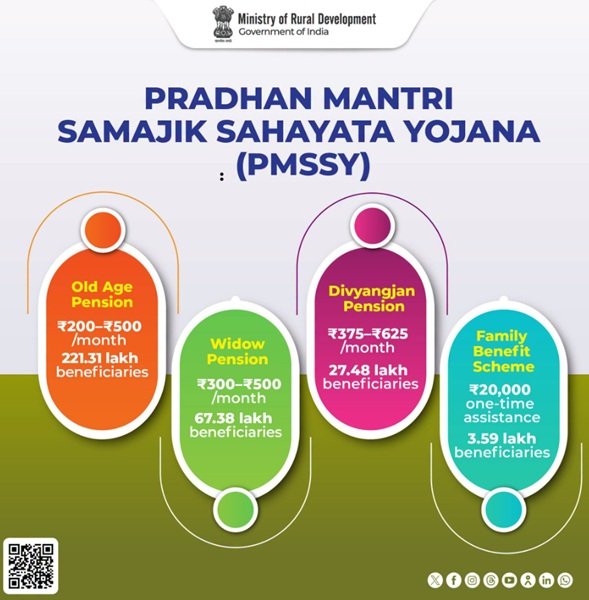
Each sub-scheme provides a different form of assistance. The central old-age pension is Rs. 200 or Rs. 500 per month, while the widow pension provides Rs. 300 or Rs. 500 per month. The disability pension provides Rs. 375 or Rs. 625 per month, and the family benefit scheme offers a one-time payment of Rs. 20,000 to eligible families after the death of their primary breadwinner.
States and Union Territories may provide additional pension assistance ranging from Rs. 50 to Rs. 5,700 per month, depending on their rules. The Annapurna Scheme also provides 10 kg of food grains free every month to eligible senior citizens who qualify for an old-age pension but do not receive it.
According to the information provided, the main change in the benefits concerns the disability pension. The disability threshold has been reduced from 80% to 40%, and the minimum age requirement has been removed. The other pension and family benefit schemes continue under their existing conditions. Around 3.20 crore beneficiaries across all 36 States and Union Territories are expected to benefit from the programme.
Eligible people can apply under the sub-scheme that matches their circumstances. Depending on the service available in their State, they can check the UMANG portal, use their State government’s portal or seek help at a Gram Panchayat, Block office, Municipal office or District Social Welfare Office.
Pensioners should also check the applicable rules for submitting their annual life certificate. Where a digital service is available, they may be able to complete this process through a mobile app instead of visiting an office. Applicants and existing beneficiaries can contact their local Block or District office for assistance with applications, documents and payment-related questions.
Senior citizens can also explore the Ayushman Bharat Vay Vandana Card for information about health coverage, which is separate from the old-age pension benefit.
Senior citizens, widows, persons with disabilities and families seeking other forms of social assistance can explore additional national-level welfare programmes on our Central Government Welfare Schemes List page.
What to Watch for After the October 2026 Decision
- Disability Guidelines: The Ministry has to issue and implement the guidelines for the revised disability pension within three months of 14 October 2026, which points to around mid-January 2027.
- New Category: Once the guidelines are out, your State will start taking applications from persons with 40% to 79% disability and from children, so a disability certificate or UDID card is worth getting now.
- Annapurna Scheme: The Cabinet release does not mention it, so its status is worth checking with your local office.
- Where to Look: Updates on the programme appear on the NSAP portal and on the Ministry of Rural Development’s website.
Benefits Provided to Eligible Beneficiaries
The Pradhan Mantri Samajik Sahayata Yojana provides financial support to eligible people through its different sub-schemes. The Central Government provides a fixed amount under each scheme, while State and Union Territory governments may offer additional assistance. The benefits available under each sub-scheme are listed below.
Central Assistance Under Each Sub-Scheme
| Sub-Scheme | Central Assistance |
|---|---|
| Pradhan Mantri Vridhavastha Pension Yojana | ₹200 per month for beneficiaries aged 60 to 79 years and ₹500 per month for those aged 80 years or above |
| Pradhan Mantri Vidhawa Pension Yojana | ₹300 per month for beneficiaries aged 40 to 79 years and ₹500 per month for those aged 80 years or above |
| Pradhan Mantri Divyangjan Pension Yojana | ₹375 per month for beneficiaries aged 0 to 79 years and ₹625 per month for those aged 80 years or above |
| Pradhan Mantri Parivar Labh Yojana | ₹20,000 as a one-time payment after the death of an eligible family’s primary breadwinner |
Additional Benefits Available to Beneficiaries
- The Central Government provides a fixed amount under each sub-scheme, while States and Union Territories may provide additional assistance.
- State and UT governments offer pension top-ups ranging from ₹50 to ₹5,700 per month, depending on their respective schemes and rules.
- In many States, the combined monthly pension amounts to approximately ₹1,100.
- Beneficiaries do not need to pay a premium or make a contribution to receive the stated assistance.
- Eligible beneficiaries receive payments directly into their bank or post office accounts through Direct Benefit Transfer (DBT), where applicable.
- Pensioners may be able to submit their annual life certificate through a mobile application, depending on the available service.
- Approximately 3.20 crore beneficiaries across all 36 States and Union Territories are expected to benefit, according to the information provided.
Key Changes in the Disability Pension
- The monthly pension amounts have increased from ₹300 and ₹500 to ₹375 and ₹625, respectively, according to the revised provisions described.
- The disability threshold has been reduced from 80% to 40%.
- The minimum age requirement has been removed, making the benefit available from birth to eligible persons who meet the applicable conditions.
Eligibility Conditions Required to be Fulfilled
The Pradhan Mantri Samajik Sahayata Yojana covers different groups through its sub-schemes. Each sub-scheme has its own eligibility conditions, so applicants must choose the one that matches their circumstances and check its requirements before applying.
Basic Conditions for All Sub-Schemes
- Must belong to a Below Poverty Line (BPL) household, as recognised by the Government and the concerned State or Union Territory
- Must be an Indian citizen residing in the State or Union Territory where the application is submitted
- Must meet the specific eligibility conditions of the relevant sub-scheme
Eligibility Conditions for Each Sub-Scheme
| Sub-Scheme | Who Can Apply |
|---|---|
| Pradhan Mantri Vridhavastha Pension Yojana | Men and women aged 60 years or above |
| Pradhan Mantri Vidhawa Pension Yojana | Widows aged 40 years or above who have not remarried |
| Pradhan Mantri Divyangjan Pension Yojana | Persons with 40% or more benchmark disability, with no minimum age limit, subject to the applicable scheme rules |
| Pradhan Mantri Parivar Labh Yojana | Eligible BPL families whose primary breadwinner died between the ages of 18 and 59 years |
The old-age pension, widow pension and family benefit schemes continue under their existing eligibility conditions, according to the information provided. For the disability pension, applicants should check the Ministry’s applicable guidelines to confirm how the BPL requirement applies under the revised rules.
Documents Required to be Attached
Under the Pradhan Mantri Samajik Sahayata Yojana, applicants must choose the relevant sub-scheme based on their situation. Each sub-scheme requires specific documents along with a few common papers. Keep the required documents ready before applying to avoid delays.
Common Documents for All Sub-Schemes
- Aadhaar Card
- BPL card or other proof of Below Poverty Line (BPL) status
- Residence proof of the State or Union Territory
- Bank or post office passbook showing the account number and IFSC code
- Recent passport-size photograph
- Mobile number for application updates
Additional Documents for Each Sub-Scheme
| Sub-Scheme | Key Document Required |
|---|---|
| Pradhan Mantri Vridhavastha Pension Yojana | Age proof, such as a birth certificate, school certificate or voter ID |
| Pradhan Mantri Vidhawa Pension Yojana | Husband’s death certificate and age proof of the applicant |
| Pradhan Mantri Divyangjan Pension Yojana | Disability certificate or UDID card showing at least 40% disability |
| Pradhan Mantri Parivar Labh Yojana | Death certificate and age proof of the deceased primary breadwinner |
How Beneficiaries Can Apply to Avail the Benefit of this Scheme
The Pradhan Mantri Samajik Sahayata Yojana covers different groups through separate sub-schemes. You must apply under the sub-scheme that matches your situation. The concerned State or Union Territory authorities then check your details and decide whether you qualify for assistance.
The application process has three main parts: choosing the right sub-scheme, preparing the required documents and submitting your application through an available online or offline method.
Part 1: Choose Your Sub-Scheme
| Your Situation | Apply For | Read Our Guide |
|---|---|---|
| You are 60 years or older | Pradhan Mantri Vridhavastha Pension Yojana | Vridhavastha Pension guide |
| You are a widow aged 40 years or above | Pradhan Mantri Vidhawa Pension Yojana | Vidhawa Pension guide |
| You or your child has a disability of 40% or more | Pradhan Mantri Divyangjan Pension Yojana | Divyangjan Pension guide |
| Your family’s primary earning member has died | Pradhan Mantri Parivar Labh Yojana | Parivar Labh guide |
Choose the sub-scheme that matches your circumstances and check its eligibility conditions before applying. Each sub-scheme has its own requirements, so selecting the correct one is important.
Part 2: Prepare Your Documents
Collect your documents before starting the application. This will help you complete the form without having to stop and look for missing papers.
Step 1: Keep your Aadhaar Card and proof of BPL status ready.
Step 2: Arrange proof of residence and your bank or post office passbook showing your account details.
Step 3: Add the document required for your sub-scheme, such as age proof, your husband’s death certificate, a disability certificate or the death certificate of the family’s primary breadwinner.
Step 4: Keep a recent passport-size photograph and your mobile number ready. Make photocopies of the documents if you plan to apply offline.
Part 3: Decide Where to Submit
If You Have a Smartphone
You can check whether your sub-scheme is available through the UMANG mobile app. The steps below explain how to look for the service.
Step 1: Install UMANG from the Google Play Store on an Android phone or from the Apple App Store on an iPhone.
Step 2: Open the app, register using your mobile number and enter the OTP sent to your phone.
Step 3: Search for the name of your sub-scheme. If you cannot find it under the new name, try searching for its existing scheme name.
Step 4: If the application service is available, select your State and enter the details requested in the form.
Step 5: Upload clear images of the required documents, review the information and submit the form.
Step 6: Save the application number or acknowledgement if the app provides one.
If You Use a Computer or Cyber Cafe
You can also check for the service through the UMANG website. Follow these steps to see whether your sub-scheme accepts online applications.
Step 1: Open the UMANG website and sign in using your registered mobile number.
Step 2: Search for your sub-scheme and open its service page if it appears in the results.
Step 3: If the service is available, complete the form and upload scanned copies of the required documents.
Step 4: Check the information before submitting the form and note down the application number or acknowledgement details.
If Your State Has Its Own Pension Portal
Some States accept applications through their own pension or social security portals. You can ask your District Social Welfare Office which website you should use.
Step 1: Contact your District Social Welfare Office or visit the State government’s official website to find the correct application portal.
Step 2: For example, Uttar Pradesh has a Social Security Pension portal, while Bihar has a Social Security Pension portal.
Step 3: Open the relevant portal and check whether it provides an application service for your sub-scheme.
Step 4: If the service is available, register or log in, select the appropriate scheme and enter the requested details.
Step 5: Upload the required documents, submit the application and save the acknowledgement details if provided.
If You Prefer to Go in Person
If you cannot apply online, you can contact a nearby government office for help. The responsible office may differ depending on your State and the sub-scheme.
Step 1: Visit your Gram Panchayat, Municipal office, Block Development Office or District Social Welfare Office to ask where applications are accepted.
Step 2: Ask for the application form for the relevant sub-scheme under the Pradhan Mantri Samajik Sahayata Yojana.
Step 3: Fill in the form carefully using a blue or black pen and attach photocopies of the required documents.
Step 4: Submit the completed form to the concerned officer and request a receipt or acknowledgement for your records.
If Someone Else Must Apply for You
If you cannot complete the online process yourself, ask a trusted family member or visit a nearby Common Service Centre (CSC) to check whether assistance is available for your application.
Step 1: Contact a nearby CSC and ask whether its operator can help you apply for your sub-scheme.
Step 2: Carry your required documents and keep your mobile phone available if the process requires OTP verification.
Step 3: Check the details entered by the operator before the form is submitted.
Step 4: Collect the application receipt or acknowledgement number, if provided, and keep it safe for future reference.
After You Submit Your Application
Submitting the form does not automatically mean that you will receive the benefit. The concerned authorities first check your details and documents before deciding whether your application meets the scheme’s conditions.
Step 1: The concerned officer checks the information relevant to your application, such as your age, disability status, the deceased person’s details or your family’s BPL status.
Step 2: The competent authority reviews the application and decides whether to approve it under the applicable rules.
Step 3: If the application is approved, the benefit is paid through the payment method applicable to your sub-scheme. Pension payments and family assistance may follow different processes.
Step 4: For general programme information, visit the official social assistance portal of the Ministry of Rural Development.
Keeping Your Pension Running
- Submit your annual life certificate on time if your pension scheme requires one. Check whether you can complete the process through an Aadhaar-based mobile service instead of visiting an office.
- Keep your bank account active and check that your account details are correct to help avoid payment problems.
- If you already receive a pension, check the official instructions before taking any action because of the scheme’s new name. Do not assume that every beneficiary must submit a fresh application.
- For the Annapurna Scheme, which provides 10 kg of free food grains each month to eligible senior citizens who qualify for an old-age pension but do not receive it, contact your local office to confirm the current application process and scheme status.
- For the revised disability pension provisions, check the Ministry’s latest guidelines to confirm when applications under the 40% disability category can be accepted in your State. You can also read the Cabinet announcement for information about the announced changes.
The Five Parts of the Programme in Numbers
| Component | Beneficiaries | Budget for 2025-26 | Funds Released to States in 2024-25 |
|---|---|---|---|
| Old-age pension (now Vridhavastha) | 221 lakh | Rs. 6,645.90 crore | Rs. 6,843.92 crore |
| Widow pension (now Vidhawa) | 67 lakh | Rs. 2,026.99 crore | Rs. 2,150.03 crore |
| Disability pension (now Divyangjan) | 8.33 lakh | Rs. 290 crore | Rs. 243.74 crore |
| Family benefit (now Parivar Labh) | 3.5 lakh | Rs. 659 crore | Rs. 394.19 crore |
| Annapurna Scheme | 8.31 lakh | Rs. 10 crore | Not stated |
| Total programme budget | Rs. 9,652 crore, including Rs. 20.11 crore for the management cell | ||
- Old-age pension receives the largest share: It accounts for about 69% of the total budget. Together, the old-age and widow pension components account for around 90%.
- Digital payments: Approximately 94% of benefit payments are made through Direct Benefit Transfer (DBT).
- Aadhaar linkage: More than 2.5 crore beneficiaries have linked their Aadhaar numbers with their accounts.
- Disability pension: This component has the smallest beneficiary base among the three pension schemes. The revised 40% disability threshold may affect the number of eligible beneficiaries once the updated guidelines take effect.
Important Links Available of the Scheme
- Pradhan Mantri Samajik Sahayata Yojana (NSAP) official portal
- Cabinet decision renaming NSAP and its sub-schemes, PIB
- National Social Assistance Programme components, budget and beneficiaries, PIB (PDF)
- UMANG website for social security services
- UMANG app on the Apple App Store
- UMANG App on the Google Play Store
- Ministry of Rural Development, Government of India
Contact Details in Case of Help Needed
- Central Ministry: Department of Rural Development, Ministry of Rural Development, Krishi Bhawan, New Delhi – 110001
- UMANG Helpline: 1800-11-5246 (for help with applying on UMANG)
- UMANG Email: customercare@umang.gov.in
- State Level: Nodal Secretary and Social Welfare or Social Justice Department of your State or UT
- District Level: District Social Welfare Officer
- Local Level: Block Development Office, Gram Panchayat or Municipal office
Frequently Asked Questions (FAQs)
Ans. The Pradhan Mantri Samajik Sahayata Yojana is the renamed umbrella programme that provides social assistance to eligible poor households through pensions and family benefits.
Ans. No. The programme began on 15 August 1995. The Government has given it a new name and approved its continuation for another five years.
Ans. The Union Cabinet approved the new name on 14 October 2026.
Ans. The Cabinet approved an outlay of ₹53,428 crore for five years, covering the period from 2026-27 to 2030-31.
Ans. Approximately 3.20 crore beneficiaries across all 36 States and Union Territories are expected to benefit.
Ans. The sub-schemes have the following names: Pradhan Mantri Vridhavastha Pension Yojana for old-age pension, Pradhan Mantri Vidhawa Pension Yojana for widow pension, Pradhan Mantri Divyangjan Pension Yojana for disability pension, and Pradhan Mantri Parivar Labh Yojana for family assistance after the death of a primary breadwinner.
Ans. The Department of Rural Development, Ministry of Rural Development, implements the programme in coordination with State and Union Territory governments.
Ans. According to the information provided, the disability pension has revised provisions. The monthly assistance increases to ₹375 and ₹625, the disability threshold changes from 80% to 40%, and the minimum age requirement is removed.
Ans. According to the information provided, these three sub-schemes continue under their existing benefit amounts and eligibility conditions.
Ans. Existing beneficiaries should follow the official instructions issued by the concerned authorities. A change in the scheme’s name does not, by itself, confirm that a fresh application is required.
Ans. The programme’s sub-schemes generally target eligible BPL households. Applicants should check the specific conditions of their sub-scheme, including the applicable BPL requirements for disability pension under the revised rules.
Ans. Yes. States and Union Territories may add their own assistance to the central pension amount under their respective rules. The information provided mentions top-ups ranging from ₹50 to ₹5,700 per month and an average pension of around ₹1,100 per month in many States.
Ans. The Annapurna Scheme provides 10 kg of food grains free of cost every month to eligible senior citizens who qualify for an old-age pension but do not receive it. Contact your local government office to confirm the scheme’s current status and application process.
Ans. First, choose the sub-scheme that matches your situation. Then check whether you can apply through the UMANG portal or your State government’s pension portal. You can also contact your Gram Panchayat, Block office, Municipal office or District Social Welfare Office for help with the application.
Ans. Eligible beneficiaries generally receive pension payments through Direct Benefit Transfer (DBT) into their bank accounts. The payment method for each benefit depends on the applicable scheme and official procedures.
Ans. Pensioners may be able to submit a digital life certificate through an Aadhaar-based mobile service, where available. They should check the official instructions to confirm the accepted method for their pension scheme.
Ans. Visit the official social assistance portal of the Ministry of Rural Development for available programme information and updates.

Tabassum is a government schemes researcher and writer with 5 years of experience tracking Central and State welfare scheme programmes across India. She has covered 500+ schemes spanning agriculture, women welfare, education, and housing, helping lakhs of beneficiaries understand their entitlements in simple language.