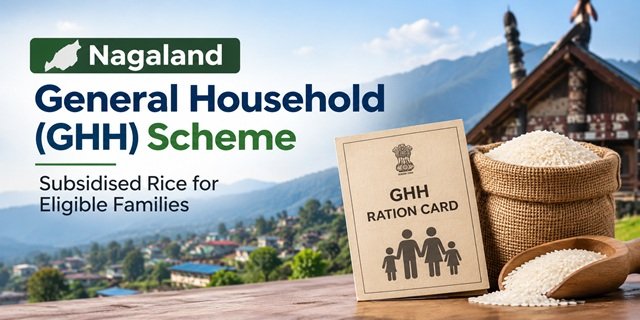
The General Household (GHH) Scheme, implemented by the Department of Food and Civil Supplies, Government of Nagaland, provides 5 kg of subsidised rice per person every month to eligible families with an annual income of Rs. 2.5 lakh or more who are not covered under NFSA’s AAY or PHH categories. Launched on 14 October 2026, the scheme identified 1,21,238 beneficiaries in its first phase.
Nagaland General Household Scheme Highlights | |
|---|---|
| Scheme Name | General Household (GHH) Scheme |
| Launch Date | 14 October 2026 |
| Launched By | KT Sukhalu, Advisor for Food and Civil Supplies |
| Implementing Department | Department of Food and Civil Supplies, Government of Nagaland |
| Scheme Framework | Tide Over Allocation under the National Food Security Act (NFSA), 2013 |
| Monthly Benefit | 5 kg of rice per person |
| Rice Price | Subsidised rate; beneficiaries must pay the notified price |
| Annual Income Condition | Rs. 2.5 lakh or more |
| Excluded Categories | Families covered under AAY or PHH |
| Head of Family | Eldest woman aged 18 or above; eldest man if no eligible woman is present |
| First-Phase Beneficiaries | 1,21,238 |
| Rice Distribution | Village Council Fair Price Shops in rural areas and designated Fair Price Shops in urban areas |
| Application Form | Form-I, available at the District Food and Civil Supplies Office |
| Official Updates | ipr.nagaland.gov.in |
Introduction of Nagaland General Household Scheme: A Brief Insight
When the National Food Security Act came into force, many families in Nagaland fell outside its coverage and lost access to subsidised ration support. These households had to buy rice at market prices, even when prices increased sharply. The General Household (GHH) Scheme aims to provide food security to these families through the public distribution system.
The scheme was formally launched on 14 October 2026 in Dimapur by KT Sukhalu, Advisor for Food and Civil Supplies. The Department of Food and Civil Supplies, Government of Nagaland, implements the scheme under the Tide Over Allocation guidelines of the National Food Security Act, 2013. It aims to protect families outside NFSA coverage from rising food prices and seasonal shortages while improving transparency in rice distribution.
Under the scheme, each eligible family member receives 5 kg of rice every month at a subsidised, government-fixed price through Fair Price Shops. Rural beneficiaries can collect rice from Village Council shops, while urban beneficiaries can visit designated shops. The GHH ration card is issued in the name of the eldest woman in the family, and 1,21,238 beneficiaries have been identified in the first phase.
Indigenous inhabitants of Nagaland and bona fide residents of the state who meet the eligibility conditions can apply. The family’s annual income must be Rs. 2.5 lakh or more, and no family member should be covered under the AAY or PHH categories. Every family member must have an Aadhaar, while non-indigenous applicants must submit an additional self-declaration.
To apply, families must submit Form-I along with the required Aadhaar details at their District Food and Civil Supplies Office or an enrolment camp. Applicants can contact their district office or Village Council for assistance with the process.
Families covered under the NFSA receive free food grains through the PM Garib Kalyan Anna Yojana. Households can also explore low-cost life insurance under the PM Jeevan Jyoti Bima Yojana and accident insurance under the PM Suraksha Bima Yojana.
Families, ration card holders, and other residents looking for welfare and food security schemes offered by the Nagaland Government can explore the available programmes on our Nagaland Government Welfare Schemes List page.
What the October 2026 Launch Means for Families
- 14 October 2026: The Food and Civil Supplies Department formally launched the GHH Scheme in Dimapur, with 1,21,238 beneficiaries identified in the first phase.
- Clearer Allocation: The department said the groundwork has been completed to remove confusion over how Tide Over rice is allotted, making distribution more transparent.
- Supply on the Ground: Rice for GHH card holders is now being routed through Village Council shops in rural areas and designated Fair Price Shops in towns, with district officials monitoring every month.
Benefits Provided to Eligible Beneficiaries
The General Household (GHH) Scheme provides eligible families in Nagaland with a monthly supply of rice at a subsidised price. It also provides a ration card in the name of the family’s eldest female member.
Monthly Rice Entitlement
| Family Size | Rice per Month |
|---|---|
| 1 member | 5 kg |
| 3 members | 15 kg |
| 4 members | 20 kg |
| 5 members | 25 kg |
Each eligible member receives 5 kg of rice per month. The total monthly quota depends on the number of family members listed on the ration card.
How the Price Is Fixed
- Rice is supplied at a subsidised price, not free of cost.
- The fixed godown issue price is Rs. 1,160 per quintal, equivalent to Rs. 11.60 per kg before local charges.
- District authorities determine the final retail price after adding transport, loading and Fair Price Shop handling charges.
- The rates may be revised in line with changes in central prices.
Where You Collect the Rice
| Area | Distribution Point |
|---|---|
| Villages | Village Council Fair Price Shop |
| Towns and cities | Designated Fair Price Shops selected by the District Officer |
Other Benefits
- Affordable rice: Helps eligible families manage their monthly food expenses.
- Women as card holders: The ration card is issued in the name of the eldest female member.
- Emergency stock: A portion of rice is reserved for natural disasters and other emergencies.
- Distribution monitoring: District administrations, Village Councils and dealers monitor supplies and submit monthly utilisation reports.
Reach of the Scheme
In the first phase, 1,21,238 beneficiaries were identified across Nagaland for subsidised rice under the scheme.
Eligibility Conditions Required to be Fulfilled
The General Household (GHH) Scheme in Nagaland provides subsidised rice to eligible families that do not qualify for NFSA benefits and meet the prescribed income criteria.
Who Can Get a GHH Ration Card
- Indian citizens who are indigenous inhabitants of Nagaland or bona fide residents of the State
- Families with an annual income of Rs. 2.5 lakh or more
- Families not covered under Antyodaya Anna Yojana (AAY) or Priority Household (PHH) under NFSA
- Families where every member has an Aadhaar Card
GHH Compared With NFSA Cards
| Point | AAY / PHH (NFSA) | GHH Scheme |
|---|---|---|
| Eligible Families | Poorest and priority households | Families outside NFSA with an annual income of Rs. 2.5 lakh or more |
| Rice Price | Free | Subsidised, on payment |
| Grain Allocation | Regular NFSA allocation | Tide Over allocation under NFSA |
Rules for Non-Indigenous Residents
- Must submit a self-declaration confirming that they do not hold a ration card or receive PDS benefits in their home State
- The GHH card can be used only to collect food grains and not as identity proof or for other purposes
Who Is Not Eligible
- Families already holding an AAY or PHH ration card
- Applicants holding another active ration card
- Families unable to provide Aadhaar details for all members
Documents Required to be Attached
Apply for a ration card under the General Household (GHH) Scheme through the District Food and Civil Supplies Office. Keep the following documents ready before applying.
Documents Needed by Every Family
- Completed and certified Form-I
- Aadhaar Card of every family member to be included
- Two recent passport-size photographs of the Head of Family
- Birth certificate, if required, especially for children
- Income proof showing an annual family income of Rs. 2.5 lakh or above
Who Should Be Named as Head of Family
| Family Situation | Head of Family |
|---|---|
| Woman aged 18 or above in the family | Eldest female member |
| No woman aged 18 or above | Eldest male member |
Extra Document for Non-Indigenous Residents
- Self-declaration in the prescribed format confirming that the applicant does not hold a ration card or receive PDS benefits in their home State
Forms for Later Changes
| Purpose | Form |
|---|---|
| Change the Head of Family | Form-II |
| Correct a member’s name | Form-III |
| Remove a member’s name | Form-IV |
| Change Fair Price Shop or address | Form-V |
| Surrender the GHH ration card | Form-VI |
How Beneficiaries Can Apply to Avail the Benefit of this Scheme
To apply for a GHH ration card, visit your District Food and Civil Supplies Office or an authorised enrolment camp. The application process is offline, and no online application form is currently available. Follow the steps below to apply.
First, Check That You Qualify
Step 1: Check that your family’s annual income is Rs. 2.5 lakh or more.
Step 2: Make sure no family member holds an AAY, PHH or any other ration card.
Step 3: Read the official GHH guidelines issued by the Food and Civil Supplies Department to understand the eligibility rules.
Get and Fill the Application Form
Step 1: Visit your District Food and Civil Supplies Office and collect Form-I for a new GHH ration card.
Step 2: Name the eldest female member aged 18 or above as the Head of Family. If no female member meets this condition, name the eldest male member.
Step 3: Enter the names and Aadhaar numbers of all family members you want to include on the card.
Step 4: Complete the form and obtain the required certification and signatures.
Attach Your Documents
Step 1: Attach Aadhaar Card copies for every family member to be included.
Step 2: Attach two recent passport-size photographs of the Head of Family.
Step 3: Keep birth certificates ready, especially for children, if the office or enrolment camp asks for them.
Step 4: If you are a non-indigenous resident, attach the signed self-declaration required under the department’s notification for non-indigenous applicants.
Submit and Wait for Verification
Step 1: Submit the completed application form and supporting documents at your District Food and Civil Supplies Office or an authorised enrolment camp.
Step 2: Officials verify your details through the Ration Card Management System to check whether any family member already appears on another ration card.
Step 3: After approval, the department issues the GHH ration card in the name of the Head of Family.
Start Collecting Your Rice
Step 1: Visit the Fair Price Shop linked to your card. In villages, this may be the Village Council Fair Price Shop; in towns, visit the designated shop.
Step 2: Pay the notified price and collect 5 kg of rice per family member every month.
Changing Details Later
Step 1: Contact the district office to change the Head of Family, correct a member’s name, remove a member, change the Fair Price Shop or address, or surrender the card. Ask for the relevant form, from Form-II to Form-VI.
Step 2: Complete the relevant form and submit it to the district office.
Important: Submitting an application does not guarantee approval. Contact your district office for updates and check the Department of Information and Public Relations, Nagaland website for official announcements.
How the GHH Scheme Took Shape
| Period | Milestone |
|---|---|
| August 2024 | Guidelines for GHH ration cards notified by the Directorate of Food and Civil Supplies |
| September 2024 | First round of applications invited from eligible families |
| December 2025 | Distribution modalities and rice rates notified for implementation |
| 2026 | Self-declaration made compulsory for non-indigenous applicants, and enrolment camps held in districts |
| 14 October 2026 | Formal launch of the scheme across Nagaland |
Important Links Available of the Scheme
- GHH Scheme guidelines under NFSA Tide Over Allocation, DIPR Nagaland
- GHH eligibility circular of Food and Civil Supplies, Nagaland
- Additional requirements for non-indigenous GHH applicants
- Official news portal, Government of Nagaland
Contact Details in Case of Help Needed
- Department: Directorate of Food and Civil Supplies, Government of Nagaland, Dimapur
- District Level: District Food and Civil Supplies Office of your district
- Village Level: Your Village Council or the linked Fair Price Shop
- Official Updates: Department of Information and Public Relations, Nagaland
Frequently Asked Questions (FAQs)
Ans. The General Household (GHH) Scheme provides subsidised rice to eligible families in Nagaland that do not fall under the NFSA’s Antyodaya Anna Yojana (AAY) or Priority Household (PHH) categories.
Ans. GHH stands for General Household.
Ans. The scheme was formally launched on 14 October 2026 in Dimapur by KT Sukhalu, Advisor for Food and Civil Supplies.
Ans. The Department of Food and Civil Supplies, Government of Nagaland, implements the scheme.
Ans. Eligible beneficiaries receive 5 kg of rice per person per month, based on the number of family members listed on the ration card.
Ans. No. Beneficiaries must pay the government-notified subsidised price. Free rice under the NFSA is available to eligible AAY and PHH cardholders under the applicable provisions.
Ans. The family’s annual income must be Rs. 2.5 lakh or more.
Ans. The eldest female family member aged 18 or above is listed as the Head of Family. If no female member meets this condition, the eldest male member is listed.
Ans. Yes. Bona fide Indian citizens residing in Nagaland can apply, subject to the applicable conditions. Non-indigenous applicants must submit the required self-declaration confirming that they do not hold a ration card in their home state.
Ans. No. Such a GHH ration card is valid only for collecting food grains and cannot be used as identity proof.
Ans. Visit your District Food and Civil Supplies Office or an authorised enrolment camp and submit Form-I with the required documents.
Ans. No. A family cannot hold multiple ration cards. Holding more than one card may lead to legal action under the applicable rules.
Ans. The first phase identified 1,21,238 beneficiaries.
Ans. Submit the relevant form at your District Food and Civil Supplies Office. Use Form-II to change the Head of Family and Form-V to change the Fair Price Shop or address.

Tabassum is a government schemes researcher and writer with 5 years of experience tracking Central and State welfare scheme programmes across India. She has covered 500+ schemes spanning agriculture, women welfare, education, and housing, helping lakhs of beneficiaries understand their entitlements in simple language.