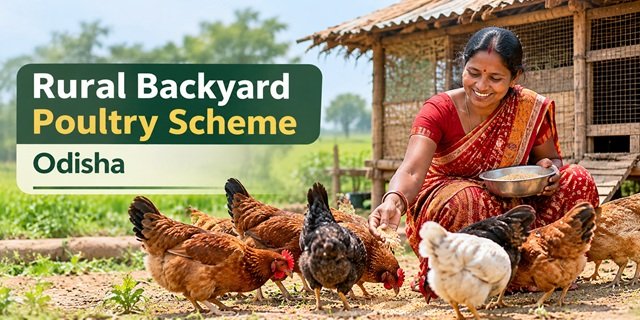
The Rural Backyard Poultry Scheme is implemented by the Directorate of Animal Husbandry and Veterinary Services, Odisha. It provides eligible rural families with 45 improved poultry birds, Rs. 500 for a night shelter and Rs. 510 for initial feed under a 100% subsidy. In 2026-27, the scheme targets 43,000 units across Odisha. Eligible applicants can apply online through GO-SUGAM.
Odisha Rural Backyard Poultry Scheme Highlights | |
|---|---|
| Scheme Name | Rural Backyard Poultry Scheme (Livelihood Support to Farmers through Rural Backyard Poultry Rearing) |
| Parent Scheme | Prani Sampad Samruddhi Yojana (Poultry Development) |
| Implementing Department | Fisheries and Animal Resources Development Department |
| Implementing Agency | Directorate of Animal Husbandry and Veterinary Services |
| Unit Size | 45 unsexed, four-week-old Low Input Technology birds |
| Available Breeds | Vanaraja, Chhabro, Kuroiler, Rainbow Rooster and Kalinga Brown |
| Total Unit Cost | Rs. 4,250 |
| Subsidy Details | 100% subsidy: Rs. 3,240 for birds, Rs. 500 for a night shelter and Rs. 510 for feed |
| Target for 2026-27 | 43,000 units across all 30 districts |
| Budget Allocation | Rs. 1,832 lakh |
| Eligible Groups | SC, ST, women, transgender persons, persons with 40% or more disability and poor farmers |
| Selection Process | First come, first served, subject to verification and approval |
| Estimated Annual Net Profit | About Rs. 13,326 per year |
| Helpline Numbers | 1962 and 155333 |
| Online Application | GO-SUGAM Portal |
Introduction of Odisha Rural Backyard Poultry Scheme: A Brief Insight
Backyard poultry provides village families in Odisha with eggs and an additional source of income. However, local birds produce fewer eggs, and many low-income households cannot afford improved breeds or suitable shelters. The Rural Backyard Poultry Scheme helps these families establish a poultry unit without paying its initial cost.
The scheme operates under the Government of Odisha’s State Plan programme, Prani Sampad Samruddhi Yojana, through its umbrella scheme for poultry development. The Directorate of Animal Husbandry and Veterinary Services, under the Fisheries and Animal Resources Development Department, implements it through District and Block Veterinary Officers.
The scheme aims to improve family nutrition by increasing access to animal protein and to raise rural incomes through backyard poultry farming.
For 2026-27, each selected household receives 45 improved birds, such as Vanaraja or Kuroiler, along with Rs. 500 for a night shelter and Rs. 510 for feed. The Government covers the full unit cost of Rs. 4,250.
The State plans to benefit 43,000 families across Odisha during 2026-27, with a budget of Rs. 1,832 lakh. According to the stated estimate, a poultry unit can generate a net profit of about Rs. 13,326 per year.
Eligible applicants include SC and ST communities, women, transgender persons, persons with at least 40% disability and poor farmers across all 30 districts. Only one member per family can receive assistance, and families that received this benefit during the previous three years cannot apply.
Applicants must submit their forms online through the GO-SUGAM portal. Officials select beneficiaries on a first come, first served basis after verification by the Block Veterinary Officer. Applicants can contact their BVO or call 1962 or 155333 for assistance.
Families living near ponds or wetlands can explore the Rural Backyard Duckery Scheme for another potential source of income. Farmers can also check the Pradhan Mantri Kisan Samman Nidhi Scheme and Odisha’s CM Kisan Yojana for income support, along with the PM Fasal Bima Yojana for crop insurance.
Those planning to establish larger egg-production farms can explore Odisha’s Commercial Layer Farming Scheme. Rural families, women farmers and others looking for more state welfare programmes can visit our List of Welfare Schemes of Odisha Government page.
Rural Backyard Poultry Scheme: 2026-27 Updates
- 2026-27 Guidelines: Odisha has set a target of 43,000 poultry units with a budget of Rs. 1,832 lakh. Each selected family receives 45 birds in one lot with 100% subsidy.
- Update on 9 October 2026: On World Egg Day, Minister Gokulananda Mallik announced full assistance for 43,000 backyard poultry beneficiaries during 2026-27. The initiative also supports Odisha’s target of producing 1,000 crore eggs annually by 2036.
- Application Process: Eligible applicants can apply online through the GO-SUGAM portal. Officials select applicants on a first come, first served basis, subject to verification and approval.
Benefits Provided to Eligible Beneficiaries
The Rural Backyard Poultry Scheme helps eligible families in Odisha establish a small poultry unit without bearing the initial setup cost. Beneficiaries receive improved chicken varieties that can provide eggs for household consumption and generate additional income through the sale of eggs and birds.
Financial Assistance for Setting Up a Poultry Unit
The government covers the full cost of one unit under the 2026-27 guidelines.
| Unit Component | Government Support |
|---|---|
| 45 unsexed Low Input Technology birds, four weeks old, at Rs. 72 per bird | Rs. 3,240 |
| Night shelter constructed using locally available materials | Rs. 500 |
| 17 kg of feed for the initial rearing period | Rs. 510 |
| Total Cost of One Unit | Rs. 4,250 |
The scheme provides 100% subsidy on the unit cost. The shelter assistance is released first, followed by the supply of birds. The feed assistance is released after the birds reach the beneficiary. Payments are processed through Direct Benefit Transfer (DBT) using the Unified Payment Layer on the GO-SUGAM portal.
Improved Poultry Breeds Available
Beneficiaries may receive improved Low Input Technology birds such as Vanaraja, Chhabro, Kuroiler, Rainbow Rooster and Kalinga Brown, along with other breeds approved by the Government of India. These birds are suitable for backyard rearing and can utilise kitchen waste and free-range feeding. The provided scheme details estimate egg production at approximately 120 eggs per bird annually.
Estimated Earnings From One Poultry Unit
The scheme guidelines provide the following income estimate for an 18-month period:
| Source of Income or Expense | Estimated Amount |
|---|---|
| Sale of 21 male birds for meat | Rs. 6,804 |
| Sale of 22 spent hens | Rs. 5,940 |
| Sale of 1,320 eggs at Rs. 6 each | Rs. 7,920 |
| Total Estimated Income | Rs. 20,664 |
| Total cost, including Rs. 675 for additional feed purchased by the farmer | Rs. 4,925 |
| Estimated Net Profit Over 18 Months | Rs. 19,989 |
| Estimated Annual Profit | Approximately Rs. 13,326 |
This estimate assumes that the family consumes half of the eggs and sells the remaining eggs. Actual earnings may vary depending on bird survival, egg production, feeding costs and local market prices.
Additional Veterinary and Technical Assistance
- Practical Training: Block-level guidance on brooding, feeding, watering and caring for young birds.
- Field-Level Support: Assistance from trained Pranimitras and Gomitras.
- Health Care: Vaccination and veterinary support to help prevent diseases.
- Quality Inspection: Verification of bird quality by the Block Veterinary Officer.
- Bird Supply: Procurement through government poultry farms and approved suppliers.
Key Changes Introduced in the 2026-27 Guidelines
| Scheme Feature | Earlier Guidelines | 2026-27 Guidelines |
|---|---|---|
| Number of Birds | 50 birds supplied in two batches of 25 | 45 birds supplied in one batch |
| Unit Cost | Rs. 3,750 | Rs. 4,250 |
| Feed Assistance | Not provided | Rs. 510 |
| Eligible Beneficiaries | Mainly SC, ST or WSHG members | SC, ST, women, transgender persons, persons with disabilities and poor farmers |
| Number of Units | Approximately 10,000 | 43,000 |
| Application Method | Through block offices | Online through the GO-SUGAM portal |
Note: The government provides 17 kg of initial feed under the scheme. Beneficiaries must arrange additional feed after this supply. Backyard grazing and kitchen waste may help reduce recurring feeding expenses, but farmers should ensure that the birds receive adequate nutrition.
Eligibility Conditions Required to be Fulfilled
The Rural Backyard Poultry Scheme supports rural families in Odisha who want to rear chickens at home and earn additional income. Applicants must belong to an eligible category and meet the conditions specified in the 2026-27 guidelines.
Who Can Apply?
- Scheduled Caste (SC) farmers
- Scheduled Tribe (ST) farmers
- Women farmers
- Transgender persons
- Persons with Disabilities with 40% or more disability
- Poor farmers belonging to the General Category
The scheme covers eligible individual farmers across all 30 districts of Odisha.
Eligibility Conditions
- The applicant must be an individual farmer residing in Odisha.
- The applicant must provide Aadhaar details for verification.
- The application must be submitted online through the GO-SUGAM portal for 2026-27.
- The applicant must be able to arrange a night shelter before receiving the birds.
- The birds must be reared through a backyard free-range system.
Who Is Not Eligible for the Scheme?
- Families in which a member received benefits under the same scheme during the previous three years.
- Additional members of a family that has already received benefits under the scheme.
- Applicants under special categories who fail to provide the required certificate.
Category-Wise Allocation
| Beneficiary Category | Number of Units |
|---|---|
| Scheduled Caste (SC) | 7,310 |
| Scheduled Tribe (ST) | 9,890 |
| Women | 12,900 |
| General Category (Male) | 12,900 |
| Total | 43,000 |
If seats remain vacant in a reserved category, the department may allocate them to other reserved categories and subsequently to the General Category, according to the applicable rules.
Documents Required to be Attached
Applicants must keep the following documents and details ready before applying for the Rural Backyard Poultry Scheme through the GO-SUGAM portal.
- Aadhaar Card of the applicant.
- Ration Card for family details.
- Bank Passbook showing the account holder’s name, account number and IFSC code.
- Caste Certificate for SC/ST applicants.
- Transgender Identity Certificate issued by the District Magistrate through the National Portal for Transgender Persons.
- Disability Certificate confirming at least 40% disability, for applicants in the disability category.
- Mobile Number for portal access and OTP verification, wherever required.
- Address Details, including village, Gram Panchayat and block.
Note: Women and poor farmers belonging to the General Category do not need an additional category certificate, according to the provided details. Keep your bank account active and verify all details before submitting the application. Check the GO-SUGAM portal for the final document requirements.
How Beneficiaries Can Apply to Avail the Benefit of the Scheme
The Rural Backyard Poultry Scheme accepts applications online through the GO-SUGAM portal. Follow the steps below to apply.
Get Ready Before Applying
Step 1: Keep your Aadhaar Card, Ration Card and bank passbook ready.
Step 2: Keep your category certificate ready if you belong to the SC, ST, transgender or differently abled category.
Step 3: Check that your bank account is active and linked with Aadhaar.
Fill the Form on GO-SUGAM
Step 1: Open the GO-SUGAM citizen login page.
Step 2: Register using your mobile number and OTP, or log in if you already have an account.
Step 3: Find the Rural Backyard Poultry Scheme under the Fisheries and Animal Resources Development Department.
Step 4: Enter your personal, address, category and bank details.
Step 5: Upload the required documents and check all the information.
Step 6: Submit the form and save your application number.
Selection and Approval
Step 1: The Block Veterinary Officer verifies your documents with the Livestock Inspector and Panchayat members.
Step 2: Officials consider applications in the order received and uploaded on the portal.
Step 3: The Chief District Veterinary Officer approves, returns or rejects your application.
After You Are Selected
Step 1: Receive Rs. 500 in your bank account to build a simple night shelter.
Step 2: Choose an available approved breed and receive 45 four-week-old birds from a Government poultry farm or approved supplier.
Step 3: The Block Veterinary Officer checks the birds, and field staff take geo-tagged photographs of your unit.
Step 4: Receive Rs. 510 for initial feed after the birds are supplied.
Step 5: Attend block-level training and seek guidance from your local Pranimitra or Gomitra.
Expected Schedule for 2026-27
| Stage | Expected Time |
|---|---|
| Application, selection and CDVO approval | From April 2026 |
| Release of night shelter amount | After approval |
| Supply of birds and feed amount | During the year, district-wise |
| All units set up and subsidy released | By February 2027 |
Important: For application help, contact your Block Veterinary Officer or visit the official DAHVS Poultry Development page.
District-Wise Target for 2026-27
| District | Units | District | Units |
|---|---|---|---|
| Angul | 1,424 | Kalahandi | 1,962 |
| Balangir | 2,006 | Kandhamal | 1,082 |
| Balasore | 2,253 | Kendrapada | 1,576 |
| Bargarh | 1,601 | Keonjhar | 1,880 |
| Bhadrak | 1,380 | Khordha | 1,203 |
| Boudh | 437 | Koraput | 1,519 |
| Cuttack | 2,361 | Malkangiri | 703 |
| Deogarh | 443 | Mayurbhanj | 2,557 |
| Dhenkanal | 1,342 | Nabarangapur | 1,196 |
| Gajapati | 943 | Nayagarh | 1,228 |
| Ganjam | 3,184 | Nuapada | 828 |
| Jagatsinghpur | 1,253 | Puri | 1,696 |
| Jajpur | 1,968 | Rayagada | 1,152 |
| Jharsuguda | 494 | Sambalpur | 873 |
| Subarnapur | 690 | Sundargarh | 1,766 |
| Total | 43,000 units | ||
Ganjam leads with 3,184 units, followed by Mayurbhanj and Cuttack, while Boudh has the smallest share. Block-wise seats within each district are fixed by the CDVO as per local demand.
Important Links Available of the Scheme
- Apply online for Rural Backyard Poultry Scheme on GO-SUGAM
- Poultry Development schemes and guidelines, DAHVS Odisha
- Animal Husbandry schemes list, Fisheries and Animal Resources Development Department
Contact Details in Case of Help Needed
- Implementing Agency: Directorate of Animal Husbandry and Veterinary Services, Mangalabag, Cuttack, Odisha
- Phone: 0671-2414310, 0671-2414629
- Toll-Free Numbers: 1962, 155333
- Email: dahvsorissa@gmail.com
- District Level: Chief District Veterinary Officer (CDVO) of your district
- Block Level: Block Veterinary Officer (BVO) or your nearest veterinary hospital
Frequently Asked Questions (FAQs)
Ans. The Odisha Government provides 45 improved poultry birds, night shelter assistance and initial feed support to eligible rural families under this scheme.
Ans. The Directorate of Animal Husbandry and Veterinary Services under the Fisheries and Animal Resources Development Department, Odisha.
Ans. Each selected beneficiary receives 45 unsexed, four-week-old Low Input Technology birds in one lot.
Ans. The total unit cost is Rs. 4,250, including Rs. 3,240 for birds, Rs. 500 for a night shelter and Rs. 510 for feed.
Ans. No. The scheme provides 100% subsidy on the unit cost, but beneficiaries must manage subsequent feeding expenses.
Ans. Available breeds include Vanaraja, Chhabro, Kuroiler, Rainbow Rooster and Kalinga Brown, along with other breeds approved by the Government of India.
Ans. Eligible groups include SC and ST applicants, women, transgender persons, persons with 40% or more disability and poor farmers in Odisha.
Ans. The scheme targets 43,000 families across Odisha’s 30 districts, with a budget of Rs. 1,832 lakh.
Ans. Submit your application online through the GO-SUGAM portal with the required documents.
Ans. Officials consider applications on a first come, first served basis, verify the documents through the Block Veterinary Officer (BVO) and obtain approval from the Chief District Veterinary Officer (CDVO).
Ans. An improved bird can lay approximately 120 eggs per year, according to the stated estimate.
Ans. The estimated net profit is about Rs. 13,326 per year under the scheme’s stated income calculation.
Ans. No. A family is ineligible if any member received a subsidy under this scheme during the previous three years.
Ans. No. The National Livestock Mission is a separate Central Government programme. The Rural Backyard Poultry Scheme operates under Odisha’s Prani Sampad Samruddhi Yojana.
Ans. Contact your Block Veterinary Officer or call 1962 or 155333 for assistance.

Tabassum is a government schemes researcher and writer with 5 years of experience tracking Central and State welfare scheme programmes across India. She has covered 500+ schemes spanning agriculture, women welfare, education, and housing, helping lakhs of beneficiaries understand their entitlements in simple language.