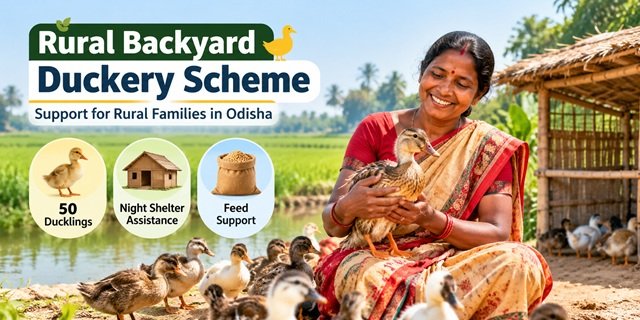
The Rural Backyard Duckery Scheme, implemented by the Directorate of Animal Husbandry and Veterinary Services, Odisha, helps eligible rural families start duck farming with government assistance. Under the scheme, beneficiaries receive 50 ducklings, Rs. 750 towards a night shelter and Rs. 500 for starter feed, with 100% subsidy on the Rs. 5,000 unit cost. Eligible SC, ST, women, transgender, persons with disabilities and poor farmers can apply online through the GO-SUGAM portal, subject to the scheme conditions.
Odisha Rural Backyard Duckery Scheme Highlights | |
|---|---|
| Scheme Name | Rural Backyard Duckery Scheme (Livelihood Support to Farmers through Rural Backyard Duck Farming) |
| Parent Scheme | Prani Sampad Samruddhi Yojana (Poultry Development) |
| Implementing Department | Fisheries and Animal Resources Development Department, Government of Odisha |
| Implementing Agency | Directorate of Animal Husbandry and Veterinary Services |
| Convergence | Farm Pond Plus Scheme |
| Unit Size | 50 two-week-old ducklings of Khaki Campbell or Indian Runner breed |
| Unit Cost | Rs. 5,000 |
| Subsidy | 100% of the unit cost: Rs. 3,750 for ducklings, Rs. 750 for a night shelter and Rs. 500 for starter feed |
| Target for 2026-27 | 3,000 units across all 30 districts of Odisha |
| Budget Allocation | Rs. 150 lakh |
| Eligible Beneficiary Groups | SC, ST, women, transgender persons, persons with disabilities (40% or more) and poor farmers belonging to the General Category |
| Selection Process | First-come, first-served basis, subject to eligibility, verification and unit availability |
| Estimated Annual Profit | Approximately Rs. 16,410 per unit, as estimated in the scheme guidelines |
| Helpline Numbers | 1962, 155333 |
| Online Application | GO-SUGAM Official Portal |
Introduction of Odisha Rural Backyard Duckery Scheme: A Brief Insight
In many villages of Odisha, ponds, paddy fields and canals provide suitable surroundings for duck rearing. However, many low-income families cannot afford the initial expenses of buying ducklings, building a shelter and arranging feed. The Rural Backyard Duckery Scheme helps such families start duck farming by providing financial support for a complete duck-rearing unit.
The Government of Odisha runs this scheme under the State Plan scheme Prani Sampad Samruddhi Yojana, as part of its broader poultry development programme. The Directorate of Animal Husbandry and Veterinary Services, under the Fisheries and Animal Resources Development Department, implements the scheme in coordination with the Farm Pond Plus scheme. The initiative aims to increase egg and meat production while improving the income of economically weaker rural families.
Under the 2026-27 guidelines, each selected family receives 50 ducklings of the Khaki Campbell or Indian Runner breed, Rs. 750 towards a night shelter and Rs. 500 for starter feed. The government covers 100% of the Rs. 5,000 unit cost. According to the scheme estimates, one unit can generate an annual profit of approximately Rs. 16,410. The government plans to establish 3,000 units across all 30 districts of Odisha.
Eligible applicants include SC and ST farmers, women, transgender persons, persons with disabilities of 40% or more, and poor farmers belonging to the General Category. However, only one member of a family can receive the benefit. Families that received assistance under the same scheme during the previous three years cannot apply.
Applicants must submit their forms online through the GO-SUGAM portal. The department selects eligible beneficiaries on a first-come, first-served basis, subject to the availability of units and the prescribed verification process. Applicants can contact their Block Veterinary Officer (BVO) or call 1962 or 155333 for assistance.
Along with duck farming, farmers can explore other government programmes that support their agricultural and financial needs. The PM Kisan Samman Nidhi Yojana and Odisha’s CM Kisan Yojana provide income support to eligible farmers, while the PM Fasal Bima Yojana offers crop insurance. Families with children pursuing higher education can explore the Krishi Vidya Nidhi Scheme, while farmers planning to establish a larger agricultural enterprise can consider the Mukhyamantri Krushi Udyog Yojana.
Farmers, rural women and other residents looking for additional agricultural and livestock support can explore the available programmes on our Odisha Government Welfare Schemes List page.
Latest Update of the Scheme
- 2026-27 Scheme Guidelines: The Odisha Government plans to establish 3,000 duck-rearing units across all 30 districts, with a total budget allocation of Rs. 150 lakh. The scheme provides 100% subsidy on the Rs. 5,000 unit cost, covering 50 ducklings, night shelter assistance and starter feed.
- Online Application: Eligible applicants can apply through the GO-SUGAM portal. Applications are processed on a first-come, first-served basis, subject to eligibility verification and the availability of units.
Benefits Provided to Eligible Beneficiaries
The Rural Backyard Duckery Scheme helps rural families in Odisha start small-scale duck farming without bearing the initial cost of setting up a unit. Under the 2026-27 guidelines, the government provides financial support worth Rs. 5,000 per unit, covering 50 ducklings, a night shelter and starter feed. Beneficiaries can use duck farming to earn additional income by selling eggs and ducks for meat.
100% Subsidy on the Duck-Rearing Unit
The government provides the following support for each eligible unit under the scheme:
| Component | Financial Support |
|---|---|
| 50 unsexed ducklings, each two weeks old, of Khaki Campbell or Indian Runner breeds, at Rs. 75 per duckling | Rs. 3,750 |
| Construction of a night shelter using locally available materials | Rs. 750 |
| Starter feed, including transportation, weighing 16 kg | Rs. 500 |
| Total Cost of One Unit | Rs. 5,000 |
The scheme covers the full unit cost of Rs. 5,000. According to the provided guidelines, the subsidy is transferred directly to the beneficiary’s bank account through Direct Benefit Transfer (DBT), using the Unified Payment Layer on the GO-SUGAM portal. The feed support is released after the ducklings are purchased.
Estimated Income From Duck Farming
The official guideline estimates the following income and expenditure for one duck-rearing unit over an 18-month period:
| Income or Expenditure | Estimated Amount |
|---|---|
| Sale of 24 male ducks for meat | Rs. 8,640 |
| Sale of 24 spent female ducks | Rs. 6,480 |
| Sale of 3,000 table eggs at Rs. 7 per egg | Rs. 21,000 |
| Total Estimated Income | Rs. 36,120 |
| Total estimated cost, including feed purchased later by the farmer | Rs. 16,505 |
| Estimated Net Profit Over 18 Months | Rs. 24,615 |
| Estimated Annual Profit | Approximately Rs. 16,410 |
According to the guideline, each female duck can lay approximately 250 eggs per year. The income estimate assumes that the family consumes half of the eggs and sells the remaining eggs in the market.
Note: These figures represent estimates provided in the guideline, not guaranteed earnings. Actual income depends on egg production, duck survival, feed expenses and local market prices.
Additional Support Provided by the Department
- Free Training: Block-level training on feeding, watering, brooding and duck rearing, organised in batches of 50.
- Vaccination and Health Care: Routine veterinary support to help prevent diseases and reduce duck mortality.
- Quality Verification: Inspection of ducklings by the Block Veterinary Officer.
- Purchase Assistance: Guidance from the Chief District Veterinary Officer (CDVO) for procuring ducklings, with priority given to the nearest Government Duck Breeding Farm.
- Field-Level Guidance: Assistance from Livestock Inspectors and Animal Husbandry Department staff.
Major Changes Under the 2026-27 Guidelines
| Scheme Feature | Earlier Guidelines | 2026-27 Guidelines |
|---|---|---|
| Unit Cost | Rs. 4,000 | Rs. 5,000 |
| Subsidy Rate | 50% in some years | 100% for all categories |
| Duckling Distribution | Two phases of 25 ducklings each | All 50 ducklings in one phase |
| Starter Feed Support | Not provided | Rs. 500 |
| Geographical Coverage | Selected districts | All 30 districts of Odisha |
| Application Process | Through the local veterinary office | Online through the GO-SUGAM portal |
Eligibility Conditions Required to be Fulfilled
The Rural Backyard Duckery Scheme supports rural families in Odisha who want to earn additional income by rearing ducks but lack the funds to establish a small duck-rearing unit. Applicants must meet the eligibility conditions specified in the official 2026-27 guidelines to receive benefits under the scheme.
Who Can Apply for the Scheme?
- Scheduled Caste (SC) farmers
- Scheduled Tribe (ST) farmers
- Women farmers
- Transgender persons
- Persons with Disabilities having at least 40% disability
- Poor farmers belonging to the General Category
Both men and women can apply, subject to the applicable category conditions. The scheme covers all 30 districts of Odisha.
Basic Eligibility Conditions
- The applicant must be an individual farmer residing in Odisha.
- The applicant must have an Aadhaar Card for identity verification.
- The applicant must submit an online application through the GO-SUGAM portal for the 2026-27 financial year.
- The applicant must have sufficient space near the house to construct a small night shelter using locally available materials.
- A Farm Pond Plus facility is beneficial but not mandatory.
Who Cannot Apply?
- Families in which any member received a subsidy under the same scheme during the previous three years.
- Families applying through more than one member, as only one member per family can receive the benefit.
- Applicants who fail to provide the required category certificate when applying under a category that requires one.
Category-Wise Target for the 2026-27 Financial Year
| Beneficiary Category | Target Number of Units |
|---|---|
| Scheduled Caste (SC) | 510 |
| Scheduled Tribe (ST) | 690 |
| Women | 900 |
| General Category (Male) | 900 |
| Total | 3,000 |
If a reserved category does not receive enough eligible applications, the unfilled units may be reassigned to other reserved categories or the General Category, as permitted under the scheme guidelines.
Documents Required to be Attached
Applicants applying for the Rural Backyard Duckery Scheme through the GO-SUGAM portal should keep clear scanned copies of the required documents ready before starting the online application. The 2026-27 guidelines specify a few basic documents for all applicants, along with additional certificates for certain categories.
Documents Required for All Applicants
- Aadhaar Card: Required for beneficiary identification and to prevent duplicate applications.
- Ration Card: A copy of the family’s ration card.
- Bank Passbook: The first page showing the account holder’s name, account number and IFSC code for receiving the subsidy through Direct Benefit Transfer (DBT).
- Mobile Number: Required for OTP verification and application-related updates.
Additional Documents Based on Applicant Category
| Applicant Category | Additional Document Required |
|---|---|
| SC or ST | Caste Certificate issued by the competent authority. |
| Transgender Persons | Certificate of Identity issued by the District Magistrate through the National Portal for Transgender Persons under the Transgender Persons (Protection of Rights) Act, 2019. |
| Persons with Disabilities | Disability Certificate confirming 40% or more disability, issued by the competent authority under the Rights of Persons with Disabilities Act, 2016. |
| Women and General Category Poor Farmers | No additional category-specific certificate is required beyond the basic documents listed above. |
Details to Keep Ready Before Applying
- Village, Gram Panchayat and block details.
- Information about the availability of a Farm Pond Plus facility, as requested in the application form.
- Availability of suitable space near the house to construct a small night shelter for the ducks.
Records Required After Selection
- Geo-tagged Photographs: Photographs of the duck-rearing unit taken during the verification process.
- Purchase Proof: Proof of purchasing ducklings from a Government Duck Breeding Farm or another reputed source, if requested by the Block Veterinary Officer.
How Beneficiaries Can Apply to Avail the Benefit of the Scheme
Farmers in Odisha can apply for the Rural Backyard Duckery Scheme online through the GO-SUGAM portal. The scheme helps eligible rural families start duck farming by providing financial support for ducklings, a night shelter and starter feed. Applications are processed on a first-come, first-served basis, subject to eligibility and the availability of units. Follow the steps below to understand how to apply and what happens after selection.
Documents and Details to Keep Ready
Step 1: Arrange your basic documents. Keep your Aadhaar Card, family Ration Card and the first page of your bank passbook ready. Make sure the scanned copies are clear and easy to read.
Step 2: Arrange your category certificate, if applicable. Applicants applying under the SC, ST, Transgender or Persons with Disabilities category should keep the relevant certificate ready.
Step 3: Check your bank account. Keep your bank account active and check that the account details are correct. The scheme provides financial assistance through Direct Benefit Transfer (DBT), so incorrect bank details may cause payment problems.
How to Apply Online Through the GO-SUGAM Portal
Step 1: Open the official portal. Visit the GO-SUGAM Citizen Login page of the Government of Odisha.
Step 2: Register or log in. If you are using the portal for the first time, register using your mobile number and complete OTP verification if prompted. If you already have an account, log in with your existing credentials.
Step 3: Find the scheme. After logging in, look for the Rural Backyard Duckery Scheme under the Fisheries and Animal Resources Development Department. If the scheme appears under a different name, check its details before proceeding.
Step 4: Fill in your personal details. Enter your name, address, village, Gram Panchayat, block and beneficiary category carefully. Provide your bank details exactly as they appear in your bank records.
Step 5: Provide information about your facilities. Answer the question about whether you have a Farm Pond Plus facility. Read the available options carefully before selecting your answer.
Step 6: Upload the required documents. Upload your Aadhaar Card, Ration Card, bank passbook page and applicable category certificate. Follow the file format and size requirements displayed on the portal.
Step 7: Review and submit the application. Check every entry before submitting the form. Correct any mistakes you find, especially in your name, mobile number, category and bank account details.
Step 8: Save your application number. After submission, note down the application or reference number and keep it safe. You may need it to check the status of your application or contact the department for assistance.
How the Department Selects Beneficiaries
Step 1: Verification of documents. The Block Veterinary Officer checks the application and supporting documents with assistance from the Livestock Inspector and Panchayat members.
Step 2: Preparation of the beneficiary list. Eligible applicants are considered according to the order in which applications are received, subject to the available unit allocation and the scheme’s selection rules.
Step 3: Final approval. The beneficiary list is sent to the Chief District Veterinary Officer (CDVO) for final approval.
Submitting an application does not automatically guarantee selection. The department must verify your eligibility, and a unit must be available under the district’s allocation.
What Happens After Your Application Is Approved?
Step 1: Receive the night shelter assistance. According to the provided scheme details, Rs. 750 is allocated for constructing a night shelter. Follow the department’s instructions regarding the release and use of this amount.
Step 2: Build a suitable shelter. Prepare a simple, safe shelter near your home using locally available materials such as bamboo or wood. The shelter should provide the ducks with a secure place to stay at night.
Step 3: Arrange the ducklings. With guidance from the CDVO office, arrange to purchase 50 ducklings that are two weeks old. The scheme details give preference to the nearest Government Duck Breeding Farm, subject to availability and departmental instructions.
Step 4: Complete the inspection. The Block Veterinary Officer checks the quality of the ducklings. The department may also take geo-tagged photographs of the duck-rearing unit to record its location and verify its establishment.
Step 5: Receive the remaining assistance. The scheme details provide Rs. 3,750 for 50 ducklings and Rs. 500 towards starter feed, including transportation. The release of these amounts depends on the prescribed purchase and verification process. Follow the instructions issued by the department before making any purchase or expecting payment.
Step 6: Attend the training programme. Participate in the block-level training, where department staff explain how to feed the ducks, provide clean water, care for young ducklings and maintain their health.
Expected Timeline for the 2026-27 Financial Year
| Activity | Expected Period |
|---|---|
| Online applications, beneficiary selection and CDVO approval | From April 2026 onwards, as per the district schedule |
| Release of night shelter assistance | After approval, subject to the prescribed process |
| Supply of ducklings and release of feed assistance | During the financial year, according to the district schedule |
| Completion of all units | By February 2027, as indicated in the provided timeline |
Note: These are the expected periods mentioned in the provided scheme details. Applicants should check the portal or contact the local veterinary office for the current application window, selection status and district-wise schedule.
Where to Get Help With Your Application
If you have difficulty finding the scheme, uploading documents or completing the application, contact your local Block Veterinary Officer for guidance. You can also visit the official Poultry Development page of the Directorate of Animal Husbandry and Veterinary Services, Odisha to explore information about poultry and duck-rearing schemes.
Always use the official GO-SUGAM portal to submit your application. Keep your application number and copies of the documents you submit so that you can refer to them whenever necessary.
District-Wise Target for 2026-27
| District | Units | District | Units |
|---|---|---|---|
| Angul | 99 | Kalahandi | 137 |
| Balangir | 140 | Kandhamal | 76 |
| Balasore | 157 | Kendrapada | 110 |
| Bargarh | 112 | Keonjhar | 131 |
| Bhadrak | 96 | Khordha | 84 |
| Boudh | 30 | Koraput | 106 |
| Cuttack | 165 | Malkangiri | 49 |
| Deogarh | 31 | Mayurbhanj | 178 |
| Dhenkanal | 94 | Nabarangapur | 84 |
| Gajapati | 66 | Nayagarh | 86 |
| Ganjam | 222 | Nuapada | 58 |
| Jagatsinghpur | 87 | Puri | 118 |
| Jajpur | 137 | Rayagada | 80 |
| Jharsuguda | 34 | Sambalpur | 61 |
| Subarnapur | 48 | Sundargarh | 124 |
| Total | 3,000 units | ||
Ganjam has the highest target, followed by Mayurbhanj and Cuttack. The CDVO of each district divides these seats among blocks based on demand.
Important Links Available of the Scheme
- Apply online for Rural Backyard Duckery Scheme on GO-SUGAM
- Poultry and duck farming schemes, Directorate of Animal Husbandry and Veterinary Services
- Animal Husbandry schemes and guidelines, FARD Department, Odisha
Contact Details in Case of Help Needed
- Implementing Agency: Directorate of Animal Husbandry and Veterinary Services, Mangalabag, Cuttack, Odisha
- Phone: 0671-2414310, 0671-2414629
- Toll-Free Numbers: 1962, 155333
- Email: dahvsorissa@gmail.com
- District Level: Office of the Chief District Veterinary Officer (CDVO)
- Block Level: Block Veterinary Officer (BVO) of your block
Frequently Asked Questions (FAQs)
Ans. The Rural Backyard Duckery Scheme is an Odisha Government initiative that helps rural families start duck farming. Under the scheme, eligible beneficiaries receive 50 ducklings, assistance for constructing a night shelter, and starter feed with a 100% subsidy.
Ans. The scheme is implemented by the Directorate of Animal Husbandry and Veterinary Services under the Fisheries and Animal Resources Development Department, Government of Odisha.
Ans. The total cost of one unit is Rs. 5,000, comprising Rs. 3,750 for ducklings, Rs. 750 for a night shelter and Rs. 500 for starter feed.
Ans. According to the provided 2026-27 scheme details, the government covers 100% of the Rs. 5,000 unit cost. Beneficiaries should check the official guidelines for the applicable payment and purchase procedures.
Ans. Eligible beneficiaries receive 50 unsexed ducklings, each two weeks old, of the Khaki Campbell or Indian Runner breed.
Ans. Eligible applicants include SC and ST farmers, women, transgender persons, persons with disabilities of 40% or more, and poor farmers belonging to the General Category in Odisha, subject to the prescribed conditions.
Ans. The scheme targets 3,000 duck-rearing units across all 30 districts of Odisha, with a total budget allocation of Rs. 150 lakh, according to the provided scheme details.
Ans. Eligible applicants can submit their applications online through the GO-SUGAM portal of the Government of Odisha.
Ans. No. Having a Farm Pond Plus facility is not compulsory, according to the provided scheme details.
Ans. The department selects eligible applicants on a first-come, first-served basis, subject to the availability of units. The Block Veterinary Officer verifies the applications, and the Chief District Veterinary Officer (CDVO) gives final approval.
Ans. The provided guideline estimates an annual profit of approximately Rs. 16,410 from selling eggs and ducks. Actual earnings may vary depending on production, feed expenses and market prices.
Ans. No. Only one member per family can receive the benefit. Families in which a member received a subsidy under the same scheme during the previous three years are also ineligible.
Ans. No. The two are separate programmes. The Semi-Commercial Duck Farming Scheme covers larger duck-rearing units and follows different subsidy provisions.
Ans. You can contact your local Block Veterinary Officer for assistance. The provided scheme details also mention the toll-free numbers 1962 and 155333; confirm their current availability with the department before relying on them.

Tabassum is a government schemes researcher and writer with 5 years of experience tracking Central and State welfare scheme programmes across India. She has covered 500+ schemes spanning agriculture, women welfare, education, and housing, helping lakhs of beneficiaries understand their entitlements in simple language.