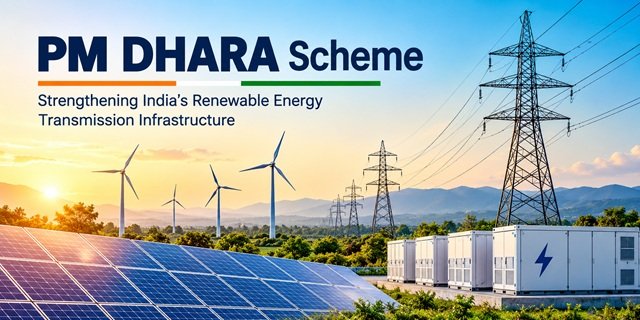
PM DHARA Scheme, approved by the Union Cabinet and implemented through the Ministry of New and Renewable Energy, aims to strengthen India’s renewable energy transmission infrastructure by creating capacity to evacuate up to 135 GW of clean energy. The scheme will be implemented through State Transmission Utilities and private transmission developers, making it an infrastructure initiative rather than a direct beneficiary scheme for citizens.
PM DHARA Scheme Highlights | |
|---|---|
| Scheme Name | PM DHARA (PM Developing Harmonized and Accelerated Renewable Energy Access) |
| Approval Date | 30 September 2026 |
| Nodal Ministry | Ministry of New and Renewable Energy (MNRE) |
| Objective | Strengthen Intra State Transmission Systems for renewable energy integration |
| Total Project Outlay | Rs. 1,86,405 crore |
| Central Financial Support | Rs. 54,082 crore |
| Renewable Energy Evacuation Capacity | 135 GW |
| Battery Energy Storage Capacity | 50 GWh BESS |
| Implementing Agencies | State Transmission Utilities and Private Transmission Service Providers |
| Coverage | States and Union Territories across India |
| Target Completion | Financial Year 2032-33 |
| Official Website | mnre.gov.in |
Introduction of PM-DHARA Scheme: A Brief Insight
India has witnessed rapid growth in solar and wind power generation over the past few years. However, in many regions, transmission infrastructure has not expanded at the same pace, making it difficult to move renewable energy from generation sites to consumers. To address this challenge, the Union Cabinet approved the PM DHARA Scheme on 30 September 2026.
The scheme is being implemented through the Ministry of New and Renewable Energy in coordination with State Transmission Utilities across the country. Its primary objective is to strengthen India’s Intra State Transmission System so that renewable energy generated from solar and wind projects can be delivered efficiently to homes, businesses, and industries.
Under PM DHARA Scheme, the Government aims to create transmission infrastructure capable of evacuating up to 135 GW of renewable energy. The programme also includes deployment of 50 GWh of Battery Energy Storage Systems, helping the power grid manage fluctuations and improve energy availability during non generation hours.
The scheme is backed by a substantial Central Financial Support of Rs. 54,082 crore, which will help reduce transmission related costs and support states in expanding their renewable energy infrastructure. This approach also helps keep electricity tariffs more stable for consumers while accelerating India’s clean energy transition.
PM DHARA Scheme is not a direct benefit scheme for citizens. Instead, implementation will take place through State Transmission Utilities and private transmission developers selected through competitive bidding. Stakeholders seeking official updates can follow notifications issued by the Ministry of New and Renewable Energy.
Farmers and renewable energy stakeholders can also explore the PM KUSUM Scheme, which promotes solar powered irrigation, along with major national initiatives such as the PM Surya Ghar Muft Bijli Yojana and the PM Gati Shakti programme focused on integrated infrastructure development.
Energy sector stakeholders, renewable energy developers, transmission companies, and readers looking for more national level initiatives can explore all available programmes on our Welfare Schemes List of Central Government page.
Benefits Provided to Eligible Beneficiaries
PM DHARA Scheme delivers benefits at a national infrastructure level by strengthening India’s transmission network, enabling large scale renewable energy integration, and improving the reliability of electricity supply across the country.
Core Infrastructure Benefits
- Transmission capacity for up to 135 GW of renewable energy generation across States and Union Territories
- 50 GWh of Battery Energy Storage Systems (BESS) planned at generation sites and other strategic locations within the power grid
- Reduced curtailment of solar and wind energy, ensuring that more renewable power generated across the country can be efficiently transmitted and utilised
- Improved grid stability and flexibility, with stored energy available during peak demand periods and non solar generation hours
Financial Support That Benefits Consumers
- Rs. 54,082 crore in Central Financial Support dedicated to strengthening intra state transmission infrastructure
- This financial assistance helps reduce the burden of transmission costs on states and distribution utilities
- Consumers ultimately benefit through more stable and affordable electricity tariffs despite major investments in grid expansion
Benefits for States and Industry
- States gain greater capacity to integrate solar, wind, hybrid, and energy storage projects into their electricity networks
- Improved transmission infrastructure supports compliance with Renewable Consumption Obligation (RCO) targets
- Renewable energy developers benefit from stronger evacuation systems and reduced transmission bottlenecks
- Significant opportunities are created for manufacturers of transmission equipment, substations, transformers, battery storage systems, and other power sector components
- Large scale construction, operation, and maintenance activities generate employment opportunities across the energy sector
Supporting India’s Long Term Energy Transition
PM DHARA Scheme plays a crucial role in supporting India’s clean energy roadmap by facilitating the integration of renewable power into the national grid. The scheme aligns with the country’s target of achieving 500 GW of non fossil fuel based power capacity by 2030 and lays the foundation for further expansion in the years ahead.
Note: With a total estimated investment of Rs. 1,86,405 crore and implementation planned up to FY 2032-33, PM DHARA Scheme represents one of India’s most significant initiatives for modernising transmission infrastructure and accelerating the transition towards a cleaner and more resilient power sector.
Eligibility Conditions Required to be Fulfilled
PM DHARA Scheme is a national power transmission infrastructure programme and not a direct benefit scheme for individuals. Therefore, the eligibility conditions under the scheme apply to participating states, transmission agencies, and project developers rather than citizens.
- All States and Union Territories are covered under PM DHARA Scheme, as its objective is to strengthen Intra State Transmission Systems across the country
- State Transmission Utilities (STUs) serve as the principal implementing agencies responsible for planning and executing approved transmission projects within their respective states
- Private Transmission Service Providers (TSPs) are eligible to participate through Tariff Based Competitive Bidding for greenfield transmission infrastructure projects
- Brownfield transmission network augmentation and modernisation projects are implemented directly by STUs under the Cost Plus framework, without a separate competitive bidding process
Who Benefits from PM DHARA Scheme
- Renewable energy developers, who receive enhanced transmission and evacuation capacity for upcoming solar, wind, hybrid, and energy storage projects
- Electricity consumers, who benefit from improved grid reliability and reduced transmission cost burden through Central Financial Support
- States and Union Territories working towards achieving their Renewable Consumption Obligation (RCO) targets
- Power distribution companies, which gain access to a stronger and more efficient transmission network for delivering electricity
Documents Required to be Attached
Since PM DHARA Scheme is a large-scale power transmission and renewable energy infrastructure programme, it does not require individual citizens to submit applications or personal documents. The documentation requirements under this scheme apply only to the agencies, utilities, and companies responsible for implementing approved projects.
- For private Transmission Service Providers (TSPs) participating in greenfield transmission projects: technical bids, financial bids, and other documentation prescribed under the Tariff Based Competitive Bidding (TBCB) framework of the Ministry of Power
- For State Transmission Utilities (STUs) undertaking brownfield transmission upgrades: detailed project reports, technical proposals, cost estimates, and approvals submitted under the Cost Plus framework
- Detailed implementation guidelines, state-wise project allocations, bidding conditions, and project-specific documentation requirements are expected to be issued by the Ministry of New and Renewable Energy (MNRE) following Cabinet approval
Note: PM DHARA Scheme is not a beneficiary-oriented scheme and therefore does not involve citizens submitting documents or registration forms. Businesses such as transmission equipment manufacturers, EPC contractors, transmission developers, and infrastructure companies interested in participating should regularly monitor official tender notices issued by the Ministry of New and Renewable Energy, the Ministry of Power, and their respective State Transmission Utilities.
How Beneficiaries Can Apply to Avail the Benefit of the Scheme
Since PM-DHARA Scheme is an infrastructure development programme, individual citizens do not need to submit any application or fill out any form. Instead, the scheme will be implemented through a planned process involving the Central Government, State Transmission Utilities, and private transmission companies. Here’s how the implementation will move forward, step by step.
Step 1: After Cabinet approval, the Ministry of New and Renewable Energy (MNRE) will release detailed operational guidelines. These guidelines will explain how projects will be allocated, how funding support will be provided, and what responsibilities participating states will have.
Step 2: For new transmission infrastructure projects, known as greenfield projects, private Transmission Service Providers (TSPs) will participate in Tariff Based Competitive Bidding (TBCB). The selected company will build, own, operate, and maintain the transmission assets for the specified period.
Step 3: For strengthening and upgrading existing transmission networks, known as brownfield projects, the respective State Transmission Utilities (STUs) will carry out the work directly under the Cost Plus framework approved by the Government.
Step 4: Once projects are approved, construction work will begin across different states. This includes setting up new transmission lines, expanding substations, and installing large scale Battery Energy Storage Systems (BESS) at suitable locations to support renewable energy integration.
Step 5: As these facilities become operational, states will be able to transfer much larger amounts of solar and wind power from generation sites to consumers. This will reduce renewable energy wastage and improve overall grid reliability.
Step 6: The Central Government will provide Rs. 54,082 crore of financial support to reduce the burden of transmission costs. This support will help states strengthen their power infrastructure while keeping the impact on electricity tariffs under control.
Important: The entire PM-DHARA Scheme implementation is planned to be completed by FY 2032-33. Companies involved in transmission infrastructure, battery storage systems, EPC contracting, and power sector equipment manufacturing should regularly monitor tender notifications issued by their respective State Transmission Utilities and the Ministry of New and Renewable Energy for participation opportunities.
Important Links Available of the Scheme
- PM DHARA Scheme Cabinet Approval Official Press Release
- Ministry of New and Renewable Energy Official Website
Contact Details in Case of Help Needed
- Nodal Ministry: Ministry of New and Renewable Energy, Government of India
- State Level: Contact your respective State Transmission Utility, for implementation-related queries
Frequently Asked Questions (FAQs)
Ans. PM DHARA Scheme is a Central Government infrastructure initiative approved by the Union Cabinet to strengthen India’s Intra State Transmission System, enabling the efficient evacuation of renewable energy and deployment of large scale battery storage facilities across the country.
Ans. PM DHARA stands for PM Developing Harmonized and Accelerated Renewable Energy Access. The scheme aims to support India’s clean energy transition by strengthening power transmission infrastructure.
Ans. No. PM DHARA Scheme is not a direct beneficiary scheme. It is an infrastructure development programme implemented through State Transmission Utilities, while private Transmission Service Providers can participate through competitive bidding for eligible projects.
Ans. The total outlay of PM DHARA Scheme is Rs. 1,86,405 crore, including Rs. 1,36,378 crore for transmission infrastructure and Rs. 50,000 crore for Battery Energy Storage Systems.
Ans. The Central Government will provide Rs. 54,082 crore as Central Financial Support to reduce transmission costs and support renewable energy integration across states.
Ans. PM DHARA Scheme is designed to create transmission infrastructure capable of evacuating and integrating up to 135 GW of renewable energy capacity into the national grid.
Ans. The scheme provides for the deployment of 50 GWh of Battery Energy Storage Systems (BESS) at renewable energy generation sites and other strategic grid locations.
Ans. The implementation of PM DHARA Scheme is targeted for completion by Financial Year 2032-33.
Ans. Yes. PM DHARA Scheme builds upon the objectives of earlier Green Energy Corridor initiatives by expanding transmission infrastructure and introducing a large scale battery storage component to support renewable energy growth.
Ans. By improving renewable energy evacuation and providing Central Financial Support for transmission infrastructure, the scheme helps reduce system bottlenecks and supports more stable and affordable electricity supply for consumers.
Ans. Stakeholders can visit the official website of the Ministry of New and Renewable Energy or contact their respective State Transmission Utility for project related information, guidelines, and tender notifications.

Tabassum is a government schemes researcher and writer with 5 years of experience tracking Central and State welfare scheme programmes across India. She has covered 500+ schemes spanning agriculture, women welfare, education, and housing, helping lakhs of beneficiaries understand their entitlements in simple language.